
Polymarket faces temporary ban in Nevada as state court challenges federal jurisdiction claims
In Nevada, a judge has issued a temporary restraining order preventing Polymarket from providing event-based contracts to state residents, challenging the notion that CFTC holds sole regulatory authority over such platforms.

A state court judge in Nevada has issued an order requiring blockchain-based prediction market platform Polymarket to cease operations within state borders temporarily, delivering a decision that contests the prediction market sector's position that federal commodity regulations override state-level gambling legislation.
According to a Thursday court order obtained by Cointelegraph, the Nevada Gaming Control Board successfully secured a 14-day temporary restraining order (TRO) targeting Blockratize, the entity operating Polymarket. Under the terms of the order, Polymarket is prohibited from making event-based contracts available to individuals residing in Nevada during the ongoing legal proceedings. The court has set Feb. 11 as the date for a hearing on a preliminary injunction.
The judicial order draws upon Nevada's gambling legislation, determining in this preliminary phase that the sports-related and other event-based markets offered by Polymarket represent unlicensed gambling activity instead of properly regulated financial instruments.
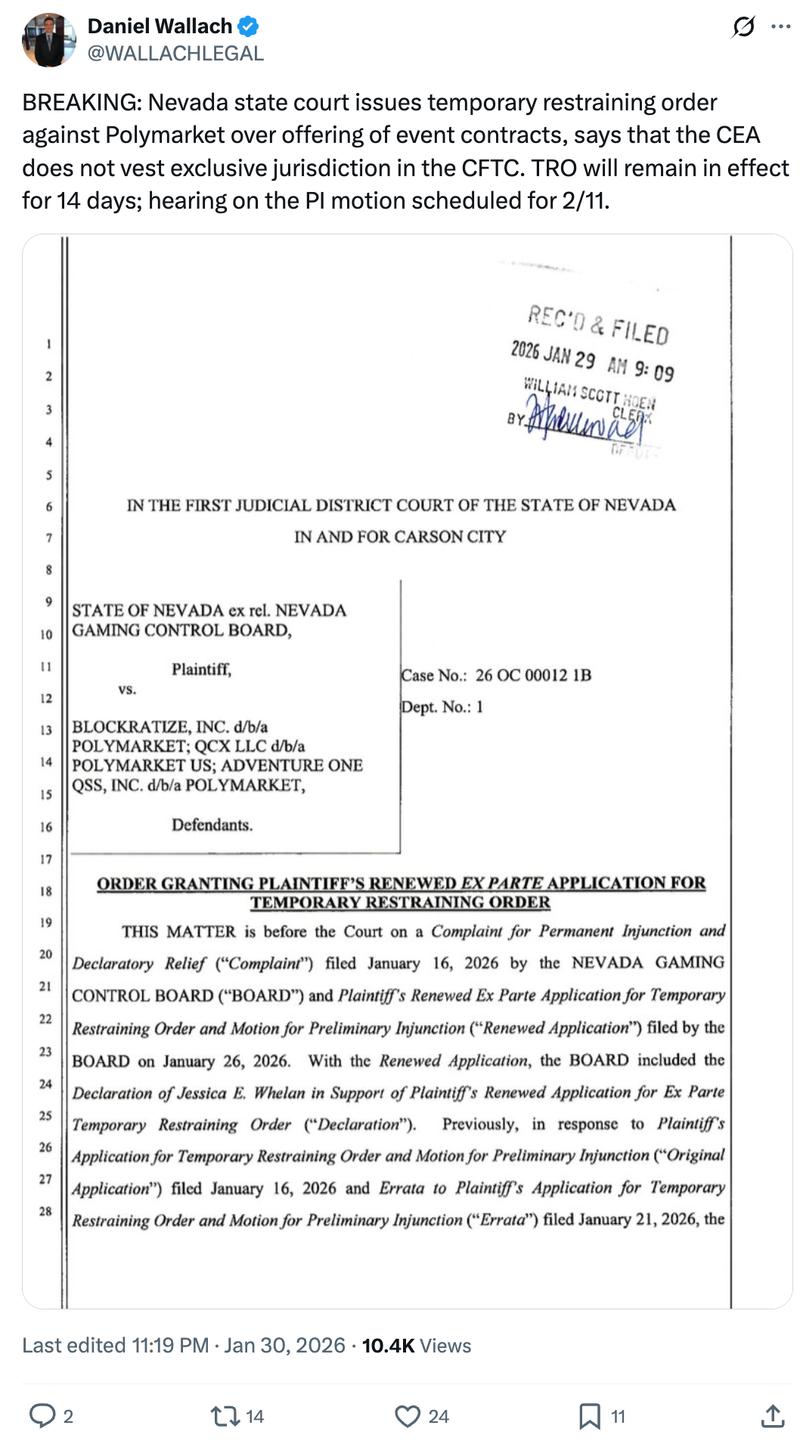
The presiding judge pointed to "immediate" and "irreparable" damage to Nevada's capacity to enforce betting integrity standards, prevent underage gambling, and maintain suitability requirements should the platform be allowed to continue operations within state boundaries without obtaining a gaming license.
Through this decision, the court dismissed Blockratize's argument asserting that the Commodity Exchange Act provides the US Commodity Futures Trading Commission (CFTC) with sole jurisdiction over the event contracts it offers, determining instead that Nevada retains the authority to enforce its own gaming regulations.
Cointelegraph has contacted Polymarket seeking commentary.
Nevada joins Tennessee in prediction market pushback
This legal action is part of a broader wave of regulatory enforcement targeting the prediction markets sector. In the previous month, Tennessee's Sports Wagering Council issued directives requiring Kalshi, Polymarket and Crypto.com's North American Derivatives Exchange to discontinue sports event contracts for individuals residing in the state, nullify Tennessee-based transactions and issue refunds to affected users. According to the council, these products constituted sports wagering and therefore fell under state gambling oversight.
Tennessee's regulatory authorities highlighted deficiencies in consumer protection measures, such as age verification protocols and responsible gaming features, as justification for their enforcement actions.
Both the Nevada and Tennessee regulatory moves are occurring against the backdrop of an expanding jurisdictional dispute. Kalshi, which operates as a CFTC-designated contract market, has been embroiled for nearly a year in state and federal litigation concerning whether its offerings qualify as derivatives or constitute prohibited gambling activities. Outcomes have varied across jurisdictions. The platform secured temporary legal protections in certain states such as Connecticut and New Jersey, while encountering unfavorable decisions or dissolved injunctive relief in other locations, including Nevada and Maryland.
This past December, Coinbase initiated legal proceedings against regulatory bodies in Connecticut, Illinois and Michigan. The cryptocurrency exchange platform petitioned federal courts to issue declarations that prediction markets operating on CFTC-regulated platforms are governed by the Commodity Exchange Act and fall under the CFTC's asserted exclusive regulatory authority, rather than being subject to 50 different state gambling statutes.