
Polygon slashes block production time to 1.75s amid payment infrastructure expansion
In a landmark upgrade representing its first block time optimization since network launch, Polygon has successfully decreased block production intervals to 1.75 seconds, as the platform positions itself to accommodate high-frequency applications including private stablecoin payment solutions.
Layer-2 (L2) blockchain platform Polygon has successfully decreased its mean block production time by 250 milliseconds to reach 1.75 seconds, representing the network's inaugural block-time optimization since its genesis, as the platform intensifies its focus on stablecoin payment systems and settlement frameworks.
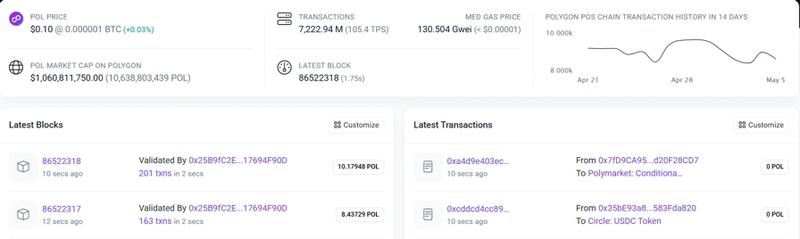
Data from Polygonscan indicates that recent blocks generated on the platform are being created at 1.75-second intervals. This technical enhancement enables Polygon to handle approximately 14% additional payments each second, achieving a maximum theoretical capacity of roughly 3,260 transactions per second (TPS), as stated by Lucca Martins, a software engineer at Polygon.
Reduced block production intervals facilitate faster clearing of transaction queues, minimizing the length of network congestion periods and associated transaction cost increases, which proves especially critical for high-frequency applications including payments, stablecoins, or decentralized finance (DeFi) exchange activities.
This technical enhancement arrives as Polygon undertakes initiatives to establish itself for applications aimed at greater institutional acceptance, including private stablecoin payment systems. Earlier this week, Polygon unveiled a novel wallet capability that allows users to discreetly route stablecoin transfers through a protected pool authenticated by zero-knowledge proofs.
This optimization represents one component of Polygon Improvement Proposal PIP-86, a dual-phase initiative that aims to additionally decrease block production time to 1.5 seconds and reduce checkpoint rewards to preserve the Polygon (POL) token emissions at the desired 1% following the block time decrease.
Cointelegraph contacted Polygon to obtain commentary regarding its block time optimization strategy, though no response had been obtained prior to publication.
Polygon focuses on private stablecoin payment solutions to attract institutional clients
The new wallet functionality introduced by Polygon forms part of a strategic objective to attract additional institutional participants by concealing senders, recipients and transaction values on the blockchain while preserving regulatory compliance via Know Your Transaction (KYT) verification and transparent audit trails.
This capability delivers enhanced privacy for commercial entities conducting stablecoin transactions, as noted by Smokey, Polygon's community lead.
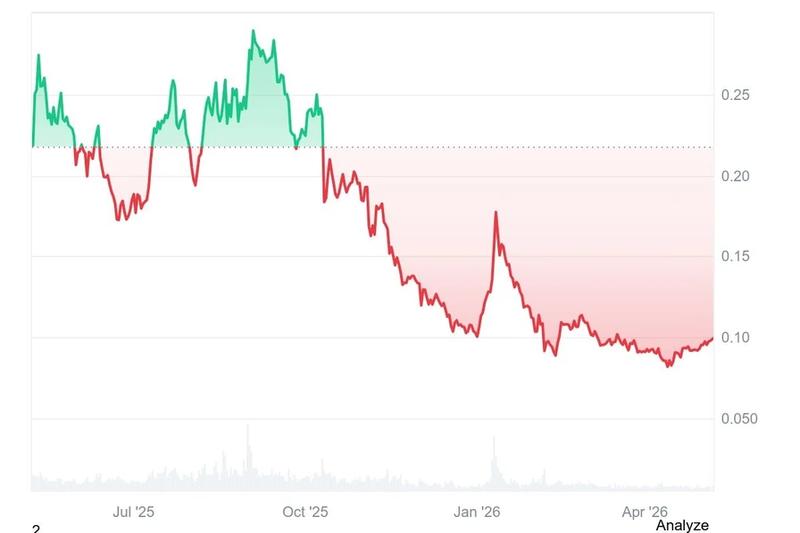
Notwithstanding the technical upgrade, Polygon's (POL) token demonstrated minimal movement during the preceding 24 hours and was valued at $0.09 at the moment of publication. The token has experienced a 54% decline throughout the past year, according to data from CoinMarketCap.
Polygon has additionally established integrations with major credit card companies. On April 29, international payments corporation Visa broadened its stablecoin experimental program to incorporate compatibility with Polygon Base, the Canton Network, Arc and Tempo.
Initiated by Visa during 2023, the experimental program permits participating partners to finalize transactions via stablecoins instead of conventional banking infrastructure, enabling assessment of whether stablecoins can deliver accelerated settlement processes.