
New SEC crypto regulations unlikely to trigger ICO frenzy redux
The Securities and Exchange Commission's 'regulation crypto assets' framework might generate early-stage FOMO among investors. However, certain tokens could remain stuck in regulatory limbo between being classified as securities and non-securities.

Following what seems like an eternity of anticipation, the Securities and Exchange Commission's proposed Regulation Crypto Assets framework could at last facilitate public token offerings within the United States.
Under this proposal, eligible issuers would be permitted to secure up to $75 million within any given 12-month timeframe, and potentially enable crypto projects to approach investors for additional capital year after year while they continue developing their networks.
This structure could establish a fresh, phased approach to token-based capital raising, and might enhance the appeal of early-round allocations for investors wagering on increased valuations down the line.
My initial view is that the $75 million exemption could make public token offerings more feasible, but it is unlikely to produce a return to the ICO boom.
Could projects raise $75M every year?
The proposal from the Securities and Exchange Commission, which was revealed on Aug. 18, establishes two distinct exemptions for particular investment contracts that involve crypto assets.
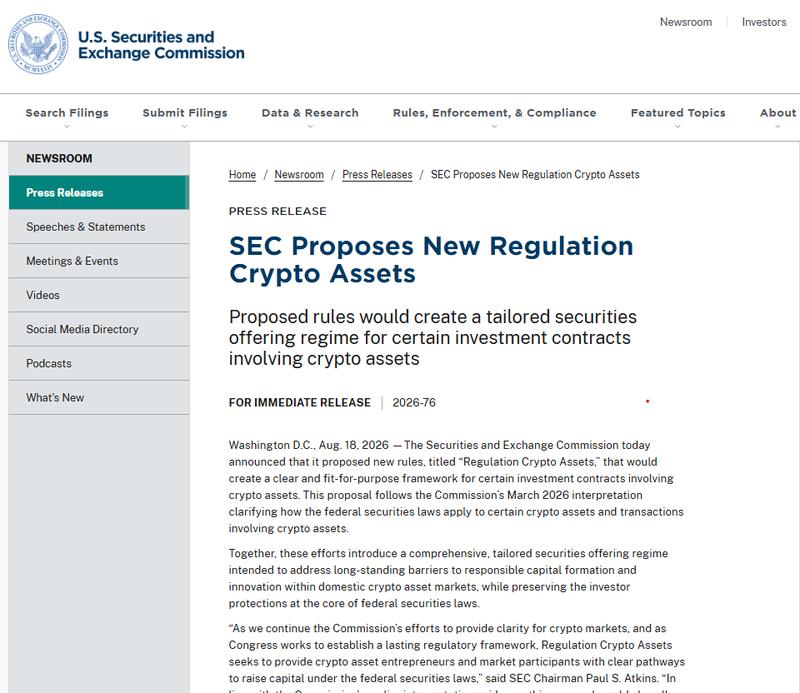
The initial exemption is a one-off provision for emerging companies, permitting offerings up to $5 million across a four-year span, while the second is a more substantial fundraising exemption that permits up to $75 million within each 12-month cycle.
This larger exemption draws partial inspiration from Regulation A and includes requirements for disclosure and continuous reporting.
Given the recurring nature of the $75 million threshold, does this mean a crypto project could raise $75 million, develop their platform for a year, and then return for an additional $75 million?
It appears the answer is affirmative.
Drew Hinkes, a partner at Winston & Strawn, informs Magazine that the 12-month restriction would permit "serial raises" of $75 million every 12 months, "provided they are actually distinct offerings."
But what are the limitations?
Lilya Tessler, a partner and leader of Sidley's Global FinTech and Blockchain group, explains that although "nothing prevents an issuer from relying on the exemption more than once," each subsequent raise "isn't automatic."
Follow-up fundraising rounds would necessitate submitting a fresh offering statement and going through SEC staff examination, and issuers would be obligated to continue filing reports on both an annual and semiannual basis. Additionally, they would need to "disclose what the issuer raised under the exemption in the prior 12 months so the cap can be verified," according to Tessler.
Nevertheless, the proposed regulatory framework represents a meaningful improvement over current conditions. A crypto project aiming to raise $225 million in aggregate, for instance, could feasibly secure the capital in installments and re-approach investors at a later stage with a more advanced network — and an elevated valuation.
Could a cap create ICO-style FOMO?
This leads to another natural question. Might the $75 million limit increase demand for early-round token allocations, triggering a wave of get-rich-quick-driven FOMO during the initial offering?
It's conceivable. Reiners suggests that represents one plausible scenario:
If investors expect a successful issuer to conduct later offerings at a higher valuation, an initial allocation may become more attractive precisely because it is limited.
That said, this approach isn't substantially different from how numerous token and equity offerings are presently organized. During its recent IPO, SpaceX sold less than 5% of its complete equity. "Scarcity in both token sales and exempt securities offerings of traditional securities long predate this proposal — issuers have always been able to limit round sizes and can continue to do so," Tessler notes.
Non-accredited investors will also be unable to invest their entire portfolio into a single token sale as they could previously. According to Tessler, the SEC's proposal restricts them to purchasing "10% of the greater of their income or net worth," irrespective of which fundraising round they choose to participate in.
Why this probably won't be 2017 all over again
Additional factors suggest we shouldn't anticipate a repeat of 2017 — particularly because an entire generation of cryptocurrency investors suffered losses from the extravagant promises and poorly designed tokenomics of earlier ICOs. As many as 90% of projects that raised capital through ICOs during 2017 and 2019 ultimately failed. Reiners observes that capital-raising markets are "shaped by investor appetite, token economics, liquidity, custody, and the reputational damage left by the last ICO cycle."
The SEC projects that approximately 130 offerings would leverage the two new exemptions annually, and roughly 475 issuers will likely utilize the wider investment contract safe harbor. This represents less of a deluge and more of a controlled flow.
Yet the SEC proposal remains highly favorable for token issuers attempting to navigate a regulatory labyrinth surrounding securities laws within the US — the type of framework Tezos and Telegram would have desperately welcomed following their multimillion-dollar legal confrontations over US securities law violations.
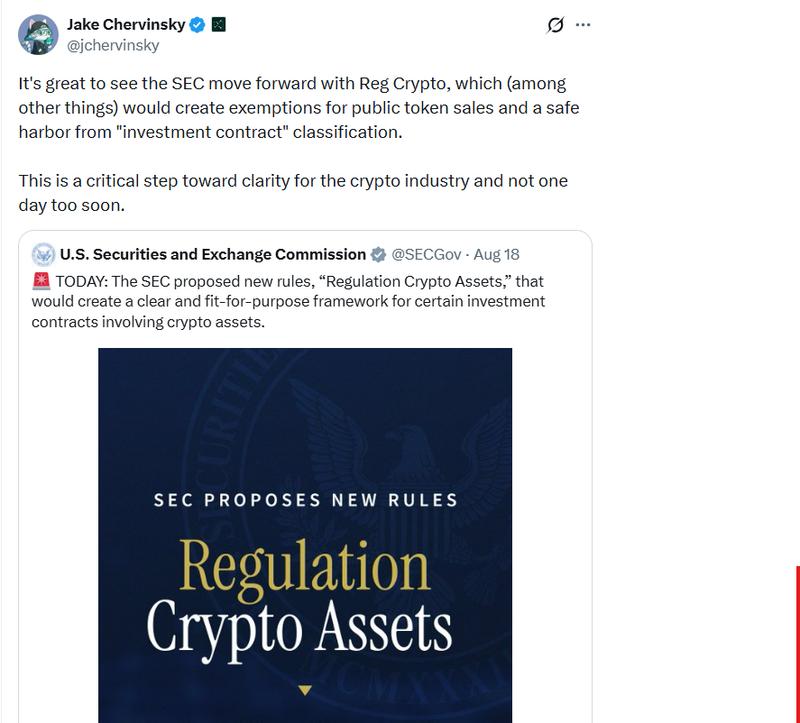
Instead of compelling issuers to independently determine whether their offerings conform with existing securities law structures, the SEC is putting forward a clear regulatory pathway for capital formation. As cryptocurrency attorney Jake Chervinsky states, "not one day too soon."
What happens when the token starts trading?
However, some potential complications exist. The SEC's proposal indicates that the investment contract tied to a crypto asset can continue transferring to subsequent buyers in secondary market transactions until the crypto asset becomes separated from the issuer's representations or commitments.
Put differently, if the team distributing a non-security token implies that secondary market investors can reasonably anticipate profits from critical managerial team activities, then it might become subject to an investment contract classification.
Hinkes identifies this as potentially problematic:
If a transaction of a non-security covered crypto asset causes the transfer of the investment contract from cryptoasset seller to cryptoasset buyer, there is a risk that the sale of the crypto asset would be viewed as a securities transaction.
This situation could prove challenging for exchanges and other platforms facilitating trading.
A new route for fundraising — but old risks remain
The possibility for tokens to exist in a regulatory grey zone between security and non-security classification also concerns Reiners. He indicates that projects might learn to function within the new regulatory structure without resolving the fundamental investor protection issues:
A public offering exemption could become a vehicle for regulatory arbitrage [...] A token issuer may satisfy the formal conditions for an exempt sale while continuing to market an asset whose value depends heavily on the issuer's managerial efforts.
This would place retail investors in an identical ambiguous situation as a decade earlier, vulnerable to "opaque disclosures, concentrated insider holdings, and aggressive promotion."