Moody's Integrates Credit Rating Services with Canton Network Blockchain
This development represents a pioneering effort to incorporate conventional risk evaluation methodologies into decentralized financial systems.

Moody's Ratings has launched an innovative platform designed to provide its credit evaluation services directly onchain, integrating its comprehensive ratings information into blockchain-powered financial systems.
Known as the Token Integration Engine (TIE), this platform bridges Moody's conventional ratings information with distributed ledger networks, enabling authorized users to obtain credit intelligence within blockchain-driven financial operations. The solution targets institutional applications, with asset issuers maintaining control over user access while Moody's continues to supervise its evaluation methodology.
According to the company, this makes Moody's the inaugural credit rating organization to provide its analytical assessments via blockchain technology. Back in June 2025, Moody's entered into a partnership with Alphaledger, an innovative fintech company, to conduct a trial initiative examining ways to incorporate conventional credit evaluation methods into distributed ledger platforms.
The first implementation operates through the Canton Network, a permissioned distributed ledger platform created specifically for institutional financial services. As part of this launch, Moody's is running its dedicated node within the network infrastructure, and the company has announced intentions to broaden the platform's reach to encompass other blockchain networks and various asset categories.
The platform has been engineered to function across multiple networks, with user permissions managed by issuers within the company's established governance structures and regulatory compliance protocols.
Moody's, an American credit evaluation firm established in 1909 with a presence spanning more than 40 nations, evaluates the financial reliability of governmental entities, corporations and investment instruments, with its assessments serving as key resources for investors throughout international capital markets.
The rise of the Canton Network
The implementation by Moody's contributes to the expanding adoption of the Canton Network as foundational infrastructure for institutional distributed ledger applications, especially within tokenized asset markets and collateral management systems.
An increasing number of investment management firms are incorporating tokenized investment vehicles into the network. Franklin Templeton broadened its Benji platform's capabilities to include Canton in November, enabling its digitized assets, which include a United States government money market fund, to function as collateral and provide liquidity within the platform's ecosystem.
Additional initiatives have concentrated on market infrastructure development and transaction settlement processes. During December, the Depository Trust and Clearing Corporation (DTCC) announced its intention to tokenize a portion of United States Treasury securities using Canton, extending blockchain-enabled procedures into fundamental clearing and settlement infrastructure, with possible expansion to cover other asset categories.
Financial institutions and digital asset infrastructure service providers are similarly developing solutions on the network. During January, Digital Asset in collaboration with Kinexys by JPMorgan revealed plans to integrate JPMorgan's dollar-denominated deposit token, JPM Coin, onto Canton, while Temple Digital Group introduced a platform facilitating round-the-clock trading of digital assets via a central limit order book mechanism with non-custodial settlement capabilities.
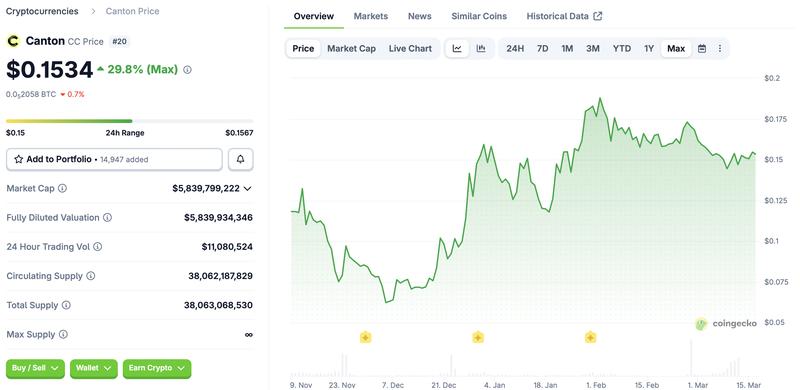
The market value of Canton Coin, which serves as the network's native digital token, has appreciated by roughly 30% following its introduction in November 2025, based on information from CoinGecko data.