
MoneyBadger partnership brings Bybit Pay crypto services to South African market
Through this new partnership, cryptocurrency payment capabilities are now available at over 650,000 retail locations, with merchants receiving funds in South African rand.

Digital asset exchange Bybit has brought its Bybit Pay payment solution to the South African market via a partnership with MoneyBadger, a domestic payments provider. The collaboration enables cryptocurrency users to complete purchases at retail locations across the country using QR code technology, while merchants receive payments in their local fiat currency.
The expansion was disclosed in Bybit's announcement on Tuesday, revealing that the integration links Bybit Pay with established payment infrastructure. This provides users with cryptocurrency payment capabilities at over 650,000 retail outlets through Scan to Pay functionality, 31,000 additional locations via Zapper, and more than 1,500 Pick n Pay retail stores. The service also extends to digital commerce through integration with Peach and Ozow payment platforms.
The payment system accepts Bitcoin (BTC), various stablecoins, and over 20 additional cryptocurrencies. Transactions complete within seconds, during which MoneyBadger immediately converts the digital assets into South African rand at the moment of sale. This instant conversion mechanism reduces merchants' exposure to cryptocurrency price fluctuations, enabling them to accept digital currency payments without maintaining crypto holdings.
Both physical retail QR code payments and e-commerce checkout options are supported by the platform. According to the exchange, transaction settlements typically complete in 10 to 15 seconds, with individual payment amounts ranging from a minimum of $0.06 up to a maximum of $2,500 per transaction.
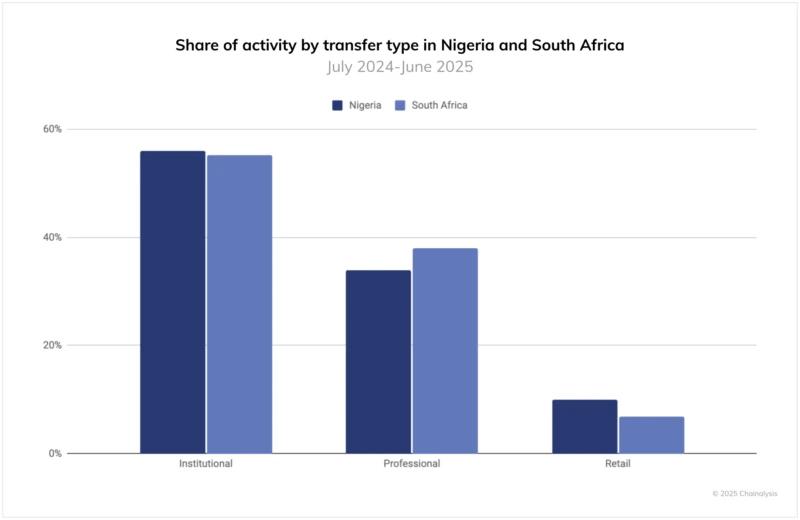
Approximately 5.8 million people in South Africa currently use cryptocurrencies, based on Triple-A's 2024 estimates, with around half of these users already utilizing digital currencies for payment purposes. According to a Chainalysis report published in September 2025, South Africa distinguishes itself within the Sub-Saharan African region through its sophisticated regulatory environment, which has cultivated a more institutionalized cryptocurrency marketplace.
Cross-border remittances fuel crypto adoption in Africa
Throughout the African continent, cryptocurrency utilization is increasingly connected to payment functions and financial inclusion, despite warnings from regulatory authorities about potential risks to conventional financial systems.
Vera Songwe, former UN under-secretary-general, stated in January that remittance flows are becoming more important than foreign aid across certain parts of the continent. She highlighted that stablecoins are emerging as a more affordable option for international money transfers.
During her remarks at the World Economic Forum, she observed that conventional remittance services typically charge approximately $6 for every $100 transferred, whereas stablecoins decrease both fees and settlement durations to mere minutes. This is especially relevant in markets experiencing elevated inflation rates and restricted access to traditional banking infrastructure.
While stablecoins see widespread adoption for payment transactions and remittances, Bitcoin (BTC) is also finding direct usage in certain local economic systems.
In March, Stafford Masie, a South African technology executive serving as executive chairman of Africa Bitcoin Corporation, revealed that Bitcoin operates as everyday currency in certain areas of the region. Some communities conduct transactions directly using satoshis. During his appearance on Natalie Brunell's Coin Stories podcast, he explained that adoption is being propelled by elevated inflation and constrained access to stable financial infrastructure, with younger demographics particularly leading the trend by circumventing traditional banking systems.

The expanding adoption of cryptocurrencies and stablecoins has prompted concerns from certain central banking authorities. In November 2025, the South African Reserve Bank issued a warning that increasing cryptocurrency and stablecoin usage could present threats to financial system stability. The bank referenced 7.8 million users registered across the nation's major cryptocurrency exchanges, with approximately $1.5 billion held in custodial accounts.