
Market Sentiment Improves as Crypto Fear and Greed Index Exits Extreme Territory
After spending 48 consecutive days deep in "extreme fear" territory, the Crypto Fear and Greed Index has emerged, indicating a shift in investor sentiment. Could renewed capital flows spark another bull run?

On Wednesday, the Crypto Fear & Greed Index held steady at 26, following a climb to 28 the previous day, which brought an end to the metric's 48-day continuous period within the "extreme fear" category.
Market sentiment is measured by the Crypto Fear & Greed index through the analysis of volatility, momentum, trading volume, and social media data. Readings that fall below 25 indicate extreme fear among market participants, whereas elevated values demonstrate growing risk appetite.
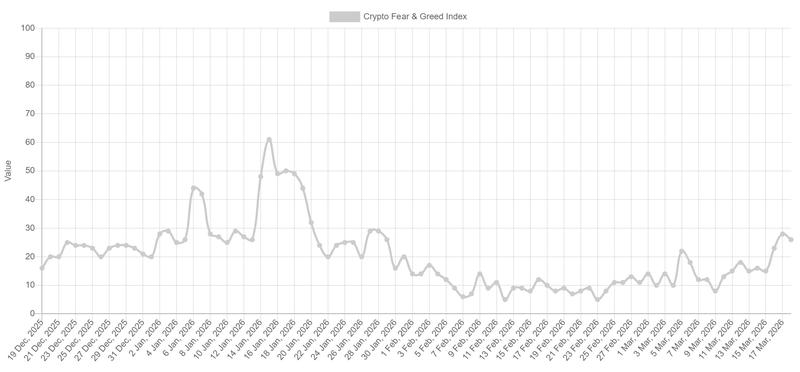
This week's index measurement suggests a notable enhancement in market sentiment, representing the first time it has escaped extreme fear territory in more than six weeks.
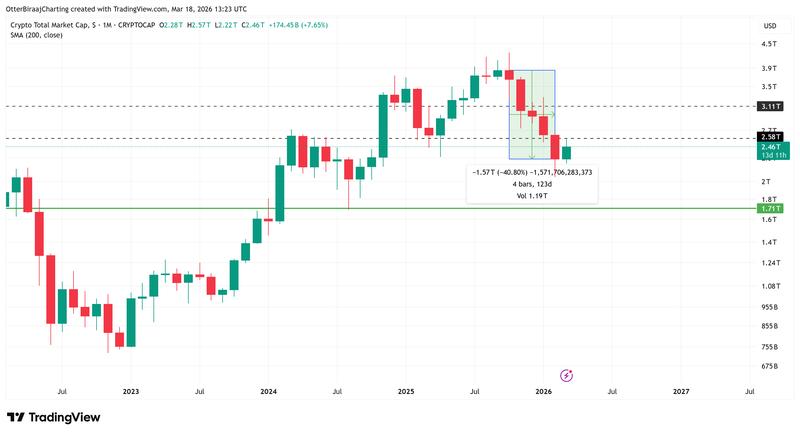
This shift aligns with a rebound in the aggregate cryptocurrency market capitalization, which has grown by 7.65% throughout March, representing approximately $174 billion in additional value. This represents the first monthly positive expansion observed since September 2025. Prior to this upturn, the market experienced a nearly 40% contraction, falling to $2.28 trillion from $3.65 trillion across the preceding five-month period.
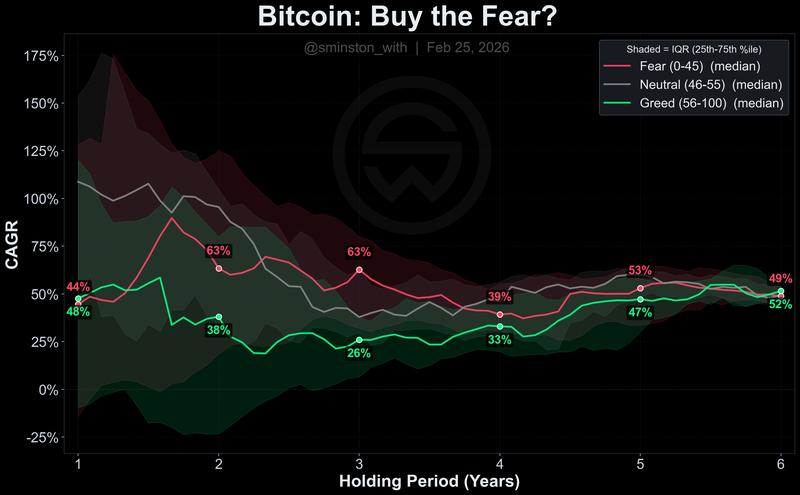
Sminston With, a market researcher, offered supplementary perspective regarding the Fear & Greed index.
According to With, examining historical Bitcoin market cycles reveals that purchasing BTC during periods of fear generated more robust returns across a two to four-year timeframe.
Average returns climbed to 331% across three years, in contrast to 100% for BTC purchases executed during greed phases. Nevertheless, across extended time horizons (four to five years), the differential in returns became less pronounced, with both entry approaches converging as Bitcoin's sustained upward growth trajectory dominated price movements.
Stablecoin inflows surge, indicating liquidity returning to markets
Exchange flow data from Binance reveals a transformation in capital circulation patterns. On March 18, Binance experienced a $2.2 billion influx of Tether USDt (USDT), representing the most substantial single-day stablecoin deposit recorded since November 2025.
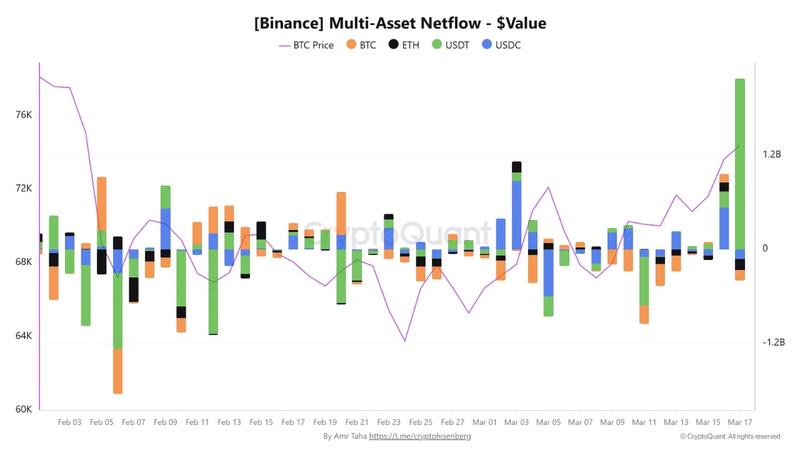
Such inflows constitute the accessible capital, commonly termed "dry powder," that stands ready for deployment into cryptocurrency markets. The surge aligned with Bitcoin advancing toward elevated price territory near $75,000 on Monday, connecting the liquidity infusion with aggressive trader positioning.
Concurrently, aggregate stablecoin reserves maintained across exchanges climbed to $68.5 billion from a six-month nadir of $64 billion recorded on March 8, representing a substantial increase of 7% over this brief interval.
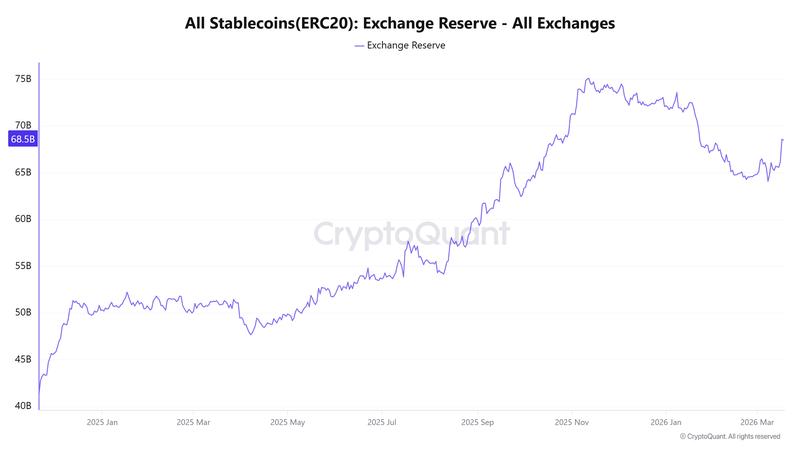
An expansion in exchange-held stablecoins generally indicates that market participants are positioning themselves to allocate capital into spot or derivatives trading. This demonstrates that traders are returning to the market with the intention of establishing positions, contributing to immediate-term purchasing power.
This article does not contain investment advice or recommendations. Every investment and trading move involves risk, and readers should conduct their own research when making a decision. While we strive to provide accurate and timely information, Cointelegraph does not guarantee the accuracy, completeness, or reliability of any information in this article. This article may contain forward-looking statements that are subject to risks and uncertainties. Cointelegraph will not be liable for any loss or damage arising from your reliance on this information.