
Market Downturn Eliminates $176B from Crypto Sector: Have Bearish Forces Regained Dominance?
Digital asset values plummeted as Bitcoin failed to maintain the $70,000 threshold. Could the ongoing shift toward artificial intelligence equities continue pressuring cryptocurrency valuations?

Key takeaways:
- An abrupt 8% decline in Bitcoin's value resulted in $1.5 billion worth of forced liquidations, bringing an end to a tight two-month correlation with small-cap stocks.
- Deteriorating investor confidence stemmed from $2.1 billion in outflows from Bitcoin exchange-traded funds and growing concerns about a potential Federal Reserve rate increase.
The world's leading cryptocurrency, Bitcoin (BTC), experienced an abrupt 9% decline within a 48-hour period, reaching the $67,000 support threshold for the first time in a two-month span. The market correction eliminated a significant $176 billion from the aggregate cryptocurrency market capitalization within a mere two-day window, resulting in $1.5 billion worth of forced liquidations affecting overleveraged traders holding long positions.
Market participants continue to express uncertainty regarding the factors responsible for cryptocurrency's lackluster performance, particularly given the remarkable resilience displayed by United States equity markets.
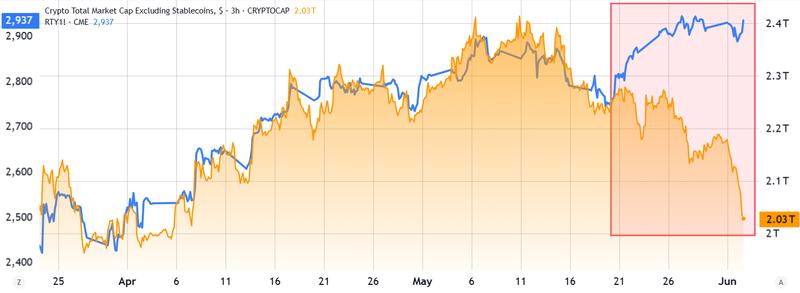
The strong correlation that existed between Bitcoin and United States small-capitalization stocks definitively ended on May 21 following a consistent two-month period. Deteriorating investor sentiment was presumably driven by $2.1 billion in net withdrawals from United States-listed spot Bitcoin exchange-traded funds occurring between May 12 and May 20, although derivatives market data had previously been suggesting insufficient institutional interest.
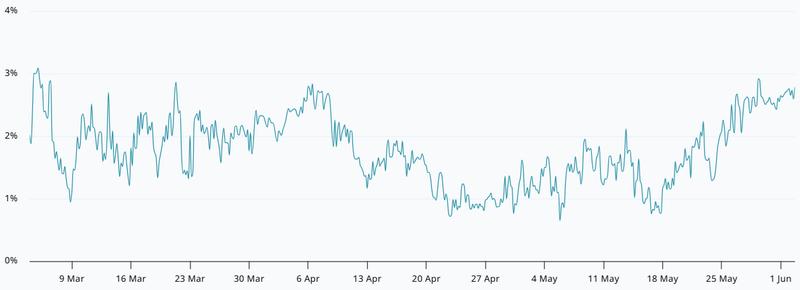
The annualized premium for BTC futures contracts compared to spot market prices has remained beneath the neutral 4% level for more than three months, validating subdued appetite for bullish leveraged positions.
Strategy's Bitcoin accumulation pause and strength in AI investments
The company Strategy (MSTR US), under the leadership of Michael Saylor, generated varied reactions following its decision to repurchase convertible debt instruments while temporarily suspending its characteristic weekly Bitcoin acquisition strategy.

The X platform user 'bjunjo' stated that Strategy transitioned into "survival mode for their debt holders and shareholders," setting aside the primary objective to acquire additional Bitcoin. Based on the analysis provided, the organization will take whatever measures necessary to satisfy its financial commitments, as evidenced by a recent BTC 32 sale. Arca's Chief Investment Officer, Jeff Dorman, characterized the decision as "a complete balance sheet mismanagement."

At the same time, X platform analyst ScroogeCap observed that Google's (GOOG US) choice to increase equity capital instead of taking on debt indicates that private equity has essentially become nonviable as market liquidity diminishes. The examination emphasizes that Oracle's (ORCL US) debt-to-equity ratio continues to be abnormally elevated, whereas Meta (META US) could potentially be compelled to access additional capital owing to "irrational spending."
According to reports, Jim Bianco from Bianco Research stated, "We have not seen the market this concentrated around a single theme in 150 years." Furthermore, research conducted by JPMorgan revealed that 41 stocks related to artificial intelligence represent half of the total market value of the S&P 500.
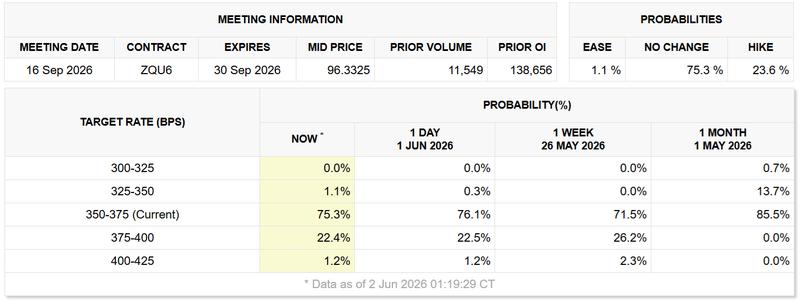
Market traders grew progressively more risk-averse as the conflict in Iran demonstrated no indication of approaching resolution, providing context for the extensive sell-off observed throughout cryptocurrency markets. United States government bond markets are currently reflecting a 23% likelihood of the US Federal Reserve implementing an interest rate hike by September, representing an increase from 0% merely one month earlier based on data from the CME FedWatch Tool.
In conclusion, the cryptocurrency market collapse witnessed on Tuesday demonstrates substantial withdrawals from spot Bitcoin exchange-traded funds, an extreme concentration of capital flowing into artificial intelligence-related investments, and a macroeconomic landscape indicating more restrictive monetary policy measures for an extended duration than market participants had previously forecasted.