
Law Firm Files Legal Action to Halt Movement of Frozen Ethereum Connected to Kelp DAO Breach
Gerstein Harrow LLP, a US-based law firm, has submitted a restraining notice along with three writs of execution aimed at stopping Arbitrum DAO from transferring frozen Ether associated with the Kelp DAO breach, claiming their clients have legal entitlement to the cryptocurrency due to its connection to North Korea.

An American law firm has submitted legal documentation seeking to prevent the movement of frozen Ether stemming from the Kelp breach, contending that their clients are entitled to more than $877 million in damages and compensation from North Korea.
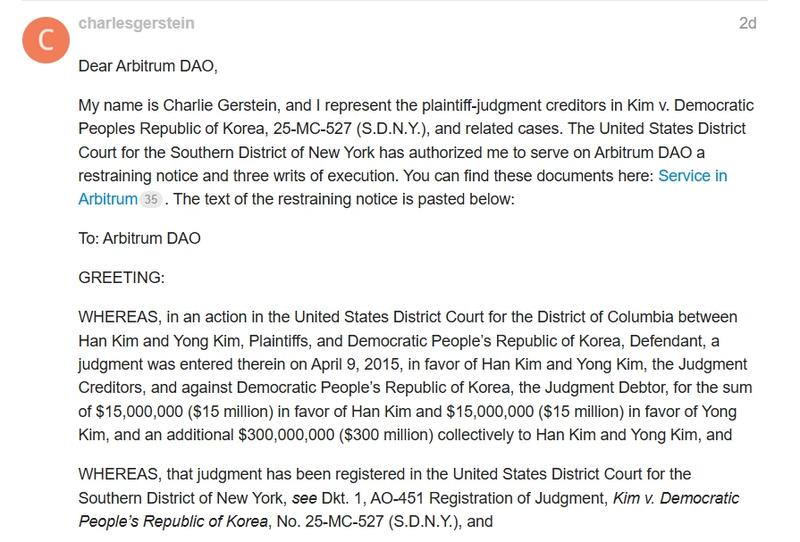
In a Friday post on the Arbitrum DAO forum, Charlie Gerstein, an attorney representing the US law firm Gerstein Harrow LLP, disclosed that a district court in New York approved a restraining notice along with three writs of execution that prohibit the DAO from transferring the Ether, with violation potentially resulting in contempt of court charges.
The legal team contended that their clients, who were not impacted by the Kelp breach, secured default judgments against North Korea in three distinct US court proceedings spanning 2010, 2015, and 2016, and are collectively entitled to $877 million in both compensatory and punitive damages, in addition to interest. The firm further contended that their clients possess a valid claim to property belonging to the DPRK. In the restraining notice, Gerstein asserted that the stolen Ether constitutes "property" in which the DPRK maintains an interest due to the hacking group's affiliation with the nation.
The freezing action could potentially delay the recovery of funds for those who were impacted by the Kelp breach. This marks not the first occasion the firm has sought to claim stolen cryptocurrency assets.
On April 18, Kelp DAO experienced a $292 million breach, which is suspected to have been executed by TraderTraitor, a subdivision of North Korea's state-sponsored hacking organization, the Lazarus Group.
In the days that followed, the Arbitrum Security Council implemented emergency measures to freeze 30,766 Ether (ETH), valued at more than $73 million, contained in a wallet associated with the Kelp breach.
Proposal suggested funds go to Kelp victims
On April 25, Aave Labs put forward a proposal suggesting that the Arbitrum DAO should unfreeze the $73 million worth of Ether connected to the Kelp DAO breach and allocate those assets to "DeFi United," an initiative designed to restore rsETH and provide compensation to its holders.
A member of the Arbitrum DAO operating under the username Zeptimus stated that should the law firm's legal action prove successful, the responsibility for the DPRK debt would be shifted to the victims of the Kelp DAO breach.
Your clients' losses are real and the DPRK should answer for them. But the remedy the restraining notice asks for, blocking the return of stolen funds to their actual owners shifts the cost of the DPRK's debt onto a different set of victims who were themselves robbed. That compounds the original harm; it doesn't redress it.
Similar claims have been filed by Gerstein Harrow previously
This is not the first time Gerstein Harrow has pursued similar legal actions, claiming their clients possess legitimate claims to assets stolen by the DPRK and subsequently frozen by cryptocurrency companies. In February, the firm submitted a claim targeting funds that were frozen by Tether following their theft in the 2023 Heco Bridge breach.
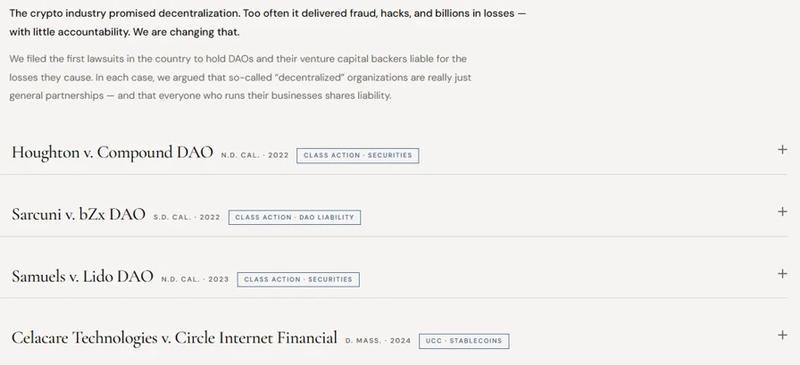
The firm has additionally filed class-action lawsuits against several DAOs. Concurrently, blockchain investigator ZachXBT has alleged that the law firm utilized his investigative work in legal filings to establish a claim on assets from the $1.5 billion Bybit breach.
Entities affiliated with North Korea have been implicated in the theft of at least $578 million across significant incidents during the month of April and have been connected to numerous major breaches in the industry, including the Bybit exploit.