
Jack Mallers' Twenty One Capital Climbs to Second Place Among Public BTC Holders Following MARA Selloff
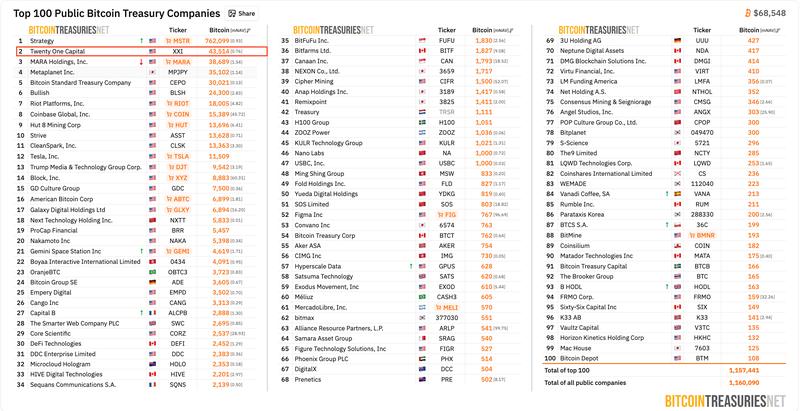
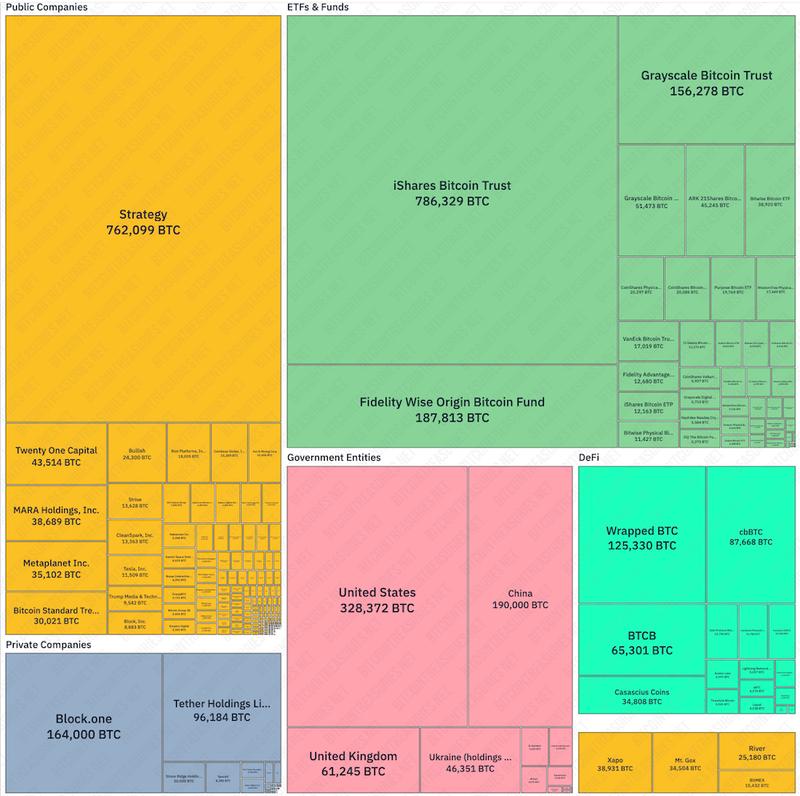
Following MARA's recent Bitcoin sale, Twenty One Capital, led by Bitcoin proponent Jack Mallers, has ascended to the second position among publicly traded companies holding BTC, with 43,514 BTC in reserves, trailing only Strategy's 762,099 BTC.

Twenty One Capital, the Bitcoin treasury company led by Jack Mallers, has ascended to become the second-largest publicly traded Bitcoin treasury based on BTC holdings, following the Bitcoin mining company MARA's decision to sell a significant portion of its cryptocurrency reserves, pushing it down to third place.
The recently established Bitcoin (BTC) treasury firm maintains 43,514 BTC within its corporate reserves, with a current market valuation exceeding $2.9 billion based on prevailing market prices at the time of publication, as reported by BitcoinTreasuries data.
The public listing of Twenty One Capital occurred late last year through a business combination transaction with Cantor Equity Partners, which operated as a special purpose acquisition company. Currently operating under the stock ticker XXI on the NYSE, the company's shares have experienced a decline exceeding 25% on a year-to-date basis.
Throughout March 2026, MARA liquidated 15,133 BTC, representing approximately $1.1 billion in value. The subsequent largest publicly traded holder of Bitcoin is Metaplanet, a Japanese BTC treasury firm holding 35,100. In a Thursday note, Bitcoin Treasuries analyst Tyler Rowe stated:
For the industry, it's a cautionary signal. MARA borrowed aggressively to stack sats during the bull run and is now selling Bitcoin at a loss to service that debt. This is the precise scenario critics of debt-fueled treasury strategies have warned about.
This strategy of aggressive borrowing stands in "sharp contrast" to the operational model made popular by Strategy, the BTC treasury company, which approaches BTC as "perpetual digital credit," utilizing it as collateral for ongoing financing of additional BTC acquisitions.
"Can miners sustainably operate as Bitcoin treasury companies without the capital markets infrastructure Saylor spent five years building," Rowe said in the note shared with Cointelegraph.
Certain market analysts observe that this shift represents the capitulation of cryptocurrency treasury and mining operations facing a difficult business landscape, made worse by the bear market in crypto that commenced in October 2025 and falling stock valuations.
Analysts forecast the decline of the crypto treasury space in 2025
During June 2025, Breed, a venture capital firm, projected that merely a handful of crypto treasury companies would endure the "death spiral" created by shrinking market net asset values (mNAVs) through the maintenance of a price premium enabling these entities to obtain additional financing.
When access to affordable financing alternatives vanishes, companies whose shares trade at or beneath their net asset value would be forced to liquidate their BTC reserves to satisfy debt commitments, as noted by Breed.
Firms treating their cryptocurrency reserves as a speculative wager, instead of a long-term strategic position, would be more prone to capitulation during the intervals between market cycles, Deng Chao, CEO of asset management firm HashKey Capital, informed Cointelegraph.
Simultaneously, cryptocurrency treasury companies implementing a disciplined treasury management strategy would endure across multiple market cycles, he indicated.