
Investigating the Truth: Is Satoshi Nakamoto Really in Possession of 1.1 Million Bitcoin?
Approximately 1.1 million Bitcoin has long been associated with Satoshi Nakamoto. However, the evidence linking this massive fortune to Bitcoin's mysterious founder remains largely circumstantial, with estimates fluctuating by over 200,000 Bitcoin.
Among the earliest facts newcomers discover about Bitcoin is its creation by an anonymous figure — someone who has become a multi-billionaire many times over in the process.
Approximately 1.1 million BTC has long been linked to Satoshi Nakamoto, though this figure relies on forensic evidence pointing to a mining operation rather than definitively identifying an individual. Moreover, this estimate can fluctuate by over 200,000 Bitcoin based on how rigorously a particular mining "fingerprint" analysis is interpreted.
The distinction between mining operations and individual ownership became particularly significant when 600 BTC that had been mined back in 2010 unexpectedly moved after lying dormant for 16 years, sparking widespread conjecture that "Satoshi's holdings" had finally been activated.
These particular coins originated from 12 block rewards that had remained inactive since they were mined during a four-day period in March 2010, staying completely untouched until Sept. 5 of this year, when the holder of the corresponding private keys transferred them sequentially within a 30-minute window.
However, the individual who transferred that $46 million worth of Bitcoin wasn't necessarily Satoshi.
Blockchain technology tracks coins, not individuals
According to onchain monitoring service Whale Alert, there was no detectable link between the 600 BTC movement and the cache of coins attributed to Bitcoin's enigmatic founder.
Blockchain analytics company Bitquery determined that 10 out of the 12 blocks failed to exhibit the characteristic mining signature that has become synonymous with Satoshi's mining activities, a pattern referred to as "Patoshi."
As for the remaining two blocks, they displayed only marginal matches that could easily be coincidental, according to Bitquery's researcher Gaurav Agrawal.
While the block rewards were indeed generated by a single mining machine, and the person who moved them this month clearly possessed the private keys, Agrawal emphasizes an important limitation:
"What the chain cannot say is whether the hand in 2026 belongs to the person who ran the machine in 2010."
This enigma will likely never be definitively resolved, given that private keys can be passed down through inheritance, transferred through sale, taken through theft, or even retrieved from an outdated hard drive discovered in a secondhand electronics shop. Agrawal observes that "the chain only records that someone had it."
The transactions that spent these coins employed contemporary wallet software, something the 2010 Bitcoin client would have been incapable of generating, meaning "at the very least, the keys were loaded into something new."
Understanding the Patoshi pattern underlying the fortune
Given that blockchain analysis cannot definitively identify who possessed those original coins, what basis do we have for attributing the 1.1 million BTC to Satoshi? The strongest evidence available remains circumstantial in nature.
Back in 2013, security researcher Sergio Demian Lerner discovered a unique identifying signature within Bitcoin's genesis blocks, indicating that a single miner was running equipment with characteristics that distinguished it from other network miners, a pattern traceable across thousands of individual blocks.
Lerner calculated that this particular miner had accumulated approximately 1.1 million BTC, and more than ten years later, he continues to maintain the accuracy of his original calculations.
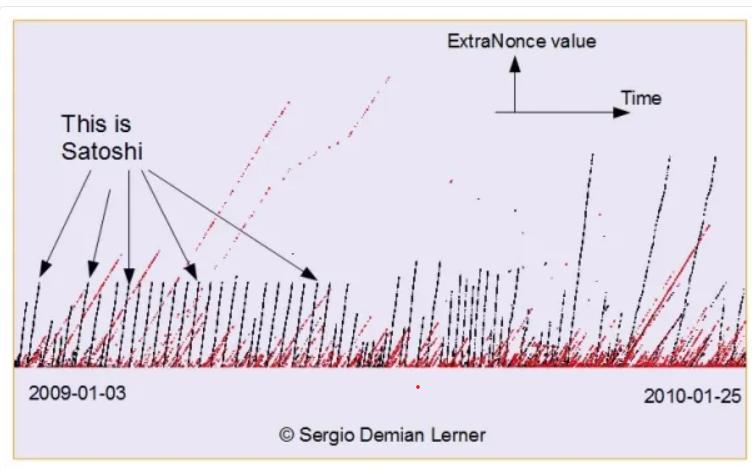
"It is accurate," he tells Magazine, "with a disclaimer that the evidence is circumstantial; there is no math proof or direct witness."
Beyond the distinctive mining signature itself, he argues that the evidence linking Patoshi to Satoshi extends further, pointing out that multiple early Bitcoin adopters, including Hal Finney, Dustin D. Trammell, Nicholas Bohm and Mike Hearn, all received coin transfers that displayed the Patoshi mining pattern:
"All those transfers were made from coinbases in the Patoshi pattern: that provides compelling reasons that Patoshi and Satoshi are the same person, although not proof."
Lerner additionally notes that the mining operation appears to have utilized custom-built mining software instead of the publicly available standard client, software that was probably developed prior to Bitcoin's public launch. This makes it "highly improbable" that some other miner could have independently developed a functional specialized mining configuration during the brief window between Bitcoin v0.1's public announcement and when the initial block was mined. He explains:
"Whoever was mining the Patoshi pattern started right at the earliest beginning."
Bitquery's independent reconstruction of the fortune from raw data
More than a decade after Lerner's initial identification of Patoshi, Bitquery undertook an independent reconstruction of the mining fingerprint using raw blockchain data, analyzing 54,316 blocks from Bitcoin's earliest period and tracking every single coin through Sept. 1, 2026.
Their most rigorous reconstruction shows 99.2% agreement with the publicly available Patoshi block list, and the company additionally identified zero anomalies when conducting a timestamp-ordering analysis across 5,836 consecutive block pairs.
"I don't know of a stronger test for this," Agrawal says.
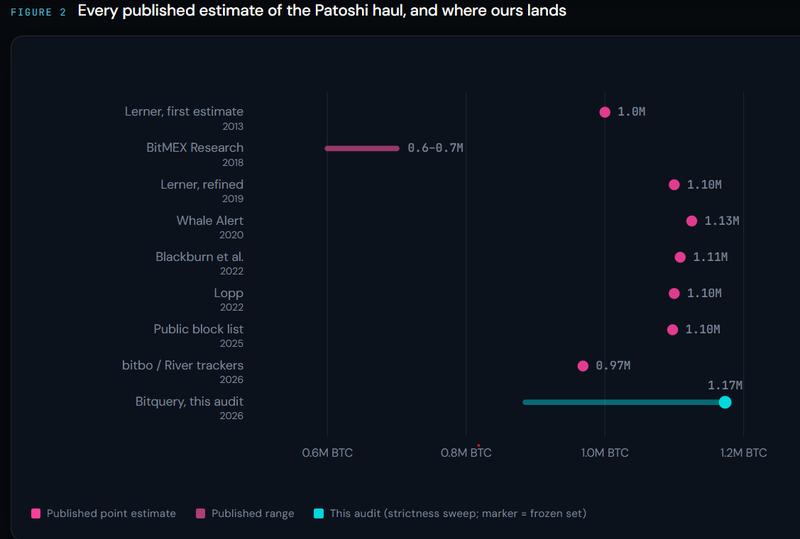
Nevertheless, the research introduces some uncertainty regarding the widely cited 1.1 million BTC figure, as Bitquery's calculated amount changes significantly based on the stringency of pattern-matching criteria applied.
"Run strictly, the fingerprint covers just under 0.9 million BTC," Agrawal says, with the "most generous reading" at around 1.17 million.
This doesn't necessarily invalidate Lerner's original calculation, but it demonstrates that the estimated size of the Patoshi holdings is sensitive to methodological choices in pattern recognition.
"The published estimates of 1.0 to 1.13 million sit inside that range, so we did not move the number," Agrawal says.
The evidence connecting Satoshi to the 1.1M BTC fortune
According to Agrawal, the assertion that "Satoshi owns 1.1 million BTC" actually comprises three separate claims layered upon one another.
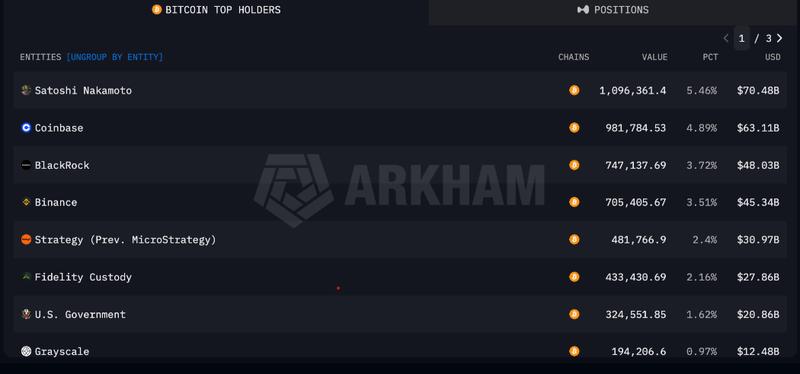
The assertion that these coins were generated by a single mining machine has robust evidentiary support. The assertion that this machine was operated by Satoshi rests on circumstantial evidence, while the assertion that Satoshi maintains control of the corresponding private keys cannot be verified merely because these coins have remained stationary.
Bitquery's analysis also uncovered a 2010 transaction that appears to have gone unreported "in any published study."
On May 17, 2010, a total of 600 BTC from early-era mining rewards were transferred across two separate transactions separated by approximately one hour. The initial transaction, occurring at 22:04 UTC, consolidated 10 block rewards totaling 500 BTC, while the subsequent transaction, at 23:07 UTC, moved an additional two block rewards worth 100 BTC.
These particular coins had been mined at various intervals throughout 2009, with some rewards dating from near Bitcoin's inception and others from the conclusion of its inaugural year.
"It matters, I think," Agrawal says, "because it is the clearest moment where the chain itself, and not a statistical pattern, says these blocks belong together." He characterizes this as "as close as the chain gets" to validating that blocks mined throughout all of 2009 were stored within a single wallet, "which is what the pattern claims for the whole set."
Therefore, we can confirm that whoever possessed those private keys had control over block rewards mined throughout 2009, though the identity of the key holder remains unknown.
In contrast to the May 2010 transaction, the 600 BTC that moved this past September cannot be attributed to the Patoshi mining operation, and no fresh evidence has emerged linking them to what is commonly referred to as "Satoshi's" holdings. As Agrawal concludes, "nothing in the math settles it, so we will never be sure."