Injective blockchain now hosts $1B worth of Pineapple Financial mortgage data
The financial services company intends to migrate over $10 billion worth of historical mortgage loans to the blockchain, converting thousands of loan files into digital onchain records.
More than $1 billion worth of residential mortgage data from Pineapple Financial has been transferred to Injective, a specialized layer-1 blockchain designed for financial use cases, marking a significant milestone in the company's initiative to bring its historical loan data onto the blockchain.
According to an announcement made Friday by Injective, Pineapple intends to ultimately transfer over 29,000 funded mortgage loans valued at more than $10 billion to the blockchain network. Rather than creating new mortgage-backed securities, each individual mortgage is documented through an onchain record that links to the original loan documentation.
These digital records incorporate over 500 distinct data points, with loan-specific details intended to enable verification processes, comprehensive audit trails and thorough risk analysis capabilities. Current data from Pineapple's monitoring dashboard indicates the migration has reached 2,079 mortgage records, representing growth from the 1,259 records that existed when the project was initially announced in December 2025.
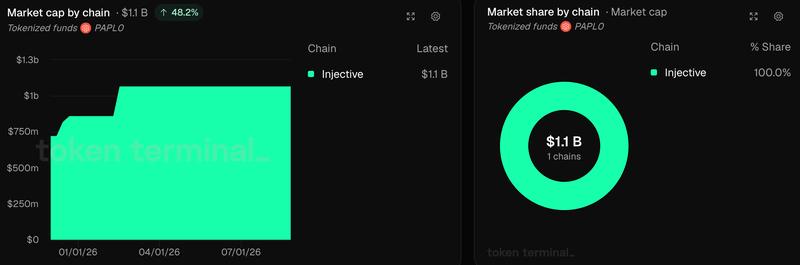
Data from Token Terminal shows that PAPL0, the onchain tracker for these mortgage records, currently holds an asset market capitalization of approximately $1.1 billion, reflecting a 48.2% increase during the past nine months. These tokens serve as representations of mortgage records and do not confer ownership rights to the actual underlying loan assets.
This mortgage record migration represents one component of Pineapple's expanding collaboration with Injective, which also encompasses a distinct $100 million digital asset treasury holding Injective (INJ) tokens. The company actively stakes its INJ holdings from this treasury, utilizing Kraken as a principal validator for these blockchain assets.
Real estate tokenization gains momentum
The real estate sector has emerged as an increasingly important area within the broader movement to bring traditionally illiquid asset classes onto blockchain networks, where tokenization technology can enhance the divisibility, transferability and accessibility of property holdings or investment positions.
Last June, Apex Group partnered with Goldman Sachs, Archax and LRC Group to launch a tokenized real estate fund that issues its shares as digital tokens via Goldman Sachs' Digital Asset Platform. This framework provides investors with blockchain-based share ownership in the fund, going beyond mere onchain recording of property information.
Dubai has similarly advanced its real estate tokenization initiatives. The Dubai Land Department introduced the second phase of a pilot program in February following the tokenization of approximately $5 million in property value, with all transaction records maintained on the XRP Ledger.
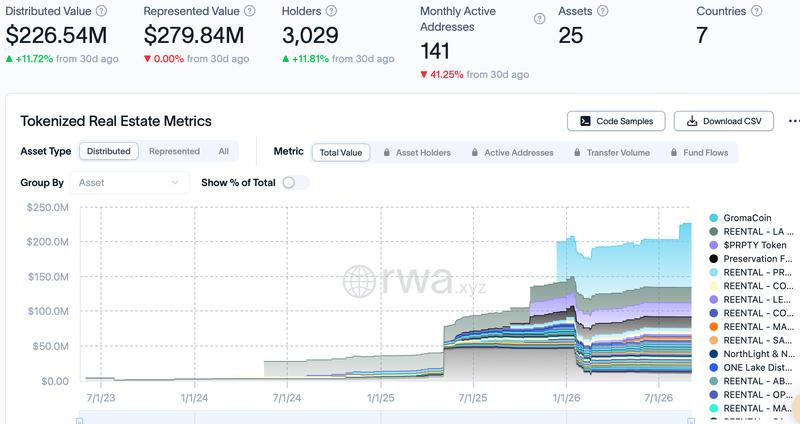
Despite these developments, tokenized real estate continues to represent only a modest portion of the overall real-world asset (RWA) market. The sector currently accounts for approximately $226.5 million in distributed value, showing an 11.7% increase over the last 30 days, which stands in contrast to the $38.8 billion total across all tokenized RWAs monitored by RWA.xyz.