
Hut 8 shifts to Q4 deficit as compute revenue share expands
The cryptocurrency mining firm Hut 8 shifted to a fourth-quarter deficit driven by digital asset impairments, though the company experienced revenue growth and executed a $7 billion, 15-year lease for AI data center infrastructure.
On Wednesday, Hut 8 (HUT) disclosed a net loss of $279.7 million for the fourth quarter, representing a reversal from the $152.2 million in income recorded during the corresponding period twelve months prior.
Total revenue for the three-month period concluding on Dec. 31 reached $88.5 million, marking a substantial increase compared to the $31.7 million generated in the equivalent quarter of the previous year.
According to the earnings statement published Wednesday, Hut 8's compute revenue during the quarter amounted to $81.9 million, climbing significantly from the $19.2 million reported in the year-ago period. The organization chose not to release quarterly data regarding Bitcoin (BTC) production volumes or sales transactions.
The company's operational performance was substantially impacted by a $401.9 million write-down on digital assets during the quarter, contrasting sharply with a $308.2 million gain recorded in the same period one year earlier.
The company disclosed that it concluded the year holding approximately $1.4 billion in combined cash and Bitcoin reserves, alongside access to revolving credit facilities totaling up to $400 million.
Throughout the quarter, Hut 8 executed a 15-year lease agreement for 245 megawatts of AI data center capacity located at its River Bend campus, with the contract carrying a total valuation of $7 billion. The deal features payment obligations that are financially guaranteed by Google and represents an extension of Hut 8's strategic shift toward AI and high-performance computing infrastructure development.
Additionally, the company finalized the divestiture of a 310 MW natural gas portfolio during February and announced the establishment of American Bitcoin Corp. as an independent publicly traded entity dedicated to Bitcoin accumulation strategies.
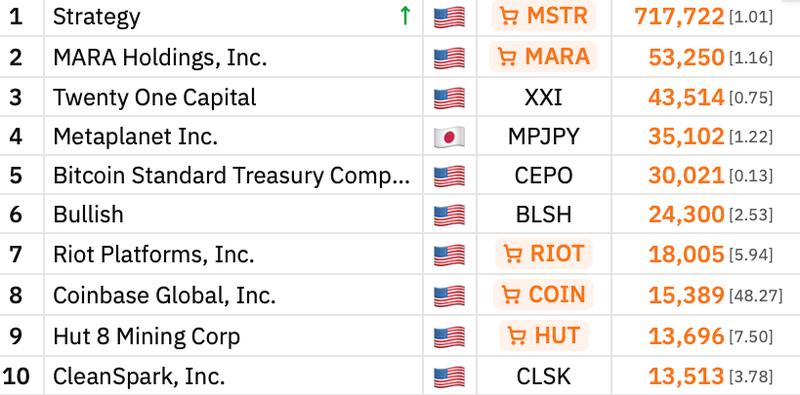
Based on information from BitcoinTreasuries.NET, Hut 8 maintains a position of 13,696 BTC, placing it among the more substantial publicly listed Bitcoin holders. The company's stock price declined approximately 4.5% during Wednesday morning trading sessions. The CoinShares Bitcoin Mining ETF (WGMI), which tracks the broader industry, registered gains of less than 1%.
Artificial intelligence and infrastructure projects drive mining equity performance
Despite Bitcoin's decline to approximately $68,150 from roughly $87,500 at year's beginning, according to CoinGecko statistics, equity shares of the majority of the largest publicly traded Bitcoin mining operations by market capitalization have demonstrated positive year-to-date performance.
TeraWulf has surged more than 50% since the start of the year, while Riot Platforms and Hut 8 have recorded increases of approximately 30% and 29%, respectively, based on information compiled by BitcoinMiningStock.io.
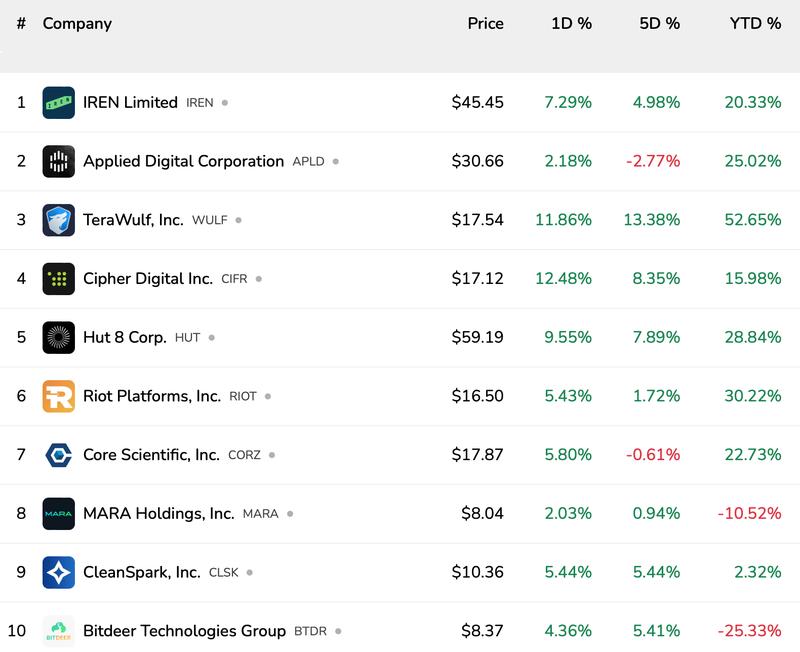
This performance gap indicates that market participants may be assessing miners based not exclusively on their Bitcoin price correlation, but progressively on their energy infrastructure capabilities and data center development approaches.
During August, TeraWulf entered into 10-year colocation lease arrangements with AI infrastructure specialist Fluidstack carrying a combined value of $3.7 billion. Google is providing financial backing for approximately $1.8 billion of these lease commitments while extending debt financing, and in exchange receiving warrants for roughly 41 million WULF shares, representing about 8% of the total company.
In the previous week, activist investment firm Starboard Value called on Riot Platforms to accelerate its transition into high-performance computing and AI data center operations, arguing that Texas-based development initiatives could generate between $9 billion and $21 billion in shareholder equity value. Starboard currently maintains a position of approximately 12.7 million Riot shares.
Additional mining companies are similarly reorienting their strategies toward AI-connected infrastructure assets. CleanSpark, Core Scientific, HIVE Digital and MARA Holdings have restructured segments of their operational infrastructure or announced comparable AI and high-performance computing strategic initiatives.
Cango reported the liquidation of $305 million in Bitcoin holdings on Feb. 9, citing the need to partially fund its projected expansion into AI and HPC infrastructure.