
Hardware Wallet Security Crisis: What the Coldcard Vulnerability Reveals About Crypto Storage Safety
A significant entropy vulnerability in Coldcard hardware wallets has sparked widespread concern about cryptocurrency storage security. What you should understand before storing your Bitcoin on Ledger, Trezor, or Foundation devices.
Right when it seemed the cryptocurrency market's collective confidence had reached rock bottom, the Coldcard entropy vulnerability emerged to demonstrate otherwise.
The identification of a security weakness in one of the sector's most established hardware wallet solutions this past Friday delivers a sobering reality check that no storage method for Bitcoin can claim absolute invulnerability.
On July 31, Coldcard made public an entropy-generation vulnerability impacting numerous Coldcard hardware devices. Following this announcement, researchers from Galaxy Digital report that malicious actors have successfully siphoned more than 1,596 Bitcoin valued at no less than $100 million via multiple synchronized exploits.
Hardware wallet producers now face pressure to clarify a technical aspect that most consumers rarely consider: the mechanism through which their wallet creates the private key safeguarding their Bitcoin holdings.
"The whole model rests on trust that the vendor got it right […] Almost no individual can audit the hardware, the firmware and the entropy generation underneath their device."
Coinkite, the organization responsible for Coldcard, has issued firmware patches and instructed impacted customers to transfer their assets, yet the episode has deeply unsettled Bitcoin holders, raising a troubling concern:
When Coldcard wallets prove vulnerable to exploitation, should we conclude that every hardware wallet faces potential security risks?
A flaw concealed in fundamental operations
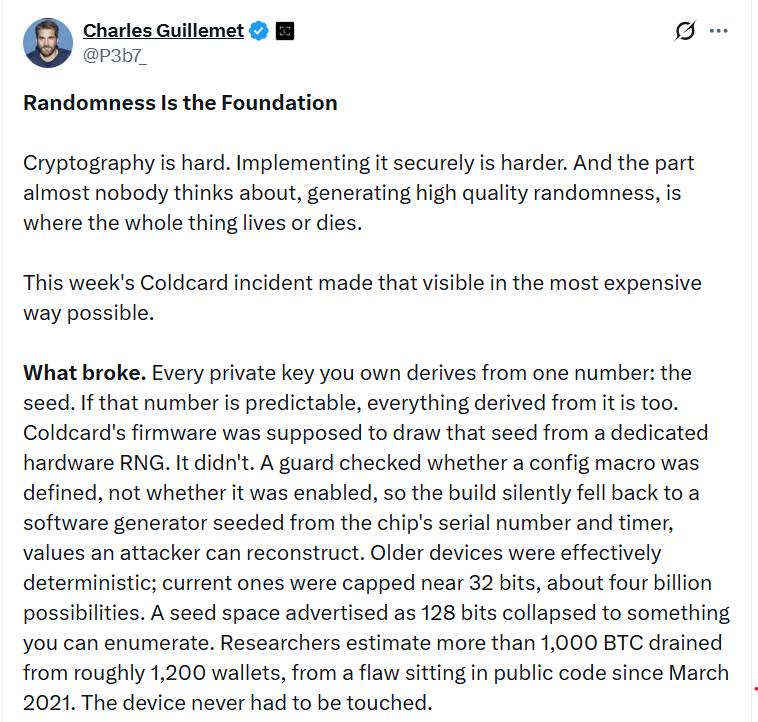
The security weakness affecting Coldcard didn't compromise Bitcoin's underlying protocol or undermine contemporary cryptographic standards, but instead targeted something far more foundational: the generation of randomness.
All Bitcoin wallets initiate their operation by creating a seed phrase derived from a reservoir of random information, meaning this randomness must possess sufficient unpredictability to render the resulting private keys practically impossible to deduce. Entropy describes the quality of this randomness.
When that randomness becomes compromised in any manner, malicious actors can narrow down the spectrum of potential keys that might be created and ultimately discover methods to recreate them.
On July 31, Coinkite initially notified customers that wallets generated on compromised firmware versions should be treated as vulnerable and instructed users to move their holdings to freshly created wallets. In the days that followed, as security researchers investigated the vulnerability more thoroughly, focus rapidly shifted toward understanding how such a critical defect in an essential wallet component had remained undetected for over five years.
Dustin Dettmer, a developer working on Core Lightning, proposed that the issue may have stemmed from firmware modifications implemented in 2021.
His analysis indicates that programming code designed to communicate with the hardware random number generator may have inadvertently deactivated it, resulting in wallet generation defaulting to MicroPython's inferior Yasmarang pseudo-random number generator.
"Certain firmware versions had a fallback path in seed generation that could produce weak entropy when generated on the device firmware itself."
Hardware units where customers created their own entropy via dice rolls or comparable manual techniques "were not affected by this specific fallback path," according to the spokesperson.
Inadequate random number generation (RNG) represents a known issue in the industry, but unlike numerous other security vulnerabilities, it proves challenging to identify.
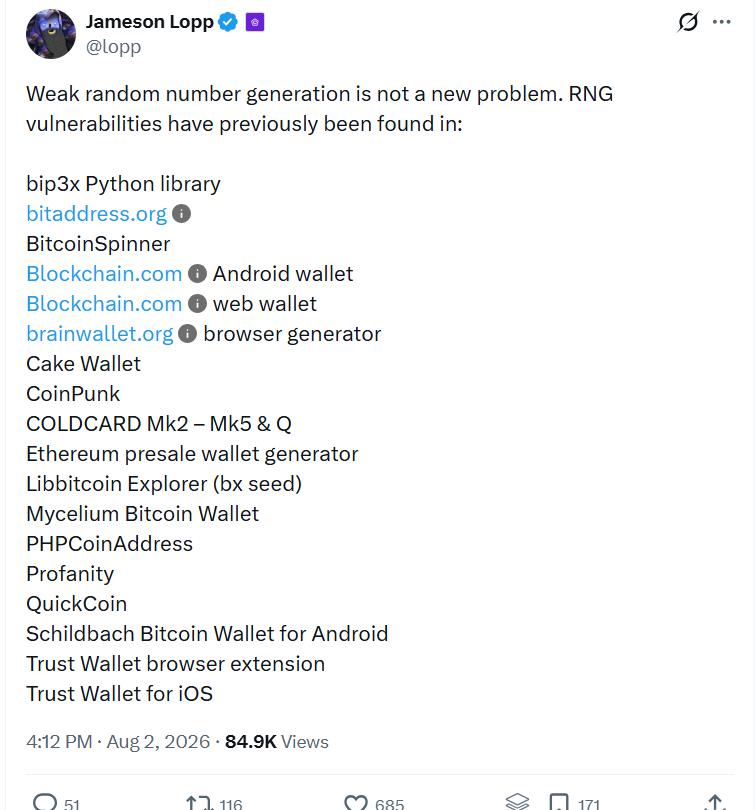
Jameson Lopp, an expert in Bitcoin security, observed that RNG weaknesses have historically impacted an extensive array of cryptocurrency wallets and software libraries, including Blockchain.com's Android wallet and Trust Wallet among others.
Vincent Bouzon, who serves as director of product security at Ledger, explains to Magazine that "weak randomness passes output tests," indicating that flawed random-number generators may still yield values appearing random, rendering such defects particularly difficult to recognize.
Varying approaches to randomness across wallet manufacturers
Manufacturers of hardware wallets universally acknowledge that reliable entropy generation remains absolutely essential, yet their methodologies for accomplishing this goal differ substantially.
Ledger's design philosophy focuses on specialized security hardware components. According to Bouzon, Ledger products create seeds utilizing a genuine random number generator integrated within a certified Secure Element. This entropy source receives certification under the AIS-31 PTG.2 standard while the Secure Element completes Common Criteria certification. His statement emphasizes:
"This Coldcard incident was a failure in one specific implementation, not a verdict on secure self-custody […] The generation of that entropy must be anchored in secure hardware, with an architecture that cannot silently downgrade to an untrusted software-based source."
Trezor, conversely, merges randomness produced within the hardware device with randomness contributed by the connected computer, avoiding reliance on one solitary entropy source, while their latest models incorporate supplementary hardware-based sources as well.
"The takeaway for the whole industry is that randomness cannot depend on a single source or a single line of code being correct."
Foundation's Passport wallet takes a comparable approach leveraging multiple entropy sources while prioritizing openness and transparency. Zach Herbert, the company's chief executive, explains that Passport merges randomness produced by distinct hardware elements prior to wallet creation.
Additionally, the firmware exists as free and open-source software featuring reproducible builds, enabling independent security researchers to confirm that the software executing on the device corresponds with the publicly available code. Herbert's perspective states:
"The bug itself was specific to Coldcard [...] The larger warning is that this went unnoticed for more than five years while people trusted the product with life-changing amounts of money."
The intersection of trust, transparency and independent verification
The fundamental disagreement separating Ledger, Trezor and Foundation doesn't concern the critical nature of randomness, but rather centers on how customers can gain confidence that it functions correctly.
Ledger maintains that independent certification delivers the most robust guarantee. Foundation depends on open-source development practices, reproducible builds and actively welcoming external security researchers, while Trezor integrates open firmware with multiple entropy sources to prevent dependence on any individual component.
Coinkite's methodology regarding security disclosure practices has attracted criticism as well, with multiple Bitcoin developers challenging the company regarding previous responses to vulnerability submissions and the lack of a conventional bug bounty program.
Herbert contends that embracing external researchers constitutes an integral element of creating secure products, together with open-source development practices and independent security audits.
Nick Percoco, serving as chief security officer at Kraken and previously holding the same position at Uptake, interprets the Coldcard situation as a chance for the industry to embrace more rigorous standards, regardless of which design philosophy manufacturers select.
"The Coldcard entropy failure should be a wake-up call for the entire hardware wallet industry," he stated, maintaining that current certification frameworks frequently validate separate components without verifying that production firmware actually utilizes them appropriately.
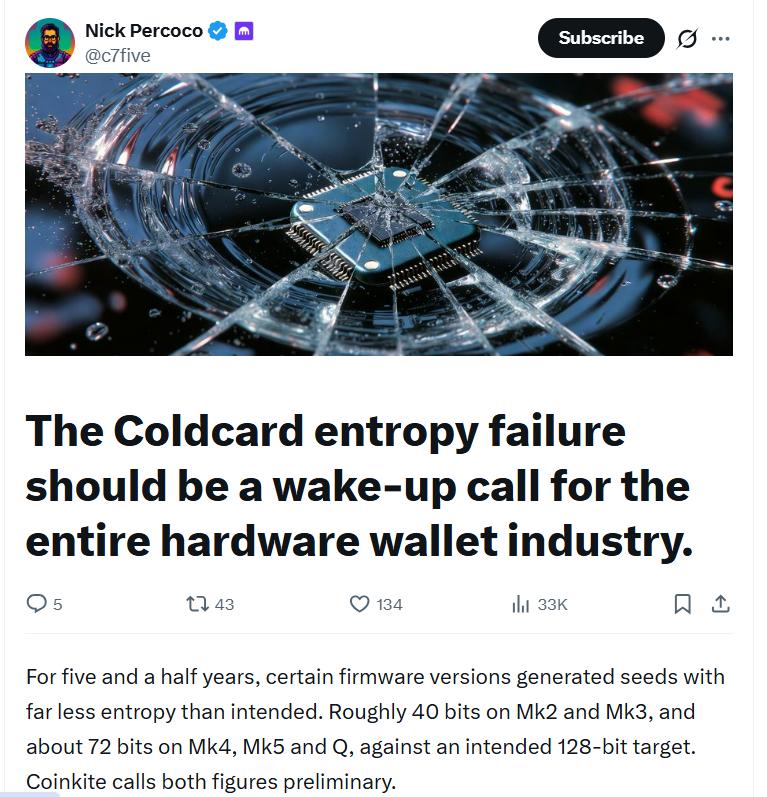
Percoco has suggested establishing an industry-specific assurance standard mandating independent validation of entropy sources, confirmation that firmware properly invokes the designated hardware random number generator and certification linked to particular hardware and firmware versions.
However, the discussion extends beyond purely technical implementation, with individuals like Herbert maintaining that open-source development practices fundamentally influence security culture. He identifies bug bounty programs and productive collaboration with independent researchers as crucial components of developing secure products.
Recommended actions for Bitcoin holders moving forward
For individuals using Coldcard devices, the immediate course of action involves adhering to Coinkite's migration instructions if they suspect their wallets were generated using compromised firmware versions.
Looking ahead to the long term, the Bitcoin community overall should treat this incident as an educational opportunity, with specialists like Tanguma emphasizing the importance of rejecting design architectures where any isolated failure point could jeopardize their cryptocurrency holdings. His recommendation states:
"Today, realistically, you want multisig and independently generated entropy [...] The mitigation that actually scales is architectural: setups where no single device, vendor or institution being wrong can lose the funds."
Therefore, at this juncture, the response appears to be negative; hardware wallets as a category are not inherently insecure.
The Coldcard incident revealed a breakdown in a particular implementation, yet it has simultaneously compelled manufacturers to demystify the process sitting at the core of self-custody: creating a secret that remains impossible for anyone else to predict.