
Fellowship PAC Launches Candidate Endorsement Campaign Ahead of Midterm Elections
A cryptocurrency-focused super PAC has allocated $300,000 toward advertising efforts supporting a Republican candidate seeking to represent Georgia's 14th Congressional District in the 2026 election cycle.
A super political action committee (PAC) called Fellowship, which asserts it has secured $100 million in funding from cryptocurrency-aligned sources in preparation for the 2026 US midterm elections, has started to disclose its expenditures and candidate endorsements for the upcoming electoral contests.
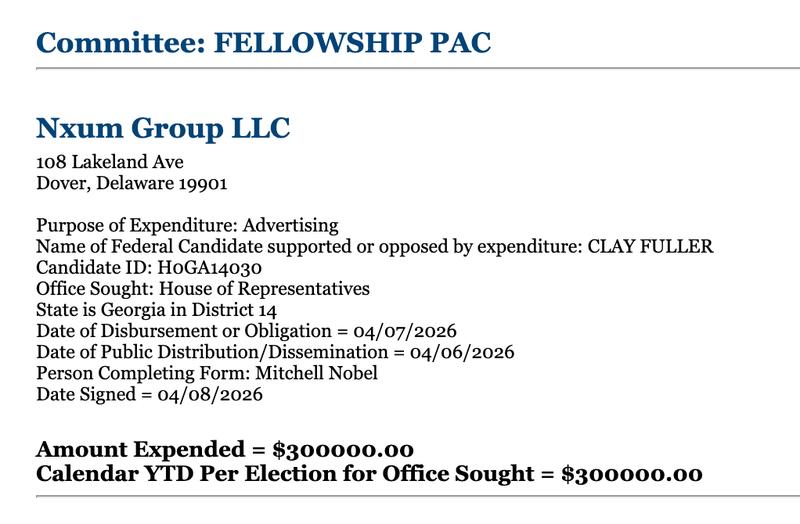
Based on documentation submitted to the Federal Election Commission (FEC), Fellowship PAC disclosed that it allocated $300,000 toward advertising in support of Clay Fuller, a Republican candidate who secured victory in a special election contest for Georgia's 14th Congressional District, filling the seat being vacated by outgoing congresswoman Marjorie Taylor Greene. The expenditure, which was recorded as disbursed on Tuesday, arrives approximately one month in advance of Georgia's Republican primary scheduled for May 19.
The Fellowship PAC represents merely one among multiple cryptocurrency-supported or affiliated political action committees anticipated to invest substantial financial resources to either back or challenge candidates during another pivotal US election cycle. During 2024, the Fairshake PAC invested in excess of $130 million on media purchases for congressional campaigns, potentially shaping election results in crucial competitive races such as the US Senate contest in Ohio.
As defined by the FEC, super PACs are permitted to "receive unlimited contributions from individuals, corporations, labor unions and other PACs for the purpose of financing independent expenditures and other independent political activity."
Beyond the sole reported expenditure documented since Fellowship PAC submitted its statement of organization in 2025, the organization published endorsements for various candidates on its X account this past Thursday, indicating its backing for Republican contenders in electoral contests spanning five different states. Among the endorsed candidates were Alan Wilson pursuing South Carolina's gubernatorial seat, Blake Miguez competing for Louisiana's 5th Congressional District, Mike Collins running for the US Senate position in Georgia, Julia Letlow seeking the US Senate seat in Louisiana, Pete Ricketts campaigning for the US Senate in Nebraska and Nate Morris vying for the US Senate seat in Kentucky.
The Fellowship PAC publicly announced its establishment in September, asserting that it had obtained "over $100 million" from backers whose identities remain undisclosed but who maintain alignment with the cryptocurrency sector. On April 1, the organization revealed that Jesse Spiro, Tether's head of government affairs, would assume the role of PAC chairman, demonstrating the group's commitment to supporting candidates who hold favorable positions on cryptocurrency policy.
US lawmakers are still stalled on crypto market structure bill as midterms approach
The CLARITY Act, a piece of legislation that received approval from the US House of Representatives in July, has encountered multiple postponements in the Senate with no definitive strategy emerging for advancing the legislation toward passage as of Monday.
News accounts published during the weekend indicated that the Senate Banking Committee, representing one of two committees required to give approval to the bill within the chamber prior to a floor vote, was intending to conduct a markup session on the proposed legislation, however the scheduled event did not appear on the committee's official calendar at the time this article was published.
This legislative proposal, which is anticipated to stand as one of the most wide-ranging pieces of legislation with significant implications for both the cryptocurrency and banking sectors, has encountered resistance from members of Congress who seek to address various concerns including ethics standards, stablecoin yield provisions, tokenized equities frameworks and other possible complications.