
Ethereum's Buterin Outlines Vision for AI Integration with Blockchain Technology
Ethereum's co-creator envisions cryptocurrency offering privacy infrastructure, verification mechanisms and economic frameworks to democratize artificial intelligence for societal advancement.

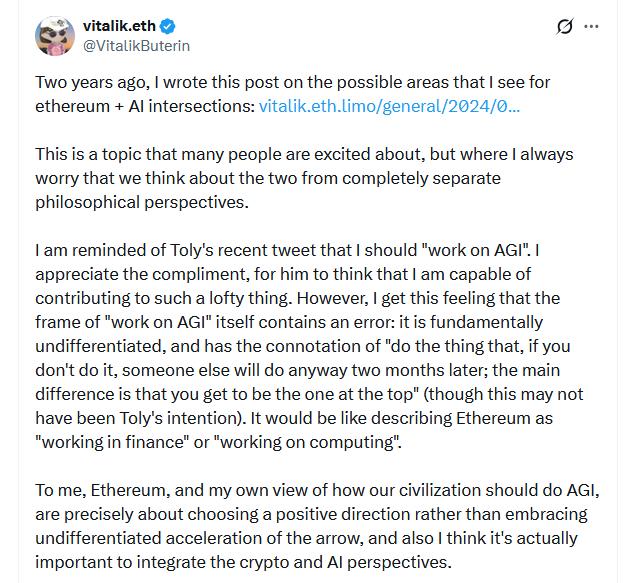
Vitalik Buterin, the co-creator of Ethereum, has articulated his most recent perspective on how Ethereum can converge with artificial intelligence technologies, envisioning a collaborative relationship that enhances markets, bolsters financial security and strengthens human autonomy.
Through a post shared on X this Monday, Buterin articulated his comprehensive outlook for artificial intelligence (AI) development, emphasizing a future where AI augments human capabilities instead of making them obsolete, while acknowledging that near-term applications will be considerably more "ordinary" in nature.
Four primary domains where Ethereum and AI technologies might converge in the immediate future were identified by Buterin: facilitating trustless and/or private AI interactions, establishing Ethereum as an economic infrastructure for AI-to-AI communications, leveraging AI to achieve the "mountain man" philosophy through comprehensive onchain verification, and enhancing both market operations and governance effectiveness.
According to Buterin's argument, achieving genuinely private AI usage demands new tools and integrations that prevent data leakage and protect personal identities from exposure.
The problem of private data being leaked by large language models (LLMs) has emerged as a growing concern following the proliferation of AI-powered chatbots. An article published by Cointelegraph Magazine the previous month emphasized that although ChatGPT is capable of providing legal guidance, the chat history you generate could potentially be leveraged against you during court proceedings.
Among other requirements, he emphasized the necessity for tools that support running LLMs locally on individual devices, employing zero-knowledge proofs for anonymous API interactions and advancing cryptographic technologies to authenticate AI-generated work.
Furthermore, Buterin imagines AI functioning as an intermediary between users and blockchain networks, proposing that AI agents might verify and audit each transaction, engage with decentralized applications and recommend transactions for user approval.
The verification capabilities of AI could prove tremendously valuable for cryptocurrency and various other industries, particularly as scammers become increasingly sophisticated. Address poisoning scams, representing just one method of attack, have experienced a substantial surge beginning in December.
Basically, take the vision that cypherpunk radicals have always dreamed of (don't trust; verify everything), that has been nonviable in reality because humans are never actually going to verify all the code ourselves. Now, we can finally make that vision happen, with LLMs doing the hard part.
Building upon this concept, Buterin foresees AI bots gaining the ability to "interact economically" by managing all blockchain activities on behalf of users and significantly improving cryptocurrency accessibility.
According to his vision, bots could be commissioned to recruit one another, manage API interactions and establish security deposits.
Economies not for the sake of economies, but to enable more decentralized authority.
Lastly, Buterin believes AI has the potential to improve blockchain-based governance and market systems when LLMs are applied to transcend the constraints of human attention spans and decision-making abilities.
While concepts such as prediction markets and decentralized governance systems are "all beautiful in theory," he noted they remain fundamentally constrained by "limits to human attention and decision-making power."
LLMs remove that limitation, and massively scale human judgement. Hence, we can revisit all of those ideas.