Emerging Markets Face New Challenge as BIS Flags Stablecoin Threat to Capital Controls
A new study reveals that stablecoins pegged to the dollar demonstrate greater resistance to capital control measures compared to conventional banking deposits, presenting fresh challenges to monetary independence in developing economies.

A recent investigation by Bank for International Settlements (BIS) researchers has revealed that stablecoins backed by the US dollar are giving rise to an emerging phenomenon of "digital dollarization" that remains mostly immune to capital control measures, especially within developing economies.
According to the research findings, authorities may possess considerably less capacity to restrict stablecoin uptake compared to their ability to regulate conventional foreign-currency banking deposits.
In their analysis, BIS researchers examined foreign-currency deposit patterns and inflows of dollar-pegged stablecoins spanning more than 130 economies, discovering that both categories demonstrate growth during times of macroeconomic turbulence. However, in contrast to conventional bank deposits, stablecoin movements demonstrated minimal sensitivity to capital controls or additional foreign exchange restrictions. According to the authors, this phenomenon is likely attributable to the fact that "stablecoins are partly circulating outside the regulatory perimeter."
According to the study, stablecoins retain the potential to compromise monetary sovereignty by enabling households and enterprises to transition into dollars beyond the traditional banking infrastructure, with particular relevance for emerging markets characterized by unstable currencies or inadequate access to dependable financial infrastructure.
Notwithstanding these concerns, the researchers discovered minimal evidence indicating that deposit dollarization compromises monetary policy transmission mechanisms, although nations with elevated levels of foreign-currency deposits encountered a moderately increased risk of heightened inflation.
According to BIS, the research outcomes indicate that policymakers may require novel instruments to address financial stability concerns as stablecoin usage expands, contending that regulatory frameworks created for conventional banking and foreign-currency deposits may prove less effective within a tokenized financial ecosystem.
Dollar-backed stablecoins expand in emerging economies
These research findings emerge at a time when stablecoin utilization as a payment mechanism is experiencing growth across multiple emerging markets.
In its latest examination of Nigeria, the International Monetary Fund (IMF) discovered that households and small enterprises are utilizing stablecoins pegged to the US dollar for international payments, remittance services and obtaining access to dollar-denominated assets as elevated inflation, currency devaluation and restricted foreign exchange availability fuel demand.
According to the IMF, stablecoins have diminished both the expense and duration needed to transfer funds internationally while broadening financial service access for users operating beyond the traditional banking infrastructure. Simultaneously, the organization cautioned that extensive adoption of dollar-backed digital tokens could undermine monetary sovereignty by diminishing demand for domestic currencies and transferring additional financial activity beyond conventional banking infrastructure.
Throughout Latin America, stablecoin adoption has similarly gained momentum. Bitso Business, which serves as the enterprise payments division of cryptocurrency exchange Bitso, documented an 81% year-over-year surge in stablecoin payment volume throughout the first half of 2026. The organization additionally reported that Circle's USDC (USDT) and Tether's USDT (USDT) represented 40% of all crypto purchases in the region in 2025, exceeding Bitcoin for the first time.
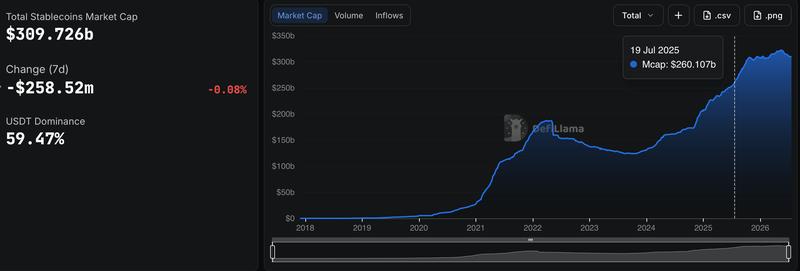
The total market capitalization of stablecoins has climbed to approximately $309.7 billion, representing an increase from roughly $260 billion a year ago.