
Economic Peril: Can the US Afford to Hit the Brakes on AI?
An $800 billion AI investment surge faces threats from proposals to decelerate development. Will slowing AI progress trigger economic collapse in the US — or can existing model applications sustain growth momentum?

Contradictory pressures are tearing the United States artificial intelligence sector in radically different directions.
Leading figures from the AI sector are making joint appeals to decelerate the speed of innovation, even as US President Donald Trump pushes for maximum acceleration to maintain competitive advantage over China and has unveiled what he calls a "Super Intelligence Force," with former SEC boss Jay Clayton at the helm.
At the same time, Goldman Sachs projects that the five dominant American AI hyperscalers will pour $800 billion into AI infrastructure development over the course of this year.
Given that US stock market performance and GPD expansion are becoming increasingly intertwined with the AI sector's vitality, would decelerating AI advancement cause economic devastation?
Who wants a slowdown and who doesn't?
Anthropic CEO Dario Amodei advocates for "pacing the frontier," decelerating progress in the most advanced AI models to enable safety research to keep pace. His proposal from September incorporates independent evaluation teams within laboratories, common safety protocols and constraints on developers in democratic nations, plus future international collaboration, including participation from countries such as China.
OpenAI's Sam Altman, Google DeepMind co-founder Demis Hassabis and xAI founder Elon Musk have given their support to his strategy. Though Amodei makes clear that pacing would permit model training and technical advancement to proceed, certain politicians seek to enforce more stringent restrictions. Senator Bernie Sanders and Representative Greg Casar's "Ban Artificial Superintelligence Act", unveiled Sept. 23, would indefinitely ban superintelligence and halt advanced AI development pending the establishment of federal safety regulations.
Senator Elizabeth Warren is also calling for an instant pause. European Commission President Ursula von der Leyen backs pacing frontier AI research.
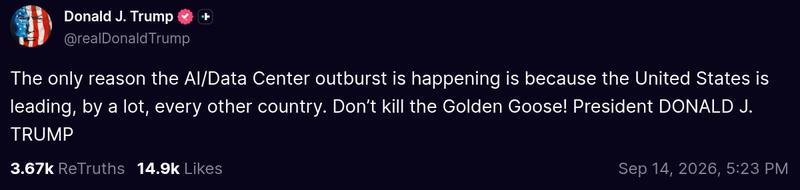
However, President Donald Trump stands against a slowdown, maintaining that limitations would advantage China and cautioning: "Don't kill the Golden Goose!" Meta's Mark Zuckerberg prefers allowing each laboratory to establish its own safe development speed, pointing to competition and liability as motivating factors.
Nvidia's Jensen Huang likewise advocates for accelerated development, while expressly supporting company-specific pauses when products are unsafe or control is uncertain. Their resistance centers on a coordinated slowdown, not every type of constraint.
On Sept. 29, Trump and prominent AI executives executed a voluntary safety agreement focusing on internal controls, independent audits and oversight. The pact creates safety obligations without mandating a collective development pause.
However, as worldwide concern about the technology intensifies, the next major AI safety incident could reignite momentum toward a slowdown.
Will a slowdown take down large bets?
Enormous capital flows are presently flooding into the AI infrastructure expansion. SoftBank initiated another $10 billion and €1 billion ($1.15 billion) bond sale not long ago to finance its OpenAI investment. It would represent Asia-Pacific and Japan's biggest non-financial corporate bond transaction and rank among this year's 20 largest worldwide, according to Reuters. SoftBank had previously poured approximately $54.6 billion into OpenAI by the end of July.
Available data indicates that AI investment velocity is accelerating at such a pace that it is exerting substantial influence on the wider US economy. A January St. Louis Fed analysis calculated that comprehensive AI-related investment represented 39% of real GDP growth throughout the first nine months of 2025:
"Together, the AI categories contributed 0.97 percentage points to real GDP growth in the first three quarters of 2025 [...] Through the third quarter of 2025, these categories made up 39% (36% excluding data centers) of total GDP growth versus 28% in 2000."
An AI slowdown would not inevitably produce economic catastrophe in the US — though it would unquestionably generate an impact. It might trigger a shift in market expectations, prompt companies to abandon infrastructure projects, lead investors to revalue AI assets and cause lenders to pull financing.
In April the IMF calculated that an AI-investment reversal would deliver a 20% decline in US equity markets and tighter credit, with US GDP 1.5% below baseline and world output 1.2% lower. A scenario published this month by major credit rating agency Fitch is even harsher, expecting a 35% equity shock plus capex retrenchment produces a US recession.
The glass half full view
The more positive perspective is that we have barely begun to exploit the complete potential of the AI technology that currently exists. David Minarsch, the CEO of AI phone agent service Valory and founding member of AI agent system Olas, tells Magazine that slowing frontier AI capability progress would still see gains significant productivity gains made through agentic system development. "There's ample evidence that AI adoption is severely lagging across many industries and even within software engineering lagging across different types of businesses and organisations," he explains,
"Even with a complete halt of training new models, the dissemination of existing models through the economy would continue, yielding the associated gains."
Shiv Shankar, founder and CEO of AI computing platform Boundless, agrees. He tells Magazine that "as people find more and more use cases, at least for the short to medium term, meaning the next couple of years, we only see inference demand going vertical." That's regardless of a model development slow down. "It's going to keep growing, and quite a lot of opportunities may be created," he concluded.
The glass half empty view
While not talking about the slowdown specifically, the International Monetary Fund (IMF) warned in January that weaker AI-productivity expectations could see reduced investment, trigger a market correction and erode household wealth. Those effects would then echo through the economy by weighing down on consumption and further investment:
"Risks to the outlook remain tilted to the downside. Reevaluation of productivity growth expectations about AI could lead to a decline in investment and trigger an abrupt financial market correction, spreading from AI-linked companies to other segments and eroding household wealth."
Bank for International Settlements (BIS) administrator Pablo Hernández de Cos explained earlier this month that "should the returns to AI disappoint, a pullback in investment could turn today's capital expenditure boom into a bust." He added that history offered some instructive parallels.
"The canal mania of the 1830s, the British railway mania of the 1840s, the electrification boom of the 1920s and the dotcom surge of the late 1990s were all based on important technological breakthroughs. All drew in more capital than eventual returns could justify. In each of these cases, the eventual correction that followed had economy-wide implications."
A July BIS paper estimated that over investment in AI infrastructure is at roughly 1.5 times the socially efficient level — highlighting debt and circular equity that make a bust and broader economic contagion more likely:
"The AI race generates significant over-investment, exceeding the socially efficient level by around 50% under a conservative baseline. Larger booms end in more disruptive busts."
The Union Bank of Switzerland argued last week that "pacing does not necessarily imply lower capex" and announced that the bank retains its "2027 AI industry capex forecast of USD $1.2 trillion, a rise of 33% from our estimate of USD $900 billion this year."
So perhaps a slowdown could potentially alleviate some of this reported over investment? Only time will tell.