
Disagreement in DAOs signals strong governance, Curve Finance creator asserts
Major decentralized finance protocols like Curve Finance and Aave rely on decentralized autonomous organizations (DAOs) for their governance structures.
According to Dr. Michael Egorov, the creator of decentralized finance (DeFi) platform Curve Finance, a decentralized autonomous organization (DAO) that experiences internal disagreements is actually demonstrating signs of robust health.
A DAO represents a decentralized form of organizational governance that utilizes smart contracts for automating various functions while relying on member voting mechanisms to manage onchain protocols.
Speaking to Cointelegraph, Egorov pointed to both a 2024 governance proposal related to the Curve DAO and a more recent conflict within the Aave DAO as examples that demonstrate why disagreements are crucial to maintaining the structure's health and effectiveness:
If everyone automatically agrees on something, it feels like people just don't really care. They vote for whatever comes in, or they don't participate at all. The first sign of that would be governance apathy, like when people are not voting at all.
The previous Curve DAO issue revolved around a 2024 governance proposal seeking to award Swiss Stake AG, which serves as the primary developer behind the Curve Finance protocol, with a grant worth approximately $6.3 million at the time, a proposal that encountered substantial opposition from Curve DAO members.
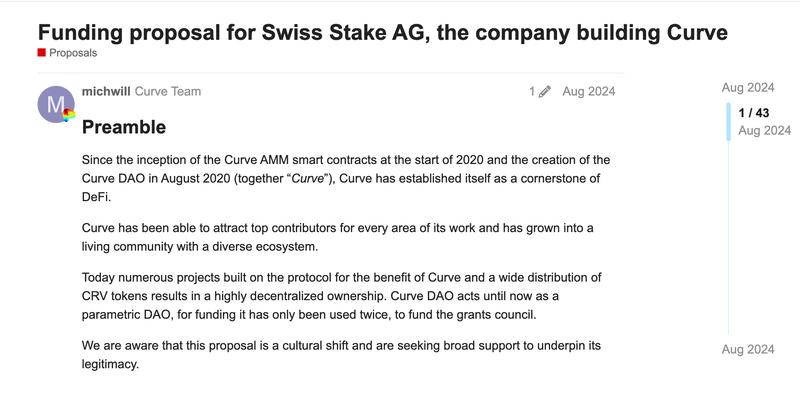
According to Egorov, the proposal underwent revisions and was resubmitted in December 2025, with the reworked proposal achieving more than 80% participation from DAO members.
Research conducted last year by blockchain development company LamprosTech revealed that "Voter turnout in most DAOs rarely passes 15%, concentrating decision-making power in the hands of a small, active group."
According to Egorov, holders of Curve tokens lock up their holdings for extended periods, which promotes long-term governance participation and engagement.
In Egorov's view, DAOs constitute a novel model for organizing human collaboration that differs from traditional companies or self-sovereign nations, yet incorporates characteristics of sovereign countries, such as political parties expressing differing opinions regarding protocol governance.
Aave dispute highlights challenges in onchain governance and intellectual property rights
A governance conflict emerged in December 2025 between Aave Labs, the primary development company responsible for Aave products, and the Aave DAO concerning fees generated from an integration with DeFi exchange aggregator CoW Swap.
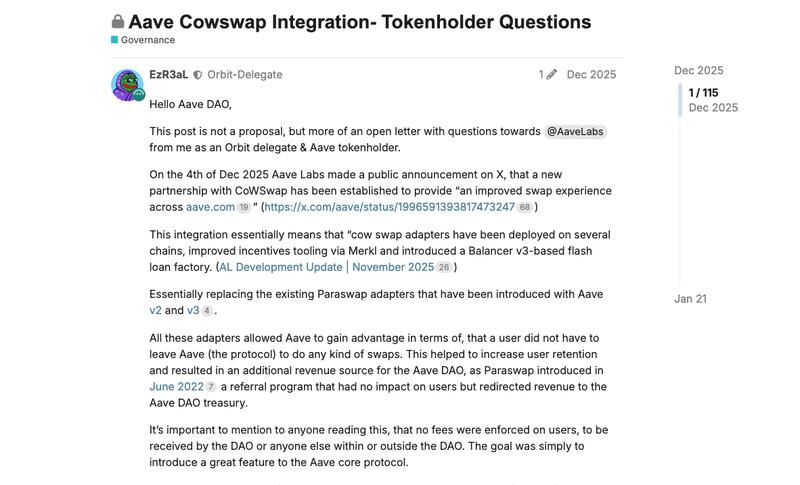
DAO members criticized the arrangement whereby integration fees flowed directly to a wallet under Aave Labs' control, and this backlash triggered a broader debate regarding which entity possesses legitimate control over the DeFi platform's intellectual property.
Subsequently, a proposal was put forward to the Aave DAO seeking to transfer control of Aave brand assets and intellectual property to the DAO itself; however, the proposal ultimately did not receive sufficient support to pass.
Legal recognition of DAOs could mitigate governance disputes
According to Egorov, DAOs face limitations in interacting with the real world without access to regulated legal structures, such as business entities or bank accounts, and DAO oversight of intellectual property represents a frequently encountered governance challenge.
He stated that DAOs are ideally suited for governing anything that exists onchain, while also suggesting that users should explore DAO applications for offchain components, though he acknowledged that centralized companies might be better equipped to handle offchain organizational structures.
Egorov suggested that if DAOs received legal recognition enabling them to interact with the traditional financial system, including the ability to own business entities and maintain bank accounts, it could help reduce governance disputes, while noting that legal frameworks have not yet evolved to accommodate the latest technological innovations.