
Digital asset treasury companies see premium evaporate as valuations slip below holdings: DWF
A majority of digital asset treasury firms are now valued beneath their cryptocurrency reserves, undermining a funding strategy that previously enabled businesses to grow their financial positions.

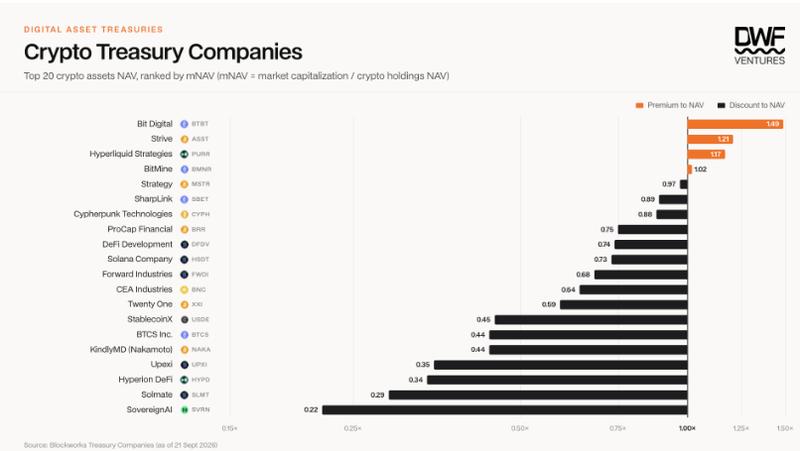
Digital asset treasury companies have largely seen their initial competitive edge evaporate, as the majority of these firms no longer enjoy the market premiums that previously enabled them to secure funding and acquire additional cryptocurrency while preserving shareholder value, a fresh analysis from DWF Ventures reveals.
Published on Thursday, the analysis discovered that merely four companies among the top 20 digital asset treasury (DAT) firms measured by assets under management maintain an mNAV above 1, indicating their market capitalization surpasses the worth of their cryptocurrency reserves. The companies trading at a premium include Bit Digital, Strive, Hyperliquid Strategies and BitMine.
These prevalent market discounts indicate that investors have grown unwilling to pay elevated premiums for cryptocurrency exposure obtained through equity positions in publicly listed corporations.
Following the introduction of the Bitcoin treasury approach by Michael Saylor's Strategy in 2020, the majority of DAT equities have delivered returns inferior to direct ownership of the underlying digital assets, DWF's research indicates. Furthermore, among those DAT stocks that have managed to outperform, DWF's analysis revealed that the performance edge compared to direct cryptocurrency ownership has typically remained modest.
This analysis emerges alongside news that Sequans Communications, a semiconductor firm based in France that adopted a Bitcoin treasury approach the previous year, revealed it had liquidated its final 314 BTC holdings, finalizing a withdrawal that commenced with the redemption of convertible debt instruments in May. The company's balance sheet currently reflects zero cryptocurrency holdings.
DWF's findings indicate that the premium valuations investors assigned to DAT equities typically reached their zenith during the strategy's early phase when it was generating significant investor interest. Strategy's mNAV, as an illustration, achieved its highest point in the latter months of 2024 throughout Bitcoin's price surge, a period characterized by robust appetite for leveraged BTC exposure opportunities.
DAT warnings predate the latest downturn
DWF represents just one among multiple organizations highlighting concerns regarding declining mNAVs. Standard Chartered identified this challenge in September 2025, during a period when Bitcoin along with the wider cryptocurrency ecosystem were experiencing strong growth, cautioning that a "collapse" in mNAV metrics might trigger extensive consolidation throughout the digital asset treasury sector.
Galaxy Digital issued comparable cautionary guidance during the prior year, contending that the DAT business model "critically depends on a persistent equity premium to NAV."
This premium valuation mechanism enables corporations to distribute new shares and deploy the capital raised toward purchasing additional cryptocurrency without eroding the proportional holdings of current shareholders. When shares trade beneath NAV instead, utilizing equity issuance for cryptocurrency acquisitions may become dilutive and compromise the fundamental financing structure underpinning the strategy.
If the premium collapses, or worse, flips to a discount, the model begins to break.
Will Owens, Galaxy research analyst
Maintaining viability for this business model has become increasingly challenging throughout the current year, as Bitcoin declined from its all-time peak exceeding $126,000 this past October to levels under $60,000 prior to staging a partial recovery toward approximately $86,000.