
Cryptocurrency Tax Season Chaos: IRS Gains Visibility Without Complete Picture
With exchanges now reporting crypto transactions to the IRS, taxpayers face new complications as the agency can see sale proceeds but lacks critical cost-basis information, creating significant challenges for digital asset investors.

Tax season has arrived once more for Americans. The daylight hours begin shortening, autumn leaves drift downward, and the Internal Revenue Service comes calling for 2025 tax filings.
Due to recently implemented regulations from the Inland Revenue Service, the federal tax agency has acquired unprecedented insight into cryptocurrency trading activities of American citizens, with brokerage platforms now mandated to disclose gross proceeds from specified digital asset transactions.
However, despite receiving documentation from trading platforms, numerous taxpayers have discovered that completing their tax filings has become more challenging rather than simpler.
Research involving 1,000 cryptocurrency investors across the United States, carried out during August by Awaken Tax, revealed that 21% of participants who had submitted, or intended to submit a tax filing extension, indicated they remained in limbo waiting for critical data from their exchange or cryptocurrency service provider.
Additionally, approximately 20% reported that their 1099-DA form, which brokers utilize to document specific digital asset sales, was either missing information or they questioned whether it properly represented their actual transactions.
These statistics emerge as American taxpayers work through their initial filing period under these novel reporting requirements, with individuals who requested extensions facing an Oct. 15 deadline for submission.
Throughout 2025, brokerage firms were typically mandated to disclose proceeds (the amount received when an asset was sold), though not the cost basis (the original purchase price paid by the taxpayer).
This obligation places the burden on taxpayers to determine their profits and losses independently, which presents difficulties even for those who trade infrequently, but transforms into an exhausting labyrinth for those who trade regularly.
Chris Herbst, managing director of CountDeFi tax reporting, tells Magazine, "For an active trader, that number can be many times their real gain, because each sale is counted at full value with no cost against it."
This reveals the fundamental challenge: while the IRS has visibility into sales transactions, taxpayers must independently determine their actual profit amounts.
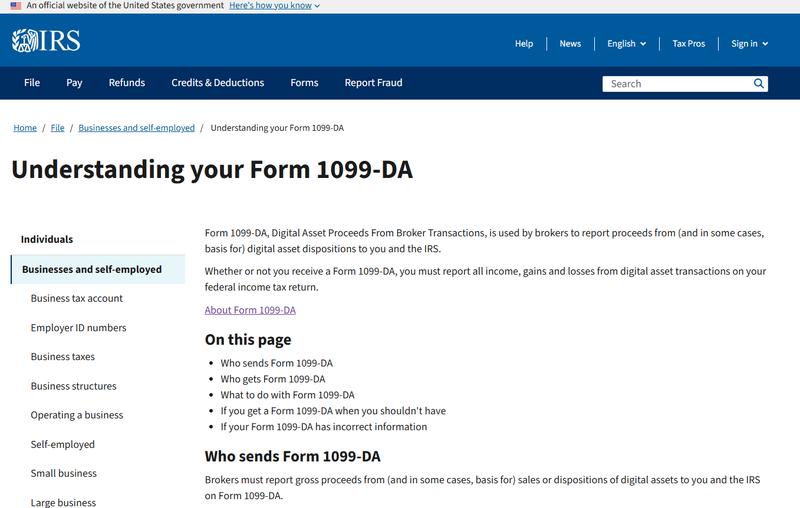
Understanding what information the new 1099-DA provides to the IRS
When dealing with a basic transaction, the math is uncomplicated. Purchasing Bitcoin at $9,000 and selling at $10,000 results in a profit of $1,000.
However, a 1099-DA issued for 2025 might display the $10,000 proceeds figure while omitting the $9,000 basis necessary for calculating the actual gain. Therefore, without knowledge of the original expenditure for a specific cryptocurrency asset, the mathematical computation transforms into an incredibly complex undertaking.
This situation means taxpayers require their own comprehensive documentation to supply the absent information, encompassing data that could be distributed across numerous exchanges, digital wallets, trading transactions and tax years.
"The gap is real," says Herbst, "but it is a record-keeping gap on the taxpayer side as much as a reporting gap on the exchange side."
Discrepancies between forms and actual records
Professionals in the tax industry report they're witnessing issues emerging as taxpayers attempt to align the newly issued forms with their complete transaction records.
Sharon Yip, founder of Crypto Tax Advisors, says her firm has found discrepancies between the 1099-DAs received by clients and the crypto tax reports it prepared for them.
Certain forms failed to capture every trade that clients executed throughout 2025, according to Yip, while trading platforms additionally employed varying formats for their client statements. Specific exchanges included cost basis for particular trades while excluding it for others, she explains, despite the fact that basis reporting wasn't required for 2025:
"It's very confusing for recipients to understand how to reconcile their 1099-DAs when compared to the crypto tax report they should use to file their tax return."
She additionally provides an illustration concerning stablecoins, noting that one client of her firm executed stablecoin transactions exceeding $300,000 on a trading platform during 2025, yet the platform's 1099-DA reflected stablecoin proceeds totaling under $100,000.
Furthermore, challenges can emerge even before taxpayers reach the stage of computing their profits. Andrew Duca, founder of Awaken Tax, mentions the firm observed clients receiving 1099-DAs considerably late during the filing period.
"Because this regulation is new, a lot of exchanges are still trying to figure it out," he says, pointing to exchanges like Kraken that "didn't send any forms to users until two weeks before the tax deadline of April 15."

Duca further references an instance of a Kraken 1099-DA from approximately the same timeframe that displays an absence of documented transaction data.
Kraken did not respond to Magazine's request for comment.
Essential information taxpayers must maintain
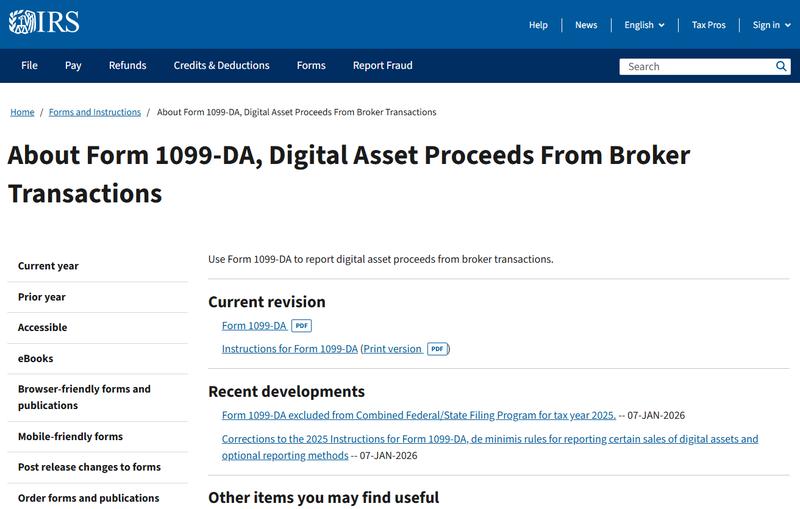
However, there's an important point to consider: these new documentation forms were never designed to substitute for taxpayers' personal record-keeping. The IRS states that taxpayers are obligated to report digital asset earnings and profits or losses regardless of whether they receive a 1099-DA.
In situations where basis information is absent from reporting, taxpayers should rely on their personal documentation to finalize their tax returns, though this process becomes increasingly intricate when cryptocurrency assets frequently migrate across different platforms.
Consider this scenario: you purchase Bitcoin through one exchange, transfer those funds to a personal wallet, subsequently move them to a different exchange and execute a sale there — and that second exchange lacks access to records showing your initial purchase price.
"The full transaction history from the day the account opened" is what taxpayers need from exchanges, Herbst says. This encompasses trading activities, associated fees, incoming deposits, outgoing withdrawals and transaction identifiers, including the wallet addresses involved.
According to him, basis information travels with the asset as it transfers across platforms, meaning a single absent piece of transaction documentation can impact a profit calculation performed years afterward on a completely different exchange.
Enhanced IRS data collection, increased taxpayer burden?
Andrew Gordon, executive director of Digital Asset Tax Action, says taxpayers are "constantly" struggling to reconcile 1099-DAs with their own records during the 2025 filing season.
He indicates that the majority of cryptocurrency tax software solutions lack functionality to import and reconcile 1099-DA data, and the limited number that offer such features still necessitate manual data entry because brokerage firms failed to distribute the 2025 forms in a machine-readable format.
According to Gordon, for individuals who trade actively, manually inputting this data can involve hundreds of separate entries. He contends that brokerage platforms should supply a machine-readable file accompanying each 1099-DA to enable information to transfer seamlessly into tax preparation software.
He further argues that exchanges should preserve comprehensive transaction records, encompassing acquisition dates, purchase amounts, associated fees and transfer information.
Gordon's primary concern centers on the fact that the IRS's enhanced visibility fails to result in a complete tax calculation for individual taxpayers.
"The 1099-DAs only reported proceeds in 2025, and proceeds reporting gives the IRS visibility it did not previously have;" however:
"Visibility without basis produces the zero-basis problem."
Taxpayers should avoid simply transferring figures from a 1099-DA directly onto their tax filing. Duca recommends they verify it against their comprehensive transaction records instead of automatically trusting the form's calculations:
"The IRS expects your return to reflect your actual gains and losses, not necessarily what's printed on a form that the exchange may have worked out incorrectly."
Can taxpayers expect improvements in 2026?
Even as cryptocurrency taxpayers continue wrestling with the 2025 filing period, additional regulatory modifications are approaching on the horizon.
Beginning in 2026, brokerage firms must typically report cost basis information for covered digital assets, providing taxpayers with additional data to determine their profits and losses. Nevertheless, assets that are transferred to a broker from another exchange or personal wallet may still remain outside these reporting requirements.
Therefore, while the IRS may possess greater knowledge regarding your cryptocurrency trading activities, when the time arrives to calculate your tax obligation, maintaining detailed personal records remains essential.