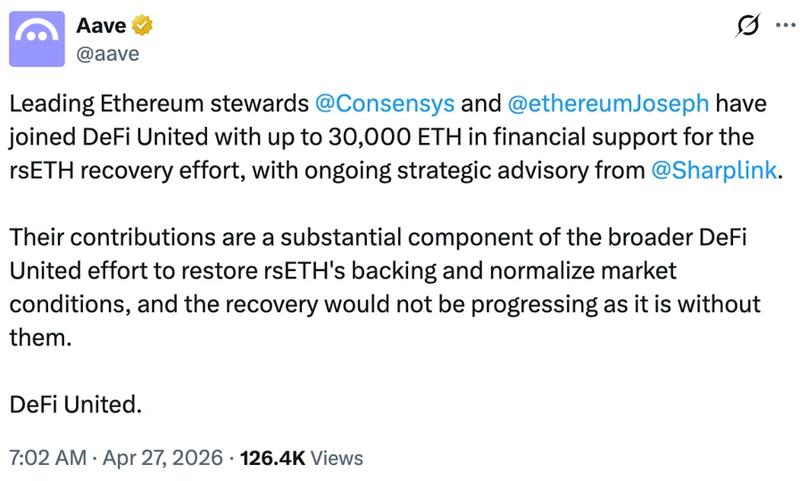
Consensys and Joe Lubin Lead 30,000 ETH Pledge for rsETH Restoration Following Bridge Hack
Ethereum co-founder Joe Lubin and Consensys pledge up to 30,000 ETH toward rsETH recovery initiative following a $290M bridge exploit that sent shockwaves through DeFi platforms.

Ethereum co-founder Joe Lubin along with Consensys have become part of DeFi United, pledging up to 30,000 ETH toward a restoration initiative designed to rebuild rsETH backing following a bridge exploit valued at $290 million that caused extensive disruptions throughout the DeFi landscape.
The program, spearheaded by members of Aave DAO, seeks to assist impacted users and bring stability to rsETH trading environments, though governance authorization remains under review across the protocols involved.
The allocated capital is designed to deliver immediate liquidity as governance procedures move forward, with a focus on minimizing disruption throughout DeFi platforms. Sharplink, an Ethereum treasury company that is publicly traded, has taken on an advisory capacity to assist in designing the restoration strategy.
Service providers to Aave DAO unveiled DeFi United on April 23, with contributing participants that include Lido, EtherFi, Ethena, Mantle and Frax, along with additional partners.
The restoration initiative comes in response to an April 18 exploit that siphoned approximately 116,500 rsETH, valued at around $290 million, from a bridge based on LayerZero technology and managed by Kelp DAO.
The security breach set off disruptions throughout the DeFi space, with numerous protocols suspending certain operations. Within Aave, the exploiter utilized rsETH as collateral to extract liquidity, leading to up to $200 million in bad debt and prompting the protocol to halt rsETH trading.
LayerZero Labs indicated that the exploit stemmed from a configuration problem in Kelp's implementation that depended on a single verification pathway for messages sent across chains.
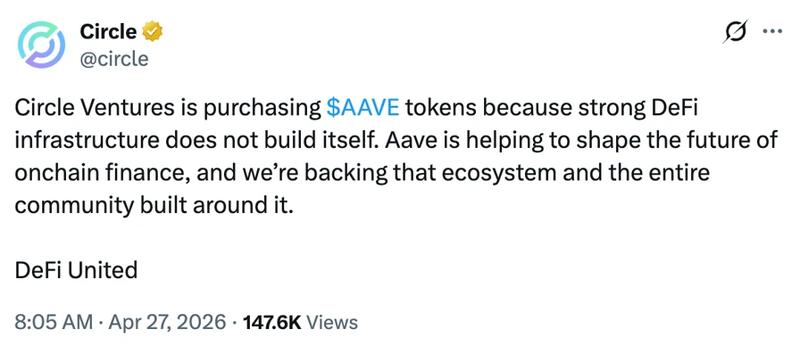
In a separate development, Circle announced Monday that its investment division is acquiring AAVE tokens to bolster the protocol and the wider DeFi ecosystem.
DeFi hacks surge in April
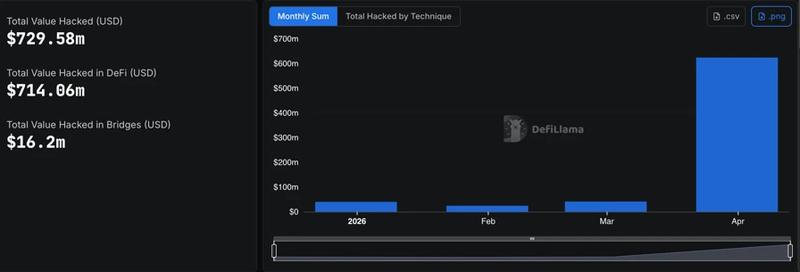
The security breach arrives during a period of escalating attacks aimed at DeFi platforms. Data from DefiLlama indicates that approximately $729 million has been stolen through crypto hacks during the past 90 days, with around $623 million of those losses occurring during April alone.
April's attacks commenced with an approximately $280 million exploit targeting Drift Protocol on April 1, executed via a social engineering attack by an exploiter believed to have connections to North Korea.
Two weeks following that incident, Rhea Finance reported that an attacker leveraged a vulnerability within its margin trading functionality to manipulate liquidity pools, causing approximately $7.6 million in losses, as documented by CertiK. The platform has since suspended operations and is currently executing a staged recovery, with the majority of funds retrieved and certain USDT amounts still frozen awaiting release by Tether.
The series of security breaches also encompasses smaller exploits that occurred earlier during the month, including a $410,000 loss suffered by Dango on April 13, a $392,000 oracle-related breach at Silo Finance on April 3 and a $423,000 access control exploit targeting Aethir on April 9.
Although none of the recent security breaches have been definitively connected to artificial intelligence, security researchers indicate that technological advancements are simplifying the process of discovering and exploiting weaknesses in DeFi platforms.
During late 2025, security researchers at Anthropic discovered that AI models possessed the capability to identify more than half of documented smart contract exploits, demonstrating how the technology might accelerate attacks in the future.
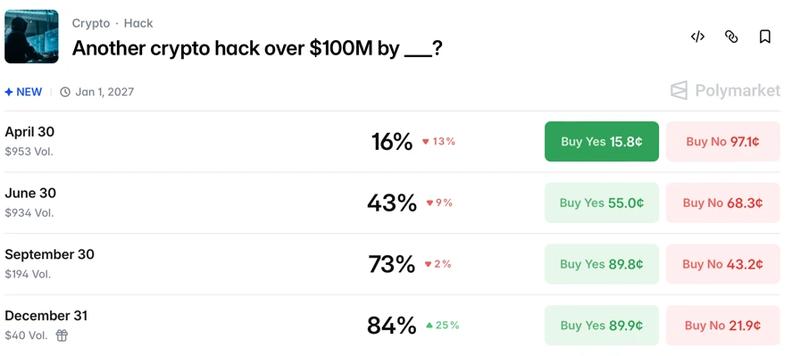
Information from Polymarket reveals traders are assigning a substantial probability to another significant crypto hack occurring this year, with likelihood standing at 84% by the conclusion of 2026.