
CFTC Challenges Four States, Real-World Assets Hit $30B Milestone: April Data Roundup
Four states face legal action from the US CFTC over prediction market enforcement, as French authorities move forward with charges against 88 individuals suspected of violent cryptocurrency extortion attempts.

Four states are now facing lawsuits from the US Commodity Futures Trading Commission (CFTC) after attempting to enforce gambling regulations at the state level against prediction market platforms.
This legal action arrives amid intense jurisdictional disputes between state authorities and platforms such as Kalshi, centered on determining which governmental body holds regulatory power over these "prediction" services. Several additional states have taken their own actions, including issuing cease-and-desist orders or filing lawsuits against these prediction market operators.
Strategy's Bitcoin holdings expanded by more than 56,000 units during the month. Among its most recent acquisitions in April, the company funded a purchase using proceeds from a $250 million offering of its common stock.
French law enforcement authorities have brought charges against 88 individuals suspected of conducting "wrench attacks" - violent attempts to forcibly extract cryptocurrency holdings from digital asset owners.
April's key statistics and developments:
US federal government sues four states for legal action on prediction markets
The CFTC initiated legal proceedings against New York state on April 24, seeking to prevent state authorities from enforcing gambling statutes against prediction platforms including Kalshi and Polymarket.
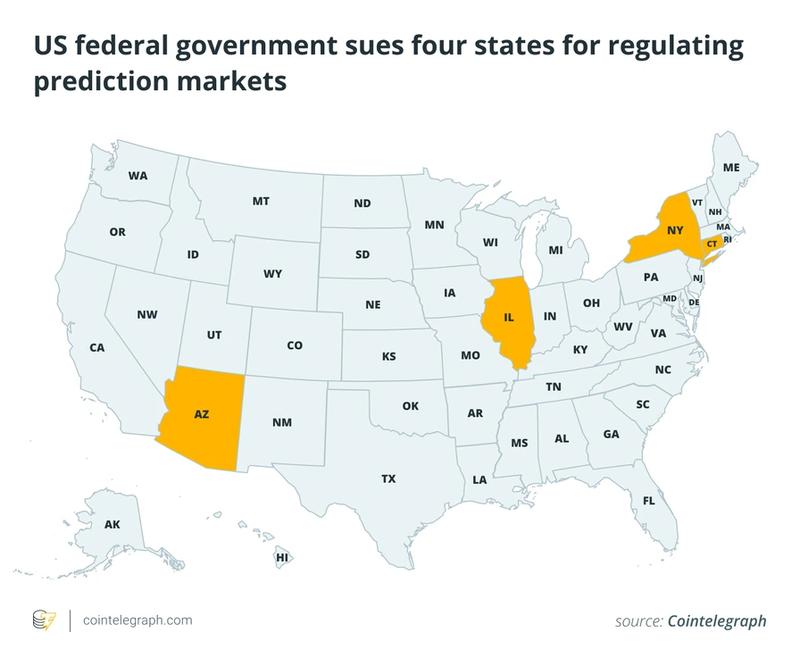
New York now stands alongside Connecticut, Arizona and Illinois as jurisdictions facing federal litigation that asserts the CFTC's exclusive regulatory jurisdiction over these prediction platforms.
Multiple states across the nation have undertaken efforts to regulate betting markets, specifically targeting Kalshi and similar platforms provided by Coinbase and Robinhood. State governments contend that these platforms function essentially as sportsbooks and should fall under gambling regulations, whereas the prediction market operators maintain they provide swap contract services that fall exclusively under CFTC oversight.
A New Jersey appellate court has sided with the CFTC's position and the prediction markets' legal interpretation. However, comparable litigation pending in Nevada may yield an opposite outcome, potentially setting up this jurisdictional question for Supreme Court review.
Strategy stacks 56,325 Bitcoin while STRC sits on sidelines
Throughout April, Strategy - the software enterprise turned Bitcoin acquisition vehicle under Michael Saylor's leadership - purchased 56,325 BTC.
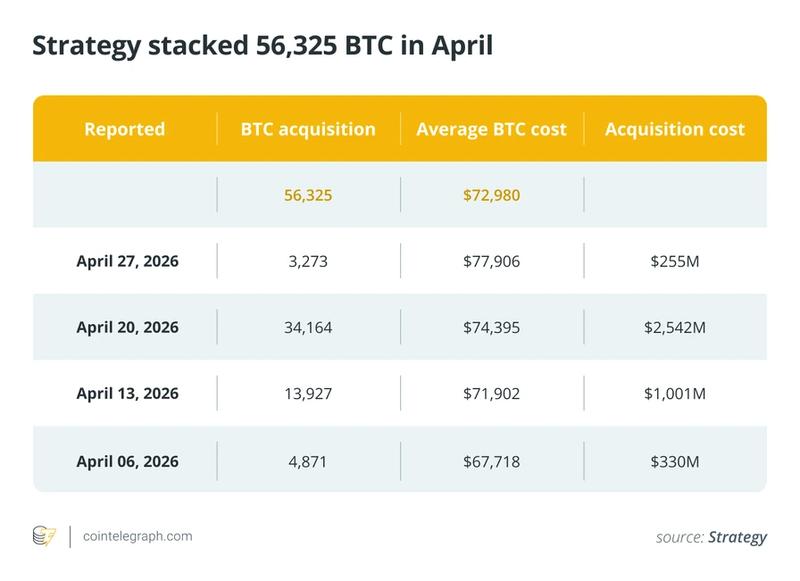
On Monday, the company acquired 3,273 BTC (approximately $249 million worth) funded by common stock (MSTR) sales. A filing submitted to the US Securities Exchange Commission reveals that Strategy divested 1,451,601 shares of Class A common stock and deployed the capital to acquire Bitcoin.
Notably absent from that particular filing was STRC, Strategy's perpetual preferred stock instrument. The company has grown progressively more dependent on this short-duration high-yield credit instrument for raising capital to fund Bitcoin acquisitions.
Following March's disappointing performance for Bitcoin, during which the company's BTC position temporarily showed unrealized losses, Strategy is now demonstrating nearly 1% gains on its Bitcoin portfolio as of Tuesday.
Global tokenized RWAs surpass $30 billion in distributed asset value
For the first time ever, the aggregate distributed asset value of tokenized real-world assets (RWAs) crossed the $30 billion threshold during April.
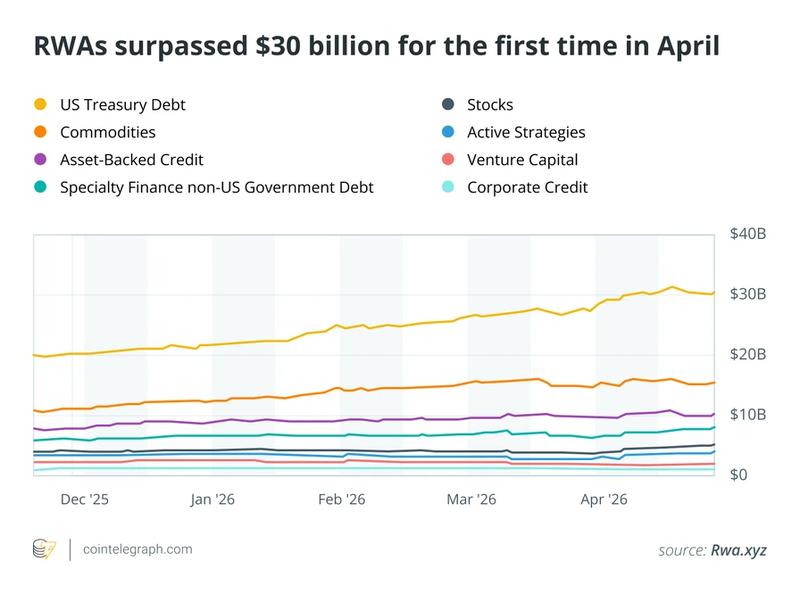
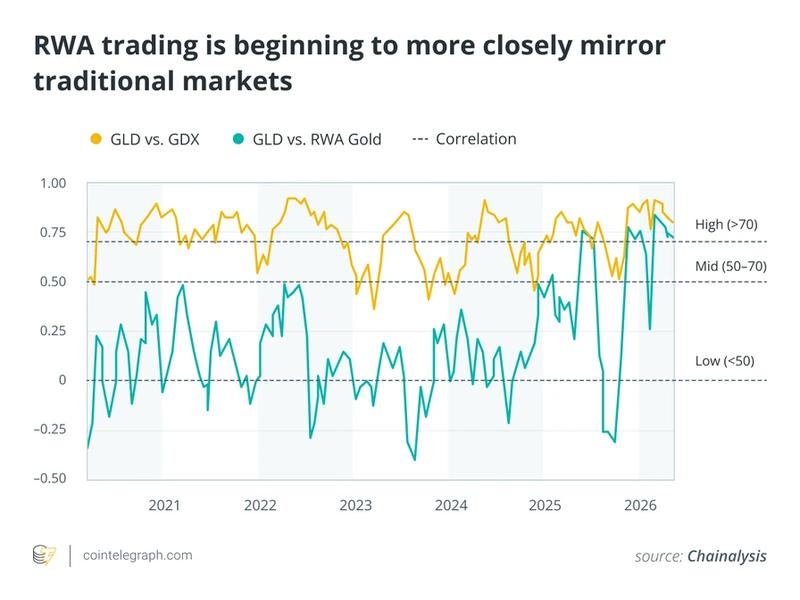
According to a Chainalysis analysis of this expanding market, institutional players experimenting with tokenized RWAs are now progressing beyond initial pilot phases and increasingly viewing blockchain infrastructure as a viable, practical implementation.
This heightened institutional involvement and market liquidity have resulted in RWA market trading behaviors that increasingly resemble traditional finance patterns, including reactions to indicators such as inflation data and geopolitical uncertainties.
Five wrench attacks in April, French prosecutors charge 88 suspects
Physical violence targeting cryptocurrency holders persists as a concerning trend, with five documented cases occurring in April. France was the location for four of these incidents, with England experiencing the fifth, based on data from Casa founder Jameson Lopp's tracking database.
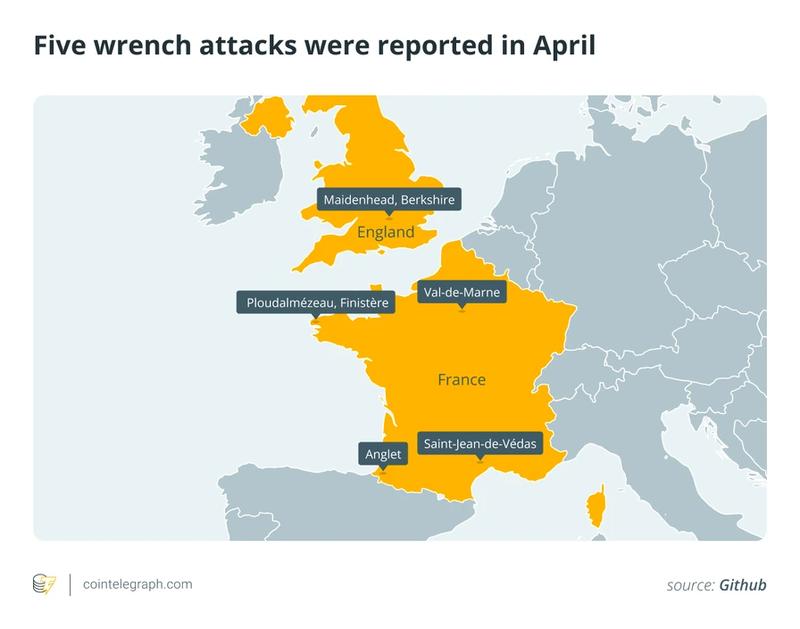
Growing prominence and public visibility of cryptocurrency traders and industry leaders has contributed to an uptick in abduction attempts and ransom-focused attacks targeting high-profile individuals within the sector.
France alone has reportedly witnessed 47 such attacks over the current year. An executive from Ledger, a crypto wallet company headquartered in France, attributes this phenomenon to legal requirements mandating that entrepreneurs publicly register their personal names and residential addresses.
French authorities have responded aggressively against perpetrators. The National Organized Crime Prosecutor's Office announced on April 24 that it had filed charges against 88 suspects spanning 12 federal districts.
Industry executives are allocating increased resources toward personal security measures, and specialized insurance providers have introduced kidnap and ransom coverage products responding to surging market demand.
Two US states now ban crypto kiosks, more move against Bitcoin ATMs
Responding to concerns about fraudulent schemes and money laundering activities, US states have intensified enforcement actions against cryptocurrency ATMs and kiosks. Tennessee joined this trend in April, becoming the second state to implement a complete prohibition.
Tennessee Governor Bill Lee signed House Bill 2505 into law on April 13, establishing cryptocurrency kiosk installation as a Class A misdemeanor offense.
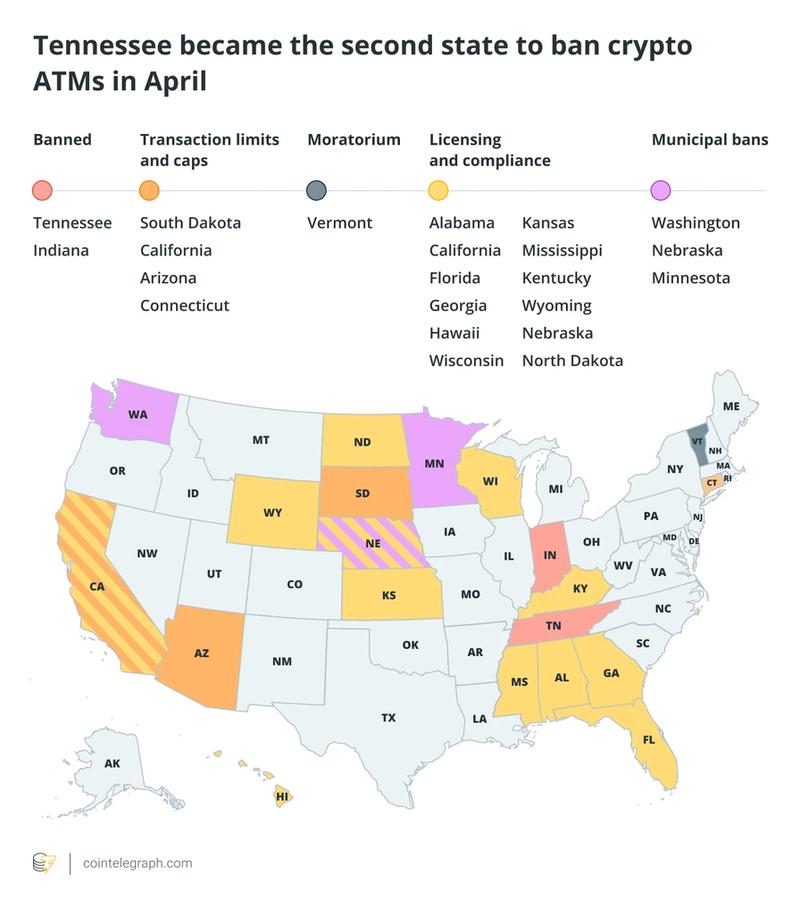
Data from Coin ATM Radar indicates 560 cryptocurrency ATMs currently operate within the state. Machine operators and host businesses must deactivate and remove these devices by July 1, or risk facing penalties including up to 11 months and 29 days of incarceration plus a $2,500 monetary fine.
Indiana previously enacted a crypto ATM ban last month. Numerous additional states have implemented stringent licensing mandates and regulatory frameworks. Vermont has established a temporary moratorium on cryptocurrency kiosks, while many municipalities have passed local ordinances banning these machines.
The American Association of Retired People has been especially vocal in supporting and advocating for enhanced regulatory controls, pointing to the widespread use of these kiosks in fraudulent schemes that disproportionately victimize elderly individuals.