
Capital Market Access, Not Bitcoin Volatility, Powers Strategy's $66B Crypto Engine: Analysis
The company's primary vulnerability isn't Bitcoin price volatility but rather maintaining capital market access needed to cover $1.76 billion in yearly financial commitments.

A dramatic cryptocurrency market downturn may pose less of a threat to Strategy's Bitcoin treasury than an extended period without access to capital markets, which could jeopardize the firm's capacity to finance approximately $1.76 billion in yearly commitments without liquidating Bitcoin assets, based on a new assessment from Regime Intelligence.
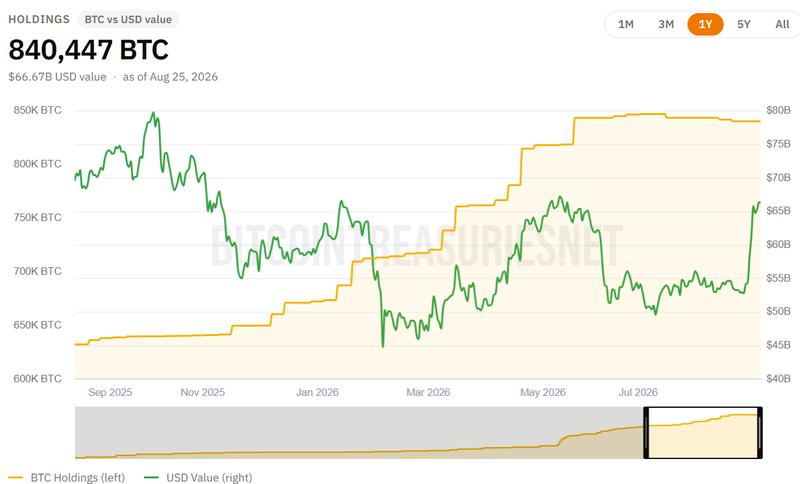
The analysis reveals that Strategy's holdings of 840,447 BTC are subordinate to approximately $22 billion in debt and senior claims, indicating the corporation's Bitcoin acquisition strategy hinges on maintaining the capacity to continuously secure new capital for meeting financial obligations.
Despite common assumptions, the primary weakness facing Strategy (MSTR) isn't exposure to Bitcoin price volatility or a liquidity crisis, but rather its ongoing reliance on capital market accessibility. The analysis highlighted that Strategy's debt structure differs from a traditional Bitcoin-collateralized margin loan, lacking any BTC-linked margin call mechanism that would compel asset liquidation during price declines.
The stress testing conducted by Regime Intelligence demonstrated that Bitcoin's price would require an approximately 96% collapse before Strategy's Bitcoin assets and reserves became insufficient to cover its convertible debt obligations. That said, this transfers the vulnerability to the opposite side of the financial statement, given that Strategy is obligated to service approximately $1.76 billion annually in preferred dividends and interest payments irrespective of Bitcoin's market value.
In my opinion, MSTR's principal challenge is to keep the flywheel running in order to cover the annual debt and preferred charges,
Sherif Saad, report author, told Cointelegraph
According to his assessment, investors should monitor Strategy's preferred stock valuation and liquid reserves, which presently provide coverage of approximately 2.6 times the company's annualized financial charges.
Should capital-raising conditions worsen, the company's Bitcoin acquisition model might shift into reverse, necessitating increased dependence on reserve funds and Bitcoin asset sales to satisfy financial commitments.
During a prolonged BTC decline, the problem becomes more serious if MSTR's share price and mNAV decline at the same time,
according to his statement, further noting that securing capital would subsequently become "progressively more difficult or expensive."
Michael Saylor's juggling act
A significant portion of the risk perception regarding Strategy revolves around the company's readiness to utilize the Bitcoin holdings on its financial statements, particularly given that executive chairman Michael Saylor had long championed a "never-sell" philosophy. Therefore, it caught many Bitcoin enthusiasts off guard when Strategy initiated Bitcoin sales this year to address its other corporate responsibilities.
Since May, the firm has executed Bitcoin sales on four occasions, including a most recent transaction involving 1,690 BTC, with revenues from these recent disposals allocated toward funding preferred shareholder dividends, stock buyback programs and its expanding US dollar cash reserve.
Notwithstanding these disposals, Strategy CEO Phong Le emphasized to investors that the firm has purchased "about 25 times more" Bitcoin compared to what it has divested throughout this year. During a CNBC interview earlier this month, he indicated that the company intends to restart its Bitcoin acquisition activities later this year.