
BTC's struggle to reclaim $70K persists amid data revealing trader reluctance toward bullish bets
Inflation worries continue to dampen Bitcoin's rally attempts as market participants decline to open bullish positions, even after a 4% price recovery on Monday.

Key takeaways:
- Pessimistic Bitcoin futures premiums combined with minimal call option probabilities indicate market participants remain doubtful even after BTC's temporary 4% recovery bounce.
- Elevated oil prices alongside measured Fed policy persist in applying pressure to risk assets, as Bitcoin derivatives data reveal insufficient confidence levels.
Bitcoin (BTC) experienced a rapid 4% increase within moments of US President Donald Trump declaring his plans to temporarily reduce tensions with Iran and engage in diplomatic negotiations. Although oil prices promptly dropped 14% down to $85 per WTI barrel and the S&P 500 rose 3%, Bitcoin derivatives data persisted in showing skepticism and insufficient confidence regarding the $68,000 support threshold.
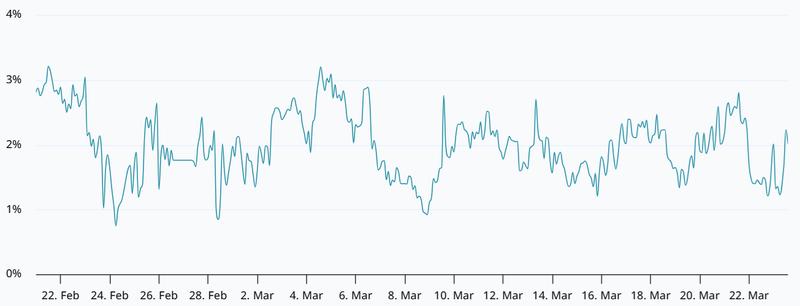
Bitcoin futures demonstrated a 2% annualized premium when compared to conventional spot markets on Monday, revealing insufficient demand for leveraged bullish positions. During neutral market conditions, this metric usually fluctuates between 4% and 8% as compensation for extended settlement timeframes. This absence of conviction among bullish traders has persisted throughout the previous month, including during a recent price surge approaching $76,000 on Tuesday.
Brief positive momentum unable to counterbalance five months of Bitcoin losses
Temporary favorable developments concerning the US and Israel-Iran war are improbable to eliminate the negative sentiment that followed a five-month downward price trend. Since the precise triggers behind Bitcoin's Oct. 10, 2025, flash crash and its subsequent inability to correlate with traditional markets stay unverified, market participants view any new developments with considerable doubt.
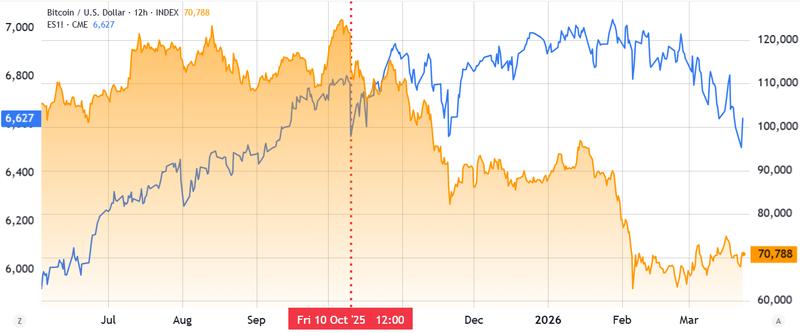
This substantial market sell-off transpired concurrently with increasing US import tariffs, which included a 100% levy imposed on Chinese goods following China's restrictions on rare earth metal exports. Nevertheless, the exceptional $19 billion in liquidations inflicted the most severe damage, generating substantial losses for market makers and traders who employed cross-margin positions.
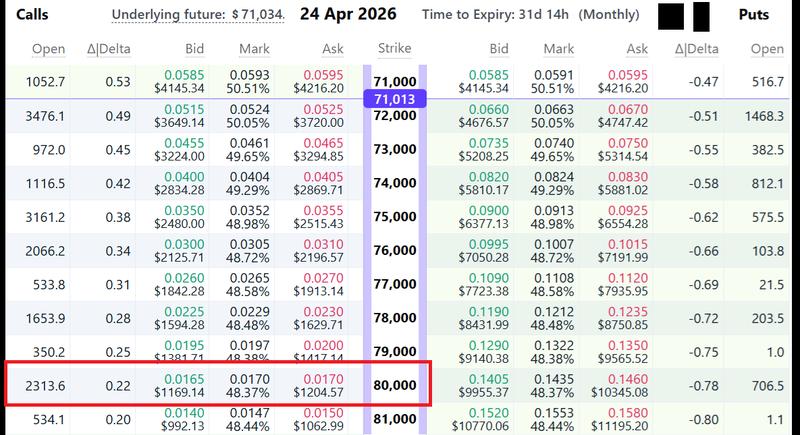
On the Deribit exchange, the $80,000 Bitcoin call option with an April 24 expiration was trading at 0.017 BTC ($1,207). Given 31 days remaining until expiration and an implied volatility of 48%, the market assigns merely a 20% probability of Bitcoin achieving $80,000. This minimal expectation for a 13% monthly price increase is uncommon in cryptocurrency markets, where market participants typically exhibit greater optimism.
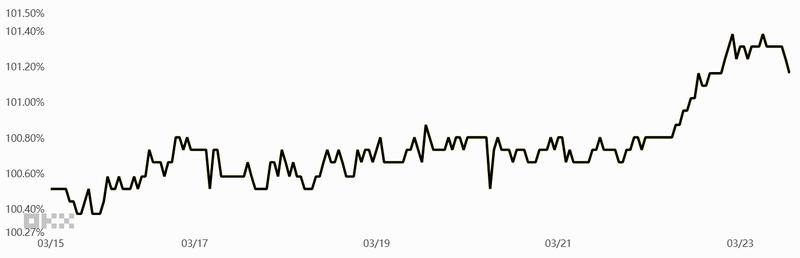
USD stablecoins exhibited a 1.3% premium relative to the official US dollar to yuan exchange rate on Monday, suggesting that there isn't a specific imbalance between purchasing and selling demand within the region. Under normal circumstances, elevated demand for cryptocurrency drives this premium beyond the 1.5% neutral range, whereas panic selling results in stablecoins trading at a discount.
Federal Reserve's decision to halt rate cuts maintains investors in fixed-income
The data reveals that there exists moderate resilience within Bitcoin derivative markets, particularly since BTC retested the $67,500 price level on Monday. Gold's unprecedented 21% price decline spanning ten days demonstrated that no asset class remains protected when traders harbor concerns about an economic recession and inflationary threats, particularly as fuel prices affect logistics and virtually every sector of the US economy.
Monday's 3% relief bounce experienced by the S&P 500 is improbable to prompt investors to abandon fixed-income positions, particularly as the Fed offered minimal indication of resuming its monetary easing policy. Elevated interest rates diminish incentives for consumer financing and generate a burden for corporate capital costs.
There exists unquestionably a substantial dependence on the war's duration for risk assets, which includes Bitcoin. Unless oil prices return to $75 or below, the likelihood is that traders will proceed with caution, though additional catalysts might need to surface for Bitcoin traders to adopt a bullish stance, particularly given the ongoing lack of conviction evident in onchain and derivatives metrics.