
BTC's $80K breakthrough nears short-term holder profitability threshold, support flip crucial
Markets showed euphoric sentiment as Bitcoin surged past the $80,000 mark, though breaking through the cost basis of short-term holders remains essential for confirming the bullish trajectory.

On Monday, Bitcoin (BTC) hit a fresh three-month peak at $80,500, marking its first test of this price point since Jan. 31. The surge beyond $80,000 positions the asset just beneath the short-term holders' cost basis sitting at $81,486, which represents the subsequent dynamic resistance threshold. To sustain the upward momentum, achieving a daily close above this critical level becomes essential for establishing $80,000 as a solid support zone.
Breaking through $81,500 could confirm the trajectory
The Bitcoin surge toward $80,000 has positioned the asset immediately beneath the realized price of short-term holders at $81,486. This particular metric represents the mean cost of coins that have been transacted within the previous 155 days and serves as an indicator of where recent purchasers transition from underwater positions to profitability.
Achieving a daily close beyond $81,500 would restore profitability for these holders and diminish selling pressure. Based on insights from crypto analyst Crazyyblockk, the losses experienced by short-term holders have contracted to approximately -2.17%, demonstrating that the overhead supply band is becoming thinner. The long-term holders (LTHs) maintain positions near +27% profit and are refraining from aggressive distribution.
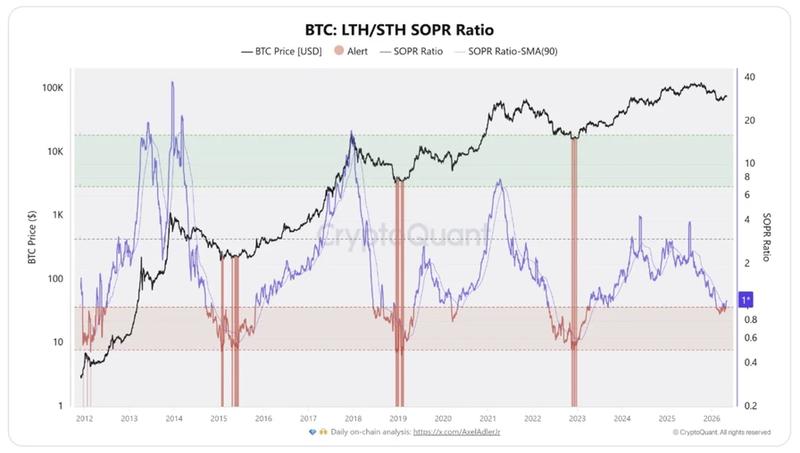
The spent-output profit ratio (SOPR), a metric that monitors whether coins are transferred at a profit or loss, has risen to 1.097 from 0.99. This movement suggests that coins are once again being transferred profitably, with long-term holders driving this trend.
The exchange inflow metrics correspond with this transition. Approximately 97.2% of recent exchange deposits originated from short-term holders, with wallet addresses containing 1 to 1,000 BTC accounting for roughly 58%.
BTC inflows reached their peak at 35,649 BTC on April 24 before declining to 3,895 BTC by May 3. This contraction diminishes immediate selling pressure and strengthens the argument for maintaining support at $80,000 once the cost basis successfully flips.
Exchange supply for BTC accumulates beneath $80,000
BTC exchange flow metrics monitored by Bitcoin researcher Axel Adler Jr reveal 8,512 BTC in net inflows throughout recent days, featuring notable spikes on April 27 and April 30. The price successfully absorbed this supply without experiencing a significant downward move, indicating robust BTC demand.
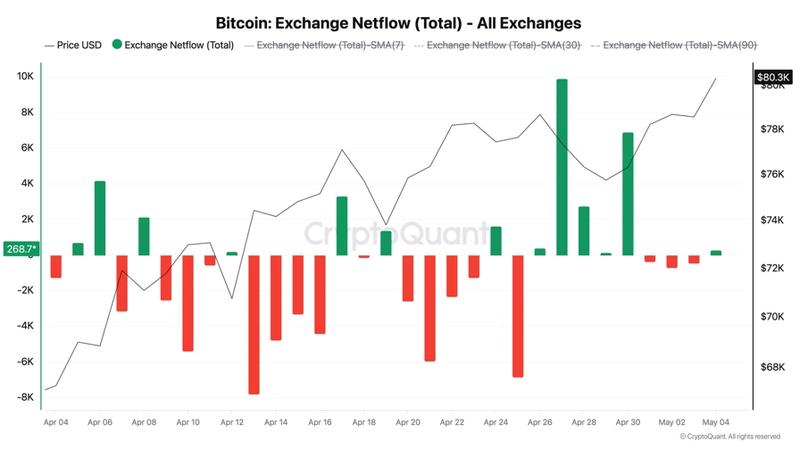
The BTC flows have subsequently moderated to nearly neutral levels at 269 BTC spanning May 1 through May 3. The short-term moving averages remain positive, whereas the longer-term moving averages hover near zero, constraining the movement to a brief impulse.
BTC exchange reserves grew by 5,773 BTC on a week-over-week basis to reach 2,685,541 BTC, before experiencing a slight decline following April 30. Adler Jr clarified that these coins are presently residing on exchanges without experiencing aggressive liquidation, creating a supply overhang that could transform into downward pressure should demand weaken.
In related observations, crypto trader Ardi pointed out that BTC is currently retesting breakout liquidity in the vicinity of $79,600. The trader noted that maintaining this price level preserves the upward movement toward the subsequent supply zone positioned near $84,000.
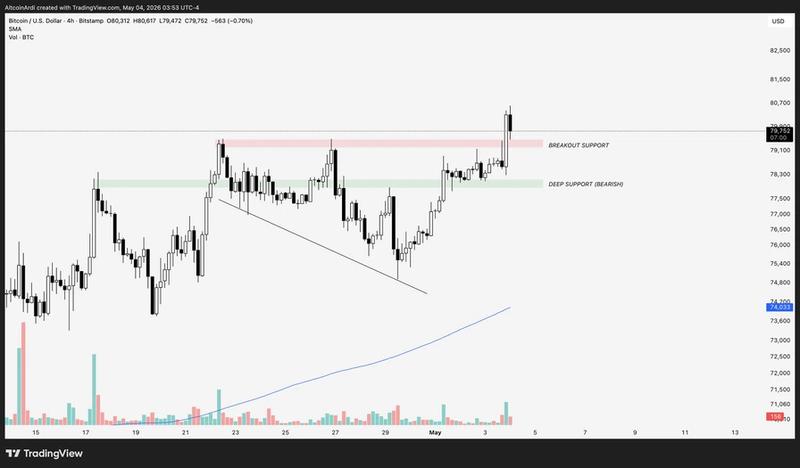
A collapse beneath $80,000 would redirect attention to the new-money cost basis positioned near $76,500 and would elevate the probability of a failed breakout scenario.