BTC Rally Loses Steam as Bitcoin 'Fresh Capital' Inflows Approach $5B Monthly
Data from Glassnode reveals that Bitcoin's realized cap increase during the 30-day period ending Oct. 5 was driven primarily by current holders rather than new capital injections.

Analysis suggests that Bitcoin (BTC) price increases have yet to demonstrate sufficient new capital flowing into the market.
Key points:
- On Oct. 5, the 30-day rolling cumulative inflows of "fresh capital" into Bitcoin hit $4.9 billion, according to Glassnode data.
- Current investors were responsible for approximately three-fifths of the $12.8 billion increase in realized cap during that timeframe.
- Profit-taking by short-term holders represented more than 80% of sales above the $85,000 price level.
Realized cap expansion not driven by Bitcoin capital inflows
Inflows of "fresh capital" into Bitcoin — including purchases by corporate treasuries, "growth in stablecoins" and capital flowing into US spot Bitcoin exchange-traded funds (ETFs) — amounted to approximately $4.9 billion during the 30-day window ending Oct. 5.
During the identical timeframe, Bitcoin's realized cap, which assigns value to each coin based on its last onchain movement price, experienced growth of $12.8 billion, representing more than double the inflow amount.
"Fresh capital therefore accounts for less than two fifths of that increase. The remaining portion represents coins transferring between hands at elevated prices among capital already circulating in the market," Glassnode noted.
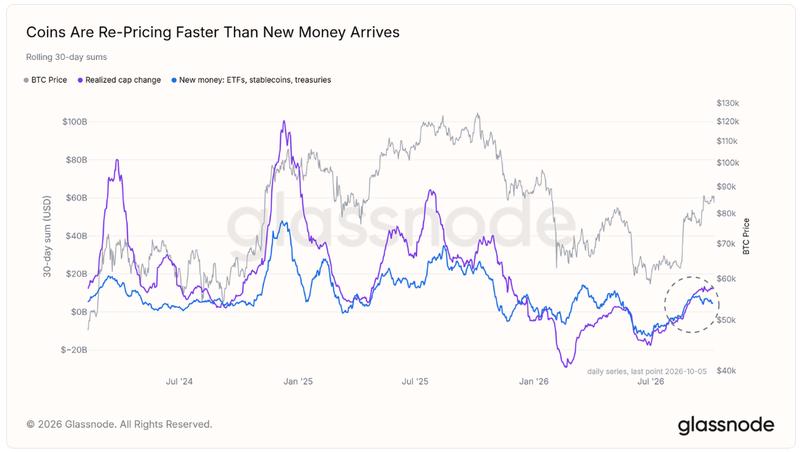
Supporting data demonstrates that recent upward movements in BTC/USD have exhibited the identical divergence pattern since the ETF products launched in January 2024. At present, however, the situation differs, with inflows remaining relatively modest when compared to short-term gains in realized cap.
"The upward price movements of 2024 and 2025 demonstrated a comparable mixture, but with significantly larger inflow volumes," Glassnode stated.
"Until those inflows pick up, the move depends on existing holders paying more."
Recent investor profit-taking spiked at $85,000 level
Beginning Sept. 21, Bitcoin has made four separate attempts to climb beyond $87,000. All of these efforts were unsuccessful as purchasing pressure encountered increasingly dense overhead ask liquidity present on exchange order books. At the time of writing on Thursday, BTC/USD was trading around $83,000, reflecting a 1% decline month-to-date.
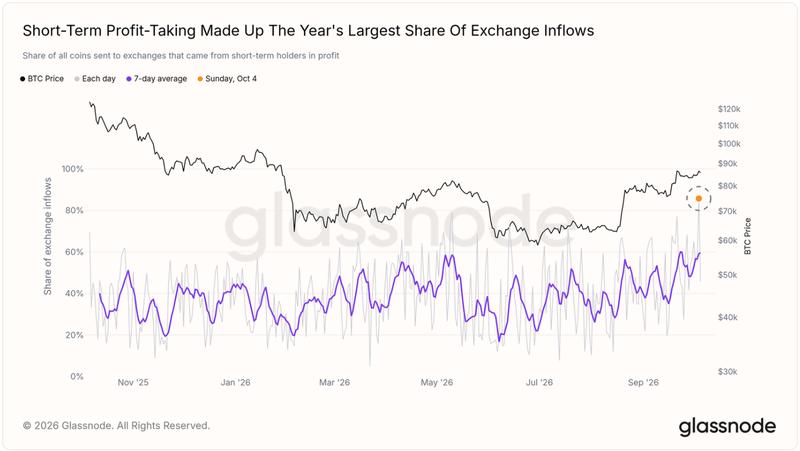
Further, Glassnode highlighted elevated profit-taking activity among newer buyers throughout the weekend, coinciding with Bitcoin's first weekly closing price above $85,000 since January.
"Among all the coins transferred to exchanges on that particular day, approximately 86% originated from short-term holders, defined as those maintaining positions for less than 155 days, moving coins at profitable prices. This represents the highest proportion recorded on any single day over the past year; typically, this figure remains below two fifths," the analysis stated.
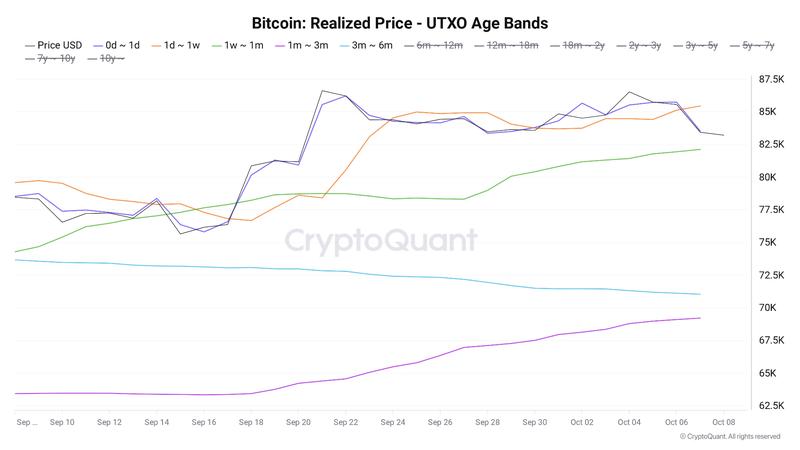
Short-term holders are conventionally regarded as being more reactive to price fluctuations. This cohort continues to maintain net profit positions, with its collective cost basis, alternatively referred to as realized price, still positioned around $78,250 as of Oct. 7, based on data from CryptoQuant.