BTC faces mounting pressure as ongoing conflict drives investors away from crypto and equities
BTC continues to struggle with volatility while exchange-traded funds tracking Bitcoin and stocks witness massive withdrawals amid fourth week of US-Israel-Iran conflict.
Following what appeared to be a promising beginning to the trading week, Bitcoin (BTC) has experienced a decline approaching 5%, moving in tandem with major indices including the S&P 500, DOW, Nasdaq, and even Gold. In contrast, Crude oil has demonstrated strength, climbing 7.30% and registering a remarkable 53% gain since hostilities between the US and Israel–Iran commenced on Feb. 28.
This widespread market deterioration underscores a systematic reallocation of capital as Middle Eastern hostilities persist, with escalating withdrawals from exchange-traded funds (ETFs) tracking the S&P 500 and Nasdaq 100 providing additional evidence of investors' move toward risk reduction.
Capital exodus takes place across all investment markets
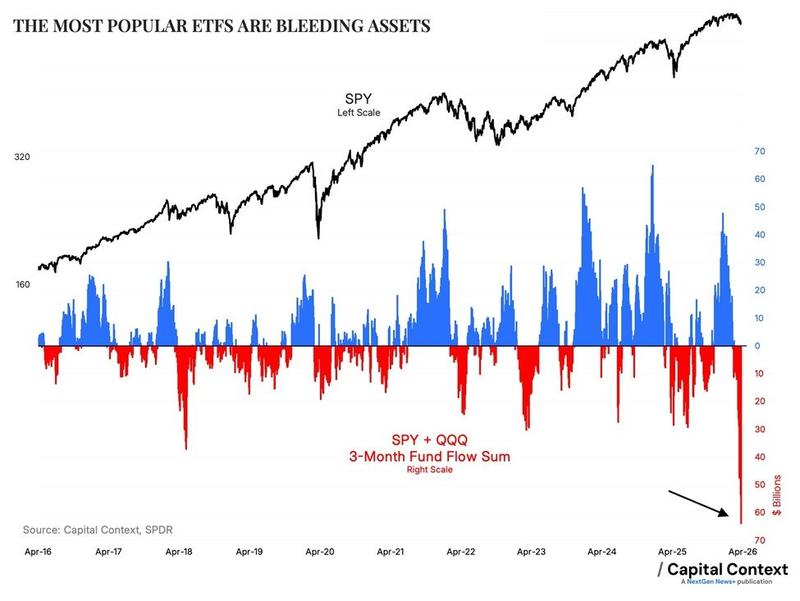
According to The Kobeissi Letter, a substantial $64 billion has been withdrawn from the S&P 500 (SPX) ETF and Nasdaq 100 ETF (QQQ) throughout the previous three-month period, establishing an unprecedented record.
This development stands in stark contrast to the $50 billion of inflows observed during November and elevates total outflows to represent 5% of assets under management.
Exchange-traded funds focused on spot Bitcoin exhibited similar patterns to the wider marketplace, documenting $253 million in withdrawals across the most recent two-day span.
Despite monthly ETF flows maintaining a positive position at $1.48 billion, this figure must be viewed within the context of $6.3 billion in aggregate outflows spanning the November through February timeframe, revealing a tenuous revival in investor appetite.
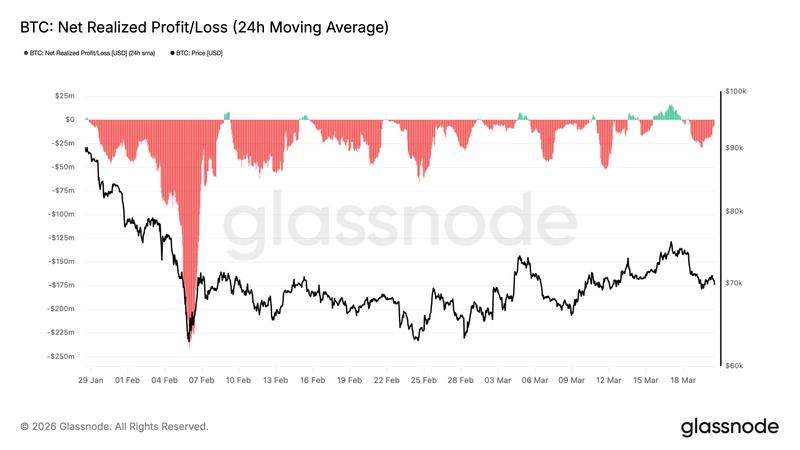
Analysis from Glassnode indicates that market participants are finding it challenging to handle the selling dynamics. The net realized profit-taking experienced a brief surge to approximately $17 million per hour (calculated as a 24-hour average) before losing steam, following which BTC's value retreated beneath the $70,000 threshold. Glassnode added,
"Broader geopolitical uncertainty appears to be compressing demand depth, limiting the market's capacity to absorb even moderate realization events."
War-influenced market cycles shape BTC price action
Traders and investors are positioning Bitcoin's current trajectory within the framework of historical geopolitical conflicts, identifying similarities between the ongoing US and Israel–Iran war and the Russia-Ukraine conflict that unfolded in 2022.
In a notable coincidence occurring in February separated by four years, crypto analyst Carlitosway highlighted that subsequent to Russia's military action against Ukraine on February 24, 2022, Bitcoin experienced an initial selloff before generating a 24% recovery bounce throughout the subsequent four-week period. This upward momentum proved short-lived, however, as BTC proceeded to decline an additional 64% by November 2022.
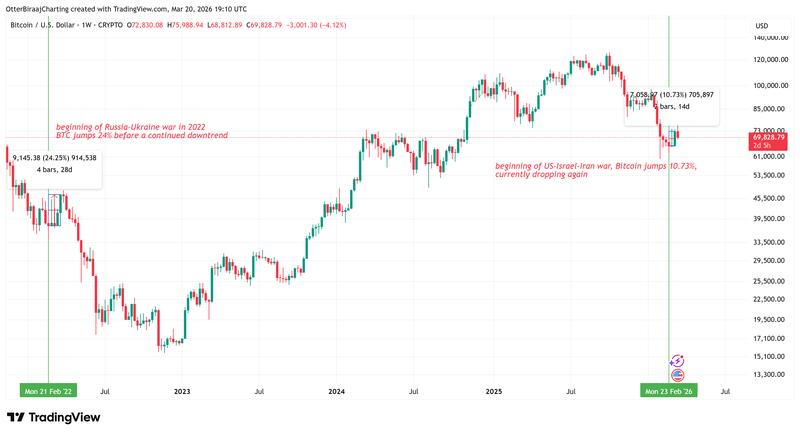
A comparable pattern is materializing during the current month, with BTC achieving a rally of nearly 10% at its peak last week following the war's commencement, though this momentum is currently experiencing deceleration.
Carlitosway attributed this vulnerability to ongoing liquidity constraints, escalating energy prices, and persistent forced liquidations throughout stress periods, all contributing factors that diminish the follow-through demand for Bitcoin.
This emerging pattern suggests a more prolonged consolidation period, during which recovery efforts may require additional time as capital gradually rebuilds and selling pressure eventually dissipates.
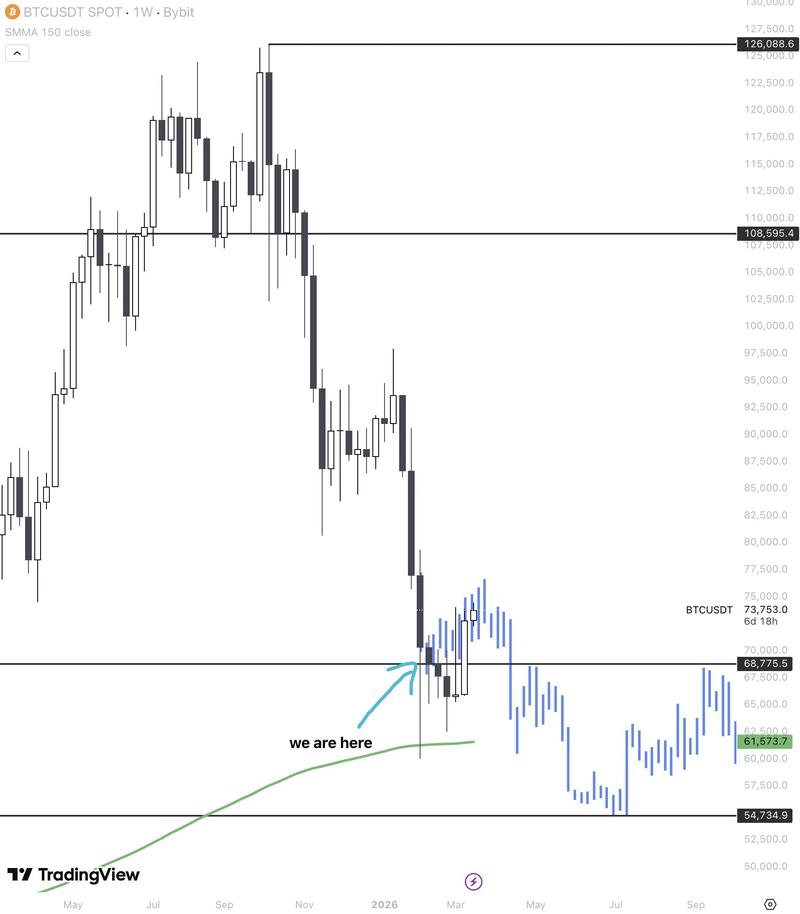
Market analyst Finish expressed the view that Bitcoin's recovery trajectory could potentially materialize following a price bottom in the vicinity of $55,000. The analyst added,
"I frankly think that until the Iran war is settled, it's gonna be hard for $BTC to rise. The environment is risk off, the SPX lost trillions in capitalisation, which leads me to a more neutral stance."