
Boundless Partners with XRP Ledger to Deliver Enterprise-Level Privacy Solutions for Public Blockchain Networks
The XRP Ledger is incorporating Boundless' zero-knowledge technology directly into its foundation layer, joining the competition to provide financial institutions with private blockchain transactions while maintaining compliance transparency.

Ripple's blockchain payment network, which operates on the XRP Ledger (XRPL), has partnered with Boundless, a provider of zero-knowledge infrastructure solutions, to enable financial institutions and asset management firms to conduct private yet regulatory-compliant transactions natively on the platform, according to a Tuesday announcement exclusively shared with Cointelegraph.
In an interview with Cointelegraph, Boundless chief executive Shiv Shankar explained that the architecture is designed to conceal sensitive information such as transaction amounts, trading frequency and involved parties from public scrutiny, while simultaneously permitting regulatory bodies to examine operations through selective disclosure mechanisms and role-based access control systems.
The integration of Boundless' technology is designed to support numerous institutional applications that have traditionally proven difficult to execute on completely transparent distributed ledgers. These applications encompass international business-to-business payment transfers, corporate treasury and capital allocation management, off-exchange trading positions, the creation of tokenized assets, and decentralized trading platform or lending protocol operations, where trade execution flow and market positions are extremely confidential, Shankar stated.
When it comes to public blockchain networks, this balance between openness and privacy has emerged as a fundamental obstacle to widespread institutional acceptance, given that financial institutions and asset management companies need to safeguard their trading methodologies and customer operations while simultaneously maintaining alignment with regulatory supervision requirements.
This strategic decision places XRPL at the forefront of an intensifying contest to provide enterprise-grade privacy features on public blockchain infrastructure, as traditional financial institutions work to circumvent what Shankar characterized as the "transparency tax" associated with completely visible blockchain-based operations.
Competitive landscape for privacy solutions grows with ZK and FHE technologies
During March, cryptographic technology firm Zama incorporated its fully homomorphic encryption (FHE) framework with institutional tokenization infrastructure provider T-REX, marketing its solution as a privacy mechanism for ERC-3643 compliant securities (financial instruments in token form that incorporate regulatory compliance requirements within the token framework) on forthcoming T-REX public blockchain networks.
Alternative initiatives are relying on varied implementations of zero-knowledge cryptographic methods, including zkSync's Prividium platform, which seeks to connect private institutional transaction execution to Ethereum through ZK proofs while maintaining original transaction information away from public observation.
According to Shankar, initiatives such as zkSync necessitate that financial institutions establish their own layer-2 solutions, which demands increased capital investment and operational complexity. By comparison, Boundless implements its solutions through smart contract deployment, which he indicated enables institutions to "stay where the liquidity is" (on Ethereum), and "gain more flexibility on where they deploy their products."
Shankar explained that the architectural approach seeks to mirror the controlled disclosure mechanisms found in conventional financial systems within a blockchain setting, instead of compelling institutions to make a binary choice between maintaining privacy and ensuring regulatory compliance.
Privacy evolves from optional capability to fundamental infrastructure component
The deployment underscores how privacy capabilities are transitioning into essential elements of foundational blockchain layers and tokenization platforms instead of remaining an elective enhancement.
The market for tokenized assets achieved a valuation of $29.25 billion during April 2026, representing a monthly increase of 7.9%, based on statistics from RWA.xyz.
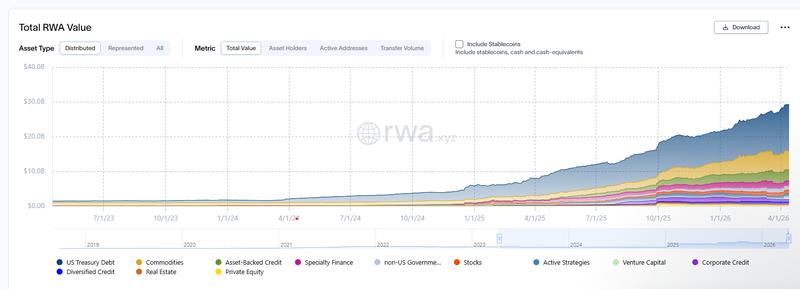
With an increasing volume of tangible real-world assets transitioning to blockchain platforms and established financial entities conducting trials with tokenized investment vehicles, bank deposits and regulated securities, blockchain networks face escalating demands to support both institutional confidentiality requirements and regulatory examination capabilities.