
Blockchain Analytics Firm: CARF Framework Captures Just 14% of $457B Taxable Crypto
According to the blockchain analytics company, only 14% of onchain crypto activity identified falls within the scope of the OECD's global tax-reporting framework for cryptocurrencies.

A recent Chainalysis analysis reveals that potentially taxable cryptocurrency activity conducted onchain amounted to no less than $457 billion worldwide in 2025, yet global reporting frameworks may only account for a small portion of these transactions.
The United States represented approximately $112.6 billion of this figure, with the North American region claiming the top spot at $134.6 billion in total, while the European Union followed closely behind with $125.1 billion.
These calculations encompass realized capital gains, earnings derived from operations like mining, staking and lending activities, along with payments made in cryptocurrency across six primary blockchain networks, though they do not include trading or other transactions that take place within centralized cryptocurrency exchanges.
According to Chainalysis, only 14% of the potentially taxable onchain activity they tracked falls under the purview of the Organisation for Economic Co-operation and Development's (OECD) Crypto-Asset Reporting Framework (CARF). The other 86% encompasses operations on decentralized exchanges, person-to-person transfers, onchain revenue streams and payment transactions.
The OECD created CARF in 2022, establishing requirements for designated crypto service providers to submit customer transaction information to relevant tax authorities.
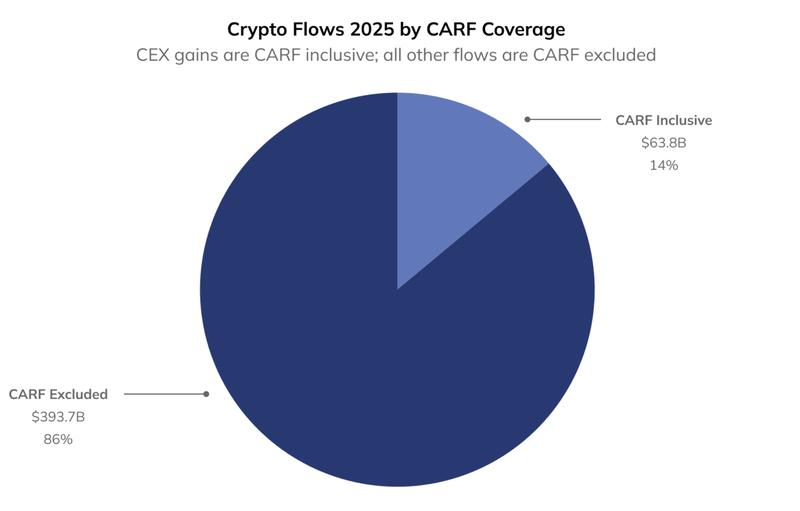
CARF's limits on onchain tax reporting
The collection of CARF data commenced on Jan. 1, 2026, across 48 different jurisdictions, including both the United Kingdom and the European Union, mandating that covered cryptocurrency platforms gather additional information regarding customers and their tax residency status.
The CARF framework requires crypto providers falling within its scope to gather customer information and tax residency details, then report transactional data to their respective domestic tax authorities, enabling cross-border information exchange between countries.
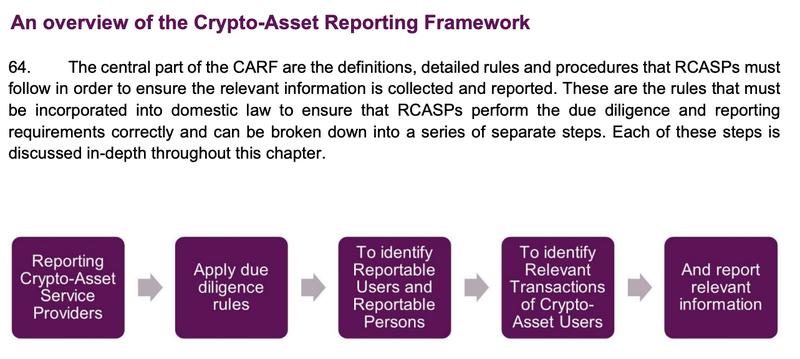
The gaps identified by Chainalysis can be largely attributed to CARF's emphasis on cryptocurrency intermediaries. In January, Colby Mangels, a former OECD adviser who contributed to CARF's development, explained to Cointelegraph that the framework's architecture centered on intermediaries who facilitate cryptocurrency transactions in a professional capacity.
As a result, a significant portion of decentralized finance activity exists beyond the reporting framework's boundaries, given the frequent absence of centralized operators or custodial relationships upon which reporting obligations could be imposed.
This landscape may evolve as regulatory bodies craft regulations for decentralized platforms. According to Mangels, tax authorities are closely monitoring developments in anti-money laundering regulatory efforts, including initiatives to establish when DeFi platforms or those who operate them should be classified as regulated cryptocurrency service providers.