
Bitcoin's Quantum Computing Concerns Already Reflected in Price, According to Bernstein
According to Bernstein analysts, the recent Bitcoin price decline has already factored in quantum computing risks, while developers maintain sufficient time to implement post-quantum security measures.

In a Monday analysis, Bernstein asserted that the recent Bitcoin price decline has incorporated the market's quantum computing anxieties, contending that while the threat poses legitimate concerns, it remains controllable and does not represent an immediate crisis scenario.
The nearly 50% decline in Bitcoin's (BTC) value from its October 2025 peak of $126,198 serves as evidence that market participants have already "priced in" multiple risks associated with quantum computing breakthroughs, Bernstein stated in their Monday research note provided to Cointelegraph. This adjustment occurred partly due to advancements in zero-knowledge privacy technology and quantum-resistant cryptographic solutions that serve to "counterbalance" the rapid progress in artificial intelligence and quantum computing capabilities.
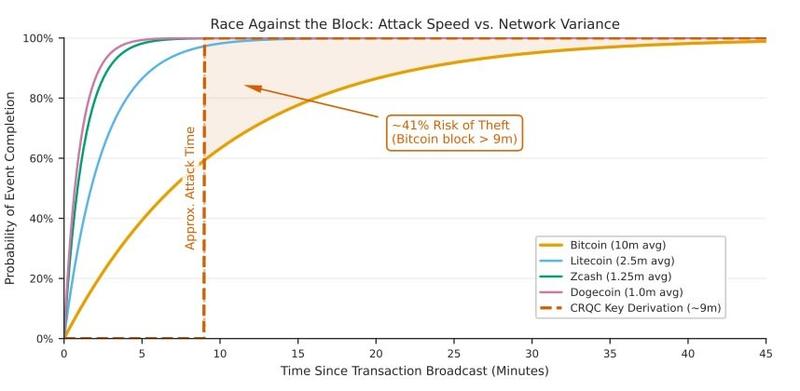
The research note emerged approximately two weeks following an announcement from Google's research team indicating that next-generation quantum computers might be capable of compromising the elliptic-curve cryptography employed by numerous blockchain networks using fewer than 500,000 physical qubits under certain architectural configurations, reigniting discussions regarding the urgency of implementing a post-quantum security pathway for Bitcoin. The Google research presented a theoretical scenario wherein a quantum computer could compromise a Bitcoin private key within a nine-minute timeframe, which falls short of Bitcoin's typical 10-minute block generation interval.
Nevertheless, Bernstein's analysis concluded that Bitcoin's core development team possesses "adequate time" to establish a post-quantum security framework. In their previous week's forecast, Bernstein estimated that Bitcoin has approximately three to five years available to implement a post-quantum security enhancement, as Cointelegraph documented on Wednesday.
Institutions will play constructive role in quantum-proofing Bitcoin
According to Bernstein's assessment, major institutional stakeholders, encompassing exchange-traded fund (ETF) providers and corporations holding Bitcoin in their treasuries like Strategy, are expected to contribute positively toward achieving consensus on implementing a post-quantum security upgrade.
"We expect institutional partners with now billions at stake to play a constructive role in building consensus on the post-quantum path."
The research note further drew attention to the recently unveiled BIP-360 proposal while emphasizing that the deliberate pace of consensus-building among Bitcoin's developer community represents responsible stewardship when managing a $1.5 trillion digital asset.
BIP-360 represents a preliminary Bitcoin Improvement Proposal introducing a Pay-to-Merkle-Root output format engineered to mitigate extended quantum exposure risks by eliminating Taproot's key-path security weakness, although it does not incorporate post-quantum digital signature algorithms within its current specification.
Bernstein's analysis suggested that BIP-360 could be deployed through a soft fork mechanism for vulnerable Bitcoin addresses, though the firm cautioned that this approach would still leave approximately 8% of the total BTC circulation in dormant addresses susceptible to potential quantum computing advances.
Quantum-proofing Bitcoin is a social issue, not technical
The fundamental obstacle to implementing quantum-resistant security for Bitcoin centers on the social dimension of adopting new cryptographic standards, rather than the technical implementation itself, according to Arthur Breitman, who co-founded the Tezos blockchain.
"The coding work could be done this afternoon," Breitman explained, yet Bitcoin users would still face the necessity of transitioning to the updated standard, as he conveyed to Cointelegraph in an interview conducted at EthCC 2026.
"If Bitcoin needed to migrate in the next month, they could do it from a technical perspective [...] but they can't get everyone to migrate their key in a month," Breitman explained. "It's going to take years for people to properly migrate their keys," he elaborated.

Zach Pandl, who serves as research director at investment firm Grayscale, expressed comparable perspectives in a research publication released last Monday. His analysis characterized Bitcoin's quantum resistance challenges as "more social than technical," considering that its UTXO architecture operates without native smart contract functionality and certain address formats already possess quantum resistance.
Nonetheless, Pandl cautioned that the Bitcoin community must reach agreement on methodologies for securing quantum-resistant protection for wallets containing lost or permanently inaccessible private keys.