
Bitcoin projected to surpass $125K in late 2026 on path to cycle high, says Bernstein
According to Bernstein's base case scenario, Bitcoin is projected to reach $125,000 by the end of 2026, followed by $300,000 in 2029, with an optimistic projection of $500,000.

Leading Wall Street research firm Bernstein anticipates that Bitcoin will bounce back from its recent downturn, surpass its 2025 all-time high, and establish fresh milestones in the upcoming years as it approaches the culmination of its historical market cycle.
According to a research report released on Wednesday and reviewed by Cointelegraph, Bernstein projects that Bitcoin (BTC) will reach $125,000 by the end of 2026 in both its baseline and optimistic scenarios.
The firm noted that Bitcoin experienced a 28% increase during the past 10 days following a roughly 50% decline from its October 2025 all-time high, a recovery that may indicate the conclusion of the ongoing bear market phase.
The prediction from the analysts arrives at a time when corporate Bitcoin purchasers and institutional investors are assuming a more significant position in the marketplace, which according to Bernstein has delivered stronger downside protection throughout the most recent cycle and led to a more moderate correction compared to the 75% to 90% drops witnessed in earlier cycles.
Next cycle could see Bitcoin reach $300,000
Under Bernstein's baseline projection, Bitcoin is expected to hit $150,000 by the middle of 2027 prior to achieving a cycle high of approximately $300,000 in 2029. The firm's optimistic scenario projects the leading cryptocurrency at $200,000 by mid-2027 and $500,000 in 2029.
The firm retained its extended-term BTC price target of approximately $1 million by 2033 in both projection scenarios.
The forecast from Bernstein relies on Bitcoin's well-documented four-year market cycles, which the firm associates with the halving event, an occurrence that reduces the quantity of new Bitcoin distributed to miners approximately every four years. Bernstein categorizes each cycle into four distinct phases: breakout, hype, drawdown and accumulation.

The firm subsequently calculates Bitcoin's probable price throughout these cycles by benchmarking it against the marginal production cost of Bitcoin, which represents the estimated expense for the most inefficient mining operations to generate new coins.
We assume that the price-to-marginal cost multiple will behave in a similar manner to previous 4-year cycles.
Bernstein analysts
In Bernstein's baseline scenario, this multiple decreases from 1.4 times at Bitcoin's $125,000 high in 2025 to 1.25 times at a forecasted $300,000 peak in 2029 and approximately 1.2 times at $1 million in 2033.
Strategy could ramp up Bitcoin buying
Bernstein further anticipates that a Bitcoin rebound will enhance the prospects for Strategy, the globe's biggest corporate holder of Bitcoin. Strategy currently possesses 840,447 BTC, representing roughly 4% of Bitcoin's total maximum supply of 21 million coins.
The analysts preserved their "Outperform" rating for Strategy while reducing its MSTR price target from $450 to $350, referencing increased equity dilution and their revised Bitcoin cycle projections. According to Yahoo Finance, MSTR concluded trading at $126.83 on Tuesday, registering a 3.4% gain for the day.
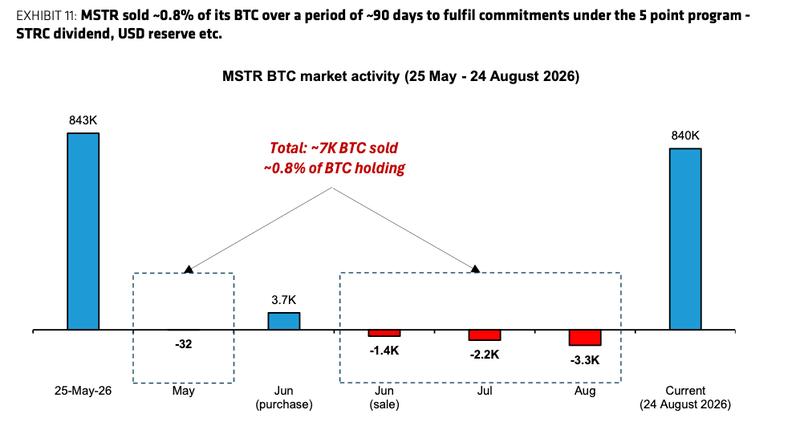
According to Bernstein, sustained Bitcoin momentum, paired with a rebound in Strategy's Stream (STRC) preferred stock to approximately $100, might enable the company to "go kinetic again" with Bitcoin acquisitions following the sale of around 7,000 BTC in 2026. Yahoo Finance reports that STRC concluded trading at $97.15 on Tuesday.
A recent evaluation from Regime Intelligence indicated that Strategy's Bitcoin holdings may face less vulnerability from a cryptocurrency market collapse than from an extended period without capital-market access, a threat that might compromise its capacity to finance approximately $1.76 billion in yearly commitments without liquidating BTC.