
Bitcoin Network Difficulty Drops 7.7% Amid Ongoing Mining Industry Challenges
The Bitcoin network has recorded its second major difficulty reduction in 2026, providing relief to active miners while they face increasing competition from AI data centers for power resources.

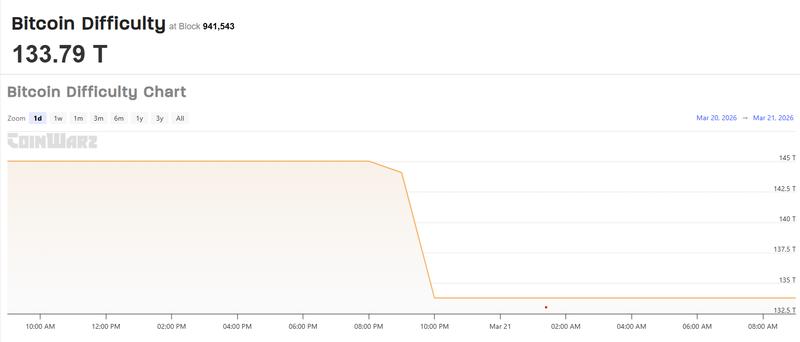
The Bitcoin network's mining difficulty experienced a decline of approximately 7.7% during the most recent adjustment on March 20, dropping to 133.79 trillion at block 941,472, marking the most significant decrease since February, based on data from CoinWarz.
This recent adjustment brings difficulty levels down from approximately 145 trillion recorded in mid-March and roughly 148 trillion at the beginning of the year. When difficulty decreases, miners require less computational power to secure the same block reward, which marginally enhances revenue per hashrate unit for operations that remain active.
This adjustment came after the network experienced slower block production than targeted across the previous 2,016 blocks. Data from CloverPool indicated that average block times reached approximately 12 minutes 36 seconds, significantly exceeding Bitcoin's targeted 10-minute interval, prompting the network to recalibrate downward.
During February, difficulty experienced a sharp decline following weather-related interruptions across the United States that temporarily disabled major American mining operations, before subsequently rebounding by approximately 15% when hashrate returned to the network after power conditions stabilized.
Bitcoin (BTC) difficulty represents the computational challenge miners face when attempting to find a valid hash for the subsequent block and undergoes automatic adjustments to maintain consistent issuance at one block per 10-minute interval.
As additional computing power, known as hashrate, enters the network, difficulty increases to ensure blocks aren't mined too rapidly, whereas a reduction in hashrate results in lower difficulty, simplifying the process for remaining miners to secure rewards.
The subsequent difficulty adjustment is presently projected for April 3, although this estimate fluctuates with every newly mined block.
Miners pivot to AI as power costs bite
This difficulty reduction also arrives as multiple publicly-listed mining companies advance deeper into AI and high-performance computing infrastructure while pursuing more consistent returns on their power and data-center resources.
Last week, crypto trader Ran Neuner argued AI had become Bitcoin mining's biggest competitor as both industries compete for electricity, even going as far as to say that "AI has killed Bitcoin forever."
Bitcoin mining operations such as Core Scientific, MARA Holdings, Hut 8 and Cipher Mining have started redirecting capacity or transitioning toward AI workloads, while certain operators have decreased hashrate or powered down less efficient mining equipment as profit margins contract.
On Feb 21, Bitdeer liquidated 943 BTC from reserves and sold newly mined coins, cutting corporate holdings to zero. In its latest weekly update on March 21, it confirmed that its BTC holdings remained at zero.