
BIS Leader Questions Stablecoin Viability for Large-Scale Payment Systems
Pablo Hernández de Cos of BIS expressed doubts about stablecoins' reliability for widespread payment use, as a fresh FSI report reveals significant regulatory variations among stablecoin issuers globally.

The Bank for International Settlements has once again voiced concerns regarding stablecoins, casting doubt on their viability as mainstream currency while nations around the globe establish regulatory systems for these digital assets.
Pablo Hernández de Cos, the General Manager of BIS and a contender for the position of European Central Bank President following Christine Lagarde's tenure next year, maintained that stablecoins cannot reliably serve as a payment mechanism on a large scale. According to Reuters reporting on Friday, he suggested that tokenized deposits from banks present a more robust solution.
Tokenised deposits offer a more direct path to harness tokenisation while preserving the monetary system's foundations
Pablo Hernández de Cos
These remarks arrive at a time when regulatory bodies across the globe are wrestling with the rise of stablecoin usage, coinciding with a recent analysis from the Financial Stability Institute (FSI), which is associated with the BIS, revealing substantial variations in regulatory approaches toward stablecoin issuers across leading financial markets.
Stablecoins could lower government borrowing costs
Hernández de Cos recognized that stablecoins might reduce the costs of government borrowing, a position similarly advocated by US Treasury Secretary Scott Bessent.
However, the impact may prove to be double-edged for everyday consumers. Should customers transfer their bank deposits into stablecoins, financial institutions might encounter elevated funding expenses and subsequently transfer those costs to households and businesses in the form of increased borrowing rates, according to Hernández de Cos.
He further highlighted restricted interoperability among different stablecoin platforms and challenges in uniformly enforcing anti-money laundering regulations. The expanding adoption of stablecoins pegged to the US dollar beyond American borders might also compromise monetary sovereignty and diminish the effectiveness of domestic monetary policy, he warned.
Stablecoin issuers face different rules worldwide
The FSI analysis, released on Thursday, examined stablecoin regulatory frameworks in the US, European Union, United Kingdom, Hong Kong and Singapore, uncovering considerable disparities regarding which entities are permitted to issue stablecoins and what additional commercial activities they may undertake.
The US and Singapore adopt comparatively stringent positions concerning non-bank issuers. According to the US GENIUS Act, activities such as lending, staking, proprietary trading and custody services for third-party crypto assets are typically excluded from the permitted operations for payment stablecoin issuers.
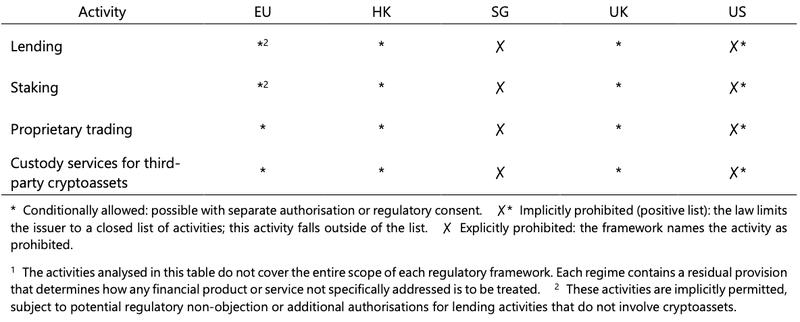
Hong Kong, the UK and EU adopt a more permissive stance, permitting certain additional activities subject to separate authorization, regulatory approval or other relevant permissions.
The study's authors also discovered that limitations throughout all five jurisdictions are directed at the issuing entity specifically rather than the broader corporate group, which means other entities within the group may engage in activities that are prohibited for the stablecoin issuer itself.