
Binance Accepts Franklin Templeton's Tokenized Money Market Funds for Off-Exchange Collateral
Institutional traders can now use tokenized shares from Franklin Templeton's money market funds as collateral on Binance, with the underlying assets maintained in off-exchange custody arrangements.

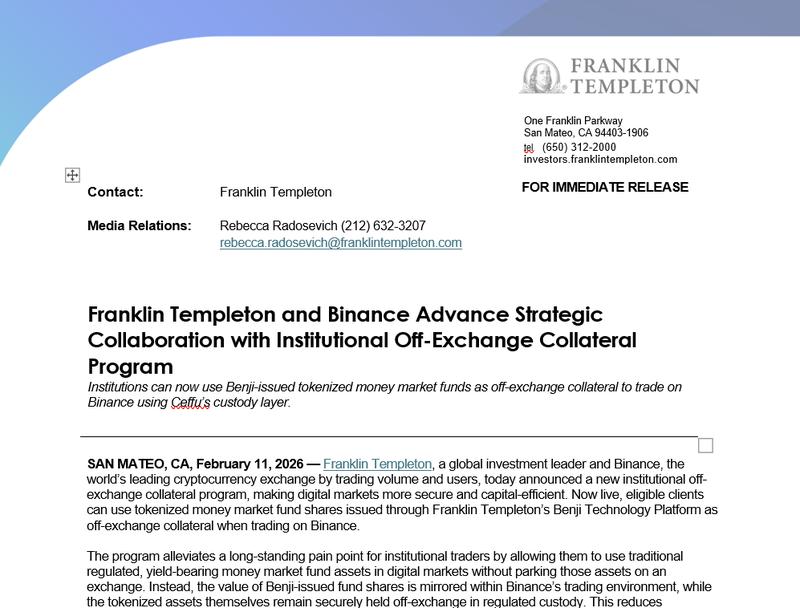
Franklin Templeton, a worldwide investment management firm, has unveiled the introduction of an off-exchange collateral program for institutional clients in partnership with Binance, enabling them to leverage tokenized money market fund (MMF) shares as backing for their trading operations while maintaining the actual assets under regulated custodial arrangements.
A Wednesday announcement provided to Cointelegraph outlined that the structure aims to minimize counterparty risk by representing collateral holdings within Binance's trading platform, as opposed to transferring client holdings directly onto the exchange itself.
Qualified institutional participants have the ability to commit tokenized MMF shares created through Franklin Templeton's Benji Technology Platform to serve as collateral for their Binance trading activities.
These tokenized fund shares remain off-exchange under the custody of Ceffu Custody, a digital asset custodian that operates under license and supervision in Dubai, while their equivalent collateral value is reflected on Binance to facilitate trading positions.
According to Franklin Templeton, this approach was created to enable institutions to generate yield on their regulated money market fund positions while simultaneously deploying those same assets to underpin digital asset trading activities, all without relinquishing their current custody arrangements or regulatory safeguards.
Our off‑exchange collateral program is just that: letting clients easily put their assets to work in regulated custody while safely earning yield in new ways.
Roger Bayston, head of digital assets at Franklin Templeton
This program expands upon a strategic partnership that was announced in 2025 between Binance and Franklin Templeton, focused on building tokenization offerings that merge regulated fund frameworks with worldwide trading infrastructure capabilities.
Off‑exchange collateral to cut counterparty risk
This structure resembles other tokenized real-world asset collateral frameworks employed in cryptocurrency markets. For instance, BlackRock's BUIDL tokenized US Treasury fund, which is issued through Securitize, is similarly recognized as acceptable trading collateral on Binance, alongside other platforms such as Crypto.com and Deribit.
This framework enables institutional participants to deposit a low-volatility, yield-generating instrument as an alternative to dormant stablecoins or tokens with greater volatility.
Additional issuers and trading venues, including WisdomTree's WTGXX and Ondo's OUSG, are investigating comparable frameworks, with tokenized bond instruments and short-term credit funds becoming increasingly adopted as onchain collateral across both centralized and decentralized marketplace environments.
Regulators flag cross‑border tokenization risks
Notwithstanding the expanding adoption of tokenized MMFs serving as collateral instruments, global regulatory authorities have issued warnings that cross-border tokenization frameworks may present novel risks.
The International Organization of Securities Commissions (IOSCO) has issued cautions that tokenized financial instruments deployed across multiple jurisdictions could potentially take advantage of disparities between national regulatory frameworks and facilitate regulatory arbitrage if oversight mechanisms and supervisory collaboration fail to advance at the same pace.
Cointelegraph reached out to Franklin Templeton with inquiries about how the tokenized MMF shares are regulated and safeguarded and how the framework was subjected to stress testing for extreme market scenarios, but had not received a response by the time of publication.