
Amina Bank of Switzerland Pioneers Regulated Custody Services for Canton Coin
In a groundbreaking move, Amina, a Swiss cryptocurrency bank, has introduced custody and trading capabilities for Canton Coin, broadening institutional participation in the Canton Network ecosystem.

Amina, a cryptocurrency-focused bank based in Switzerland, has introduced custody and trading capabilities for Canton Coin, marking a milestone as the first regulated financial institution to provide services for this token associated with the Canton Network, a blockchain platform designed for institutional use cases.
According to an announcement released on Wednesday, Amina revealed that its customers will now have regulated access to the Canton Network, which serves as a public blockchain infrastructure specifically engineered for capital markets applications and tokenized financial services. Digital Asset developed this network with backing from major financial players including the Depository Trust & Clearing Corporation, Visa, BitGo, Goldman Sachs and Citadel.
This development enables institutional customers to custody and exchange Canton Coin via a banking infrastructure that operates under Swiss Financial Market Supervisory Authority (FINMA) oversight, eliminating the need to depend on cryptocurrency-native exchanges or custodial services. This could prove beneficial for enterprises leveraging Canton for tokenization processes and settlement operations.

This announcement represents a continuation of Amina's strategic expansion into tokenized finance infrastructure. Earlier in March, the Zug, Switzerland-based financial institution achieved another first by becoming the inaugural regulated banking entity to participate on 21X, an EU-regulated blockchain securities trading venue that functions under the bloc's DLT pilot regime designed for tokenized securities markets.
Canton expands institutional finance footprint
The Canton Network has established itself as blockchain infrastructure tailored specifically for conventional financial institutions, concentrating on use cases including tokenized assets, settlement operations, collateral management systems and repurchase agreement markets. Data from CoinMarketCap indicates that Canton Coin token currently trades at approximately $0.15, representing a total market capitalization of $5.7 billion.
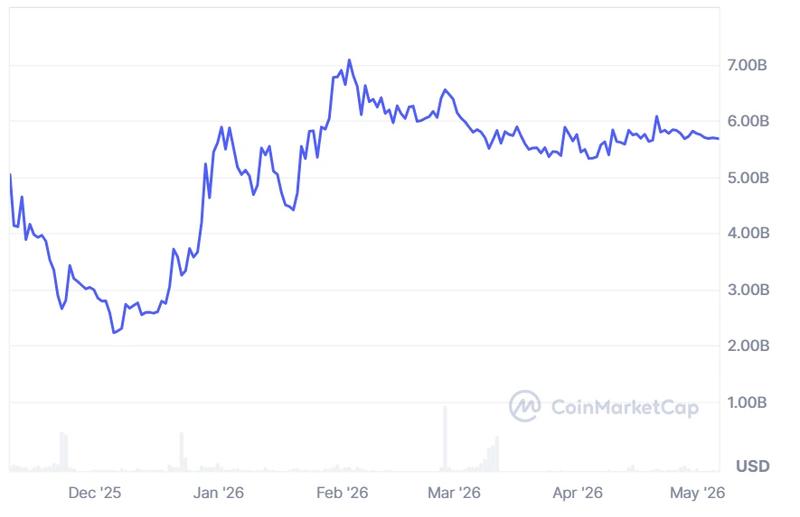
During April, BitGo extended its Canton Coin service offerings beyond simple custody functions to encompass trading capabilities and onchain settlement functionality, thereby increasing institutional access points to the network's native token and associated financial operations.
In a separate development, S&P Dow Jones Indices recently integrated its US Treasury Index benchmark onto the Canton Network infrastructure, providing institutional participants with the ability to access fixed-income benchmark information through tokenized infrastructure systems.
The Canton Network operates in a competitive landscape that includes several enterprise blockchain platforms also targeting the institutional finance sector. One such competitor is R3's Corda, a distributed ledger platform specifically engineered for banking institutions and regulated financial markets with particular focus on privacy features and permissioned transaction structures.
Hyperledger Fabric represents another competing platform, having achieved significant adoption across enterprise blockchain implementations, with particular traction among financial institutions and major corporate entities.