
$4.2 Billion in Tether Tokens Frozen Over Criminal Links in Three-Year Period: New Data
The stablecoin issuer has immobilized massive amounts of USDt connected to fraud schemes and money laundering operations as law enforcement agencies turn to crypto firms for assistance.

Over the span of three years, Tether, the company behind the world's leading stablecoin, has immobilized approximately $4.2 billion in USDt tokens that authorities have linked to illicit operations, according to recent reports.
The majority of these restricted assets were locked down beginning in 2023, coinciding with heightened regulatory oversight and law enforcement crackdowns on cryptocurrency fraud schemes and attempts to circumvent financial sanctions, according to statements the company based in El Salvador provided to Reuters on Friday.
The USDt (USDT) stablecoin, which maintains a peg to the US dollar, represents the most widely circulated stablecoin globally, boasting over $180 billion currently in circulation—a dramatic surge from approximately $70 billion just three years earlier.
The company possesses the capability to immobilize tokens at the blockchain level by adding specific wallet addresses to a blacklist whenever law enforcement or regulatory agencies submit formal requests.
Tether helps governments freeze funds
This past Tuesday, Tether made public that it had cooperated with the US Department of Justice to confiscate close to $61 million in USDt connected to so-called "pig-butchering" fraud operations, a type of scam where perpetrators cultivate trust and emotional connections with targets before convincing them to transfer funds.
Additionally, earlier within the current month, the firm took action to freeze around $544 million worth of digital assets following a formal request from Turkish government authorities, immobilizing cryptocurrency linked to what officials described as an unlawful internet gambling and money-laundering enterprise.
Data from Elliptic, a company specializing in blockchain analytics, indicates that by the end of 2025, both Tether and Circle, another major stablecoin provider, had placed approximately 5,700 digital wallet addresses on their blacklists, collectively holding around $2.5 billion in value, with USDt accounting for roughly three-quarters of the addresses at the time they were restricted.
USDt supply shrinks
Cointelegraph has previously reported that USDt faces its most significant monthly reduction in circulating supply over a three-year timeframe, with the total amount in circulation decreasing by approximately $1.5 billion throughout February, following a $1.2 billion reduction observed in January, based on data tracked on the blockchain. This supply contraction mirrors similar patterns witnessed during the aftermath of the FTX exchange failure in the final months of 2022 and could signal reduced liquidity conditions within cryptocurrency trading environments.
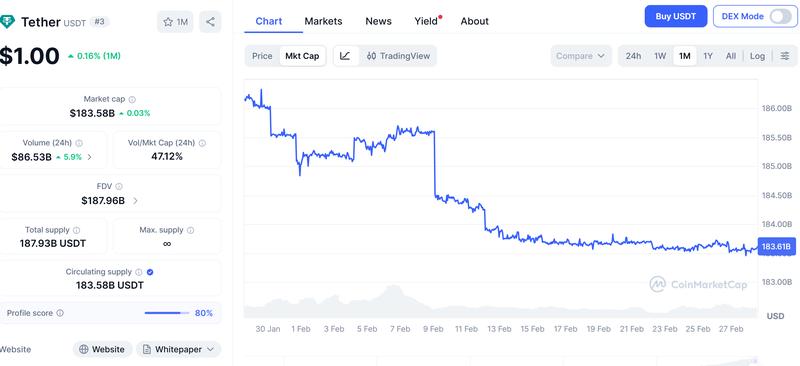
According to Tether's official statement, these statistics represent temporary shifts in token distribution patterns rather than indicating declining market demand for the stablecoin, while pointing out that USDC (USDC), a competing stablecoin, experienced comparable multibillion-dollar supply reductions throughout the identical timeframe.