
21Shares Reduces Cryptocurrency Price Projections for 2026 Amid Institutional Growth
Crypto asset manager 21Shares observes digital currency infrastructure development outpacing market valuations, with ETFs, stablecoins, and prediction platforms evolving while multiple 2026 price estimates are adjusted downward.

Digital asset manager 21Shares has revised downward a number of its previously optimistic projections for the cryptocurrency sector this year, noting that institutional participation remains robust despite challenging market dynamics and limited retail investor engagement that have dampened growth momentum.
According to the firm's midyear market outlook, the sector's foundational infrastructure has evolved at a faster rate than asset valuations. Segments including exchange-traded funds (ETFs), regulatory frameworks for stablecoins, asset tokenization, and prediction markets have shown continued development, but depressed cryptocurrency valuations, significant decentralized finance (DeFi) security breaches, and enterprise adoption falling short of expectations have made several of the company's 2026 projections unattainable.
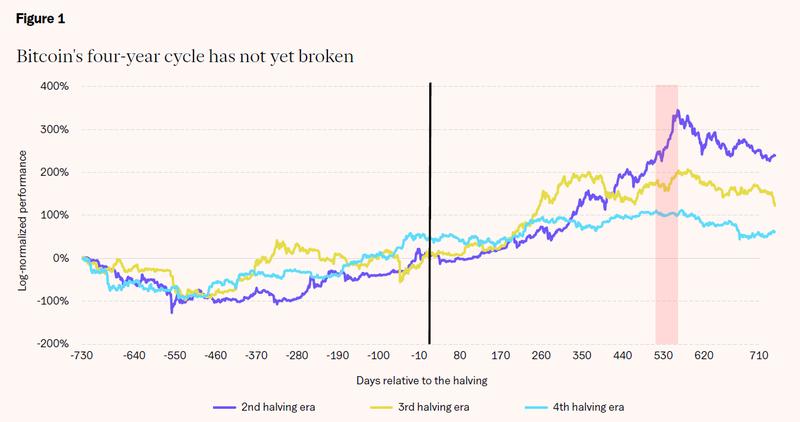
Among the report's most definitive findings was that Bitcoin's (BTC) traditional four-year market cycle continues to hold true, even as evidence suggests the asset class is increasingly influenced by institutional market participants.
"After reaching approximately $126,000 in October 2025, Bitcoin experienced a significant pullback and has since traded consistent with historical post-halving cycle patterns," the analysts stated, maintaining that while institutional participation has moderated the severity of market corrections, it has not fundamentally changed Bitcoin's cyclical nature.
Ophelia Snyder, former co-founder of 21Shares who left the firm after its FalconX acquisition in 2025, recently offered comparable insights regarding the transformation of crypto markets driven by institutional capital.
"The investor base is larger, more institutional, and more connected to the broader financial system. As a result, competing narratives, geopolitical developments, and macroeconomic shifts all have a much larger impact on crypto pricing than they once did."
Ophelia Snyder, former 21Shares co-founder, in a recent Substack post
Prediction markets expected to outperform
Within the categories exceeding performance forecasts, 21Shares identified prediction markets as among crypto's most robust expansion sectors, estimating that annual trading volumes will eclipse $100 billion during the current year.
The analysis also emphasized industry consolidation as a characteristic trend throughout the ecosystem. Publicly traded corporations maintaining cryptocurrency reserves on their financial statements are starting to show divergence, with numerous smaller treasury holders valued below the net worth of their digital asset portfolios, indicating further sector consolidation ahead.
An equivalent trend is becoming apparent throughout Ethereum's layer-2 network environment, where a select group of leading rollup solutions continue capturing increased market dominance while numerous smaller protocols face challenges attracting substantial user bases and liquidity pools.
Crypto ETFs show resilience despite outflows
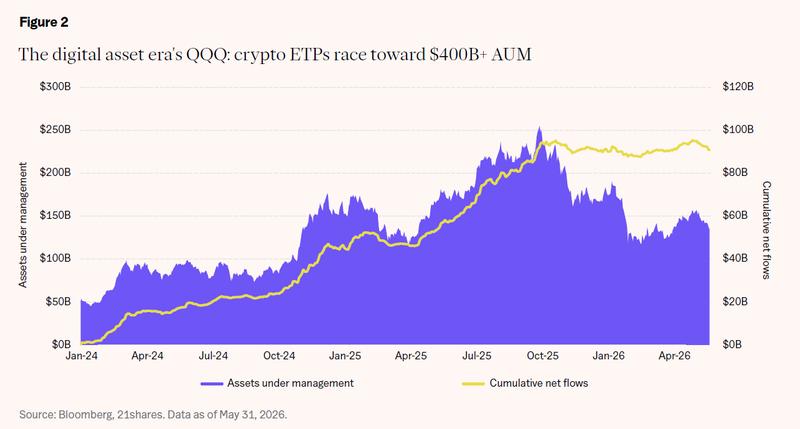
This enduring strength is equally visible within cryptocurrency exchange-traded products, which have maintained their appeal to long-term institutional capital despite less favorable market circumstances.
Although US spot Bitcoin ETFs have experienced approximately $3 billion in net capital withdrawals throughout the year, 21Shares emphasized that these statistics fail to capture the complete picture. Total holdings remain slightly above 1.25 million BTC, approaching an all-time record for the token, indicating that numerous investors have maintained their positions throughout the market decline.
"Investors are holding through volatility or quietly building strategic positions, even with Bitcoin trading well below its highs," the analysts wrote.
The research team also noted advancing regulatory transparency within the United States, referencing the Securities and Exchange Commission's standardized listing requirements that have facilitated the transformation of a substantial queue of cryptocurrency ETF applications into a consistent pipeline of fresh product introductions extending beyond Bitcoin and Ether.
"Hyperliquid stands out," the analysts wrote. "US spot ETFs tracking the asset attracted over $150 million in net inflows in under a month, evidence that traditional capital continues to flow toward digital assets."