
ZEC Community Approves 25-Second Block Times While Maintaining Halving Protocol
Overwhelming majority of Zcash token holders—nearly 99%—support accelerated block production to 25 seconds and preservation of current ZEC emission and halving mechanisms.
In a community poll concerning the upcoming major network upgrade, Zcash cryptocurrency holders have expressed support for slashing the blockchain's target block production time from 75 seconds down to 25 seconds while maintaining the current halving mechanism.
According to voting results made public on Monday, the accelerated block time initiative garnered 99.9% approval among Zcash (ZEC)-weighted participants, whereas 98.9% voted in favor of maintaining the existing halving structure. Voting influence was proportional to qualifying ZEC token ownership, and both figures account for abstaining votes.
According to the upgrade proposal, the reduced time interval would decrease the anticipated waiting period for initial transaction confirmation. To maintain the current daily issuance rate unchanged, the volume of newly minted ZEC distributed per individual block would be proportionally reduced.
These modifications are slated for inclusion in NU7, an upcoming Zcash network enhancement with no confirmed launch timeline. Community members also showed preference for omitting any features that haven't been completed by Sept. 30.
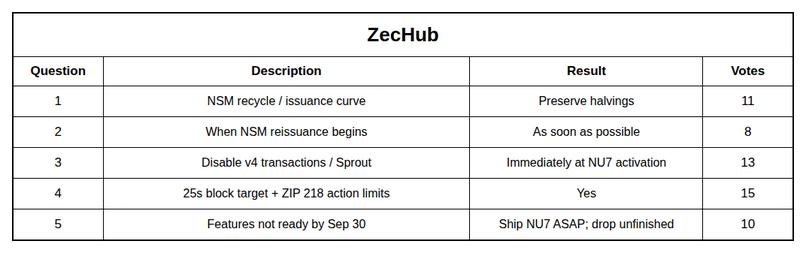
This token holder referendum operated independently from surveys conducted among ZecHub participants, members of the Zcash Community Advisory Panel, and additional community organizations. Participation eligibility required possession of transferable ZEC tokens within the Ironwood shielded pool at the moment of the voting checkpoint. Development teams intend to complete delivery of all final components for this upgrade before the Sept. 30 deadline, though activation dates for testnet and mainnet deployment have yet to be established.
Halvings represent predetermined reductions that decrease new ZEC token creation by fifty percent at regular intervals. The prevailing choice among token holders would maintain this existing timeline while permitting tokens previously withdrawn from active circulation under an alternative proposal to be reintroduced through future mining rewards.
Results from the advisory panel demonstrated a narrower division, with 57 panel members supporting a smooth issuance trajectory that would eliminate halvings, while 54 members preferred retaining the current system.
Zcash coinholders favor delaying reissuance
The Network Sustainability Mechanism (NSM) represented another significant feature under consideration for incorporation into NU7, comprising a proposed modification to Zcash's economic framework designed to redirect a fraction of transaction fees into a reserve pool instead of depending exclusively on mining rewards.
Approximately 97% of participating token holders supported postponing NSM reissuance implementation until February 2031, with 2.3 million ZEC tokens cast in favor of the delay, compared to merely 70,239 tokens voting for immediate activation.
The NSM proposal emerged in January as a response to ongoing concerns regarding the network's long-term security funding, given that diminishing block rewards could eventually prove inadequate for incentivizing miners to continue transaction validation. The three-component mechanism embedded in this model is designed to burn and redistribute 60% of ZEC transaction fees back into subsequent block rewards, while ensuring compliance with the token's 21 million unit maximum supply cap.
During the preceding 24 hours, ZEC experienced a 3.8% price increase, building upon its 132% surge observed throughout the past month, based on CoinMarketCap statistics.