USDC Functions as Neutral Infrastructure, Not Payment Network Competitor, Circle CEO Declares
Circle's Jeremy Allaire explained at the World Economic Forum in Davos that USDC operates as shared infrastructure, positioning it alongside rather than against traditional payment processors and financial institutions.

Jeremy Allaire, chief executive of Circle, characterized the firm's US dollar-backed stablecoin as foundational financial infrastructure featuring network effects, distinguishing it from offerings designed to challenge established payment processors.
During an appearance on CNBC's Squawk Box at the World Economic Forum in Davos, Switzerland, Allaire clarified that Circle doesn't regard payment card networks like Visa or Mastercard as rivals, instead characterizing these firms as "significant partners."
Allaire explained that stablecoins represent "network effect businesses," where adoption and transaction volume grow as additional developers and financial institutions incorporate the technology, emphasizing that Circle functions as a "neutral company" avoiding competition with banking institutions, payment processors or cryptocurrency exchanges.
The CEO also noted that the future trajectory and impact of stablecoins remains uncertain.
Over time, the cost of storing and moving money around goes to zero. In that future world, where AI agents are doing the money movement, it's going to be hard to know exactly what the payment business model is over that period of time.

When questioned about the prospects of the stagnant Digital Asset Markets Clarity legislation passing through the US Congress during the current year, Allaire responded: "There's clearly a bipartisan desire to do that," noting that the proposed legislation goes beyond stablecoin regulation to encompass the wider application of digital tokens within capital markets, benefiting both conventional banking institutions and cryptocurrency firms.
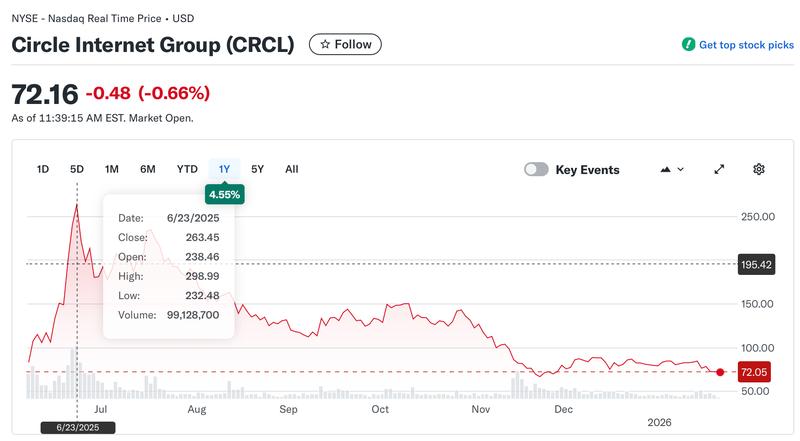
As the company behind USDC, currently the second-largest stablecoin measured by market capitalization, Circle completed its public debut in June 2025, setting its initial public offering price at $31 per share prior to commencing trading at $69.
Circle's stock price climbed to a peak of $263.45 during late May, though it has subsequently declined to $72, based on data from Yahoo Finance.
Stablecoin competitors emerge in 2025
The accelerated growth of the stablecoin sector has introduced numerous new entrants seeking to challenge Circle's market standing.
During March, reports surfaced that Fidelity Investments had reached the concluding phases of testing a stablecoin pegged to the US dollar. The asset management giant, overseeing $5.8 trillion, intends to introduce the stablecoin via its cryptocurrency division, Fidelity Digital Assets.
Approximately one month following that announcement, Stripe revealed plans to develop a stablecoin backed by US dollars targeting businesses operating outside the United States, the United Kingdom and Europe. Bridge will provide the underlying technology for the stablecoin.
Additionally, cryptocurrency payments provider MoonPay is developing a US dollar-backed stablecoin focused on routine payment transactions, scheduled for introduction in early 2026.
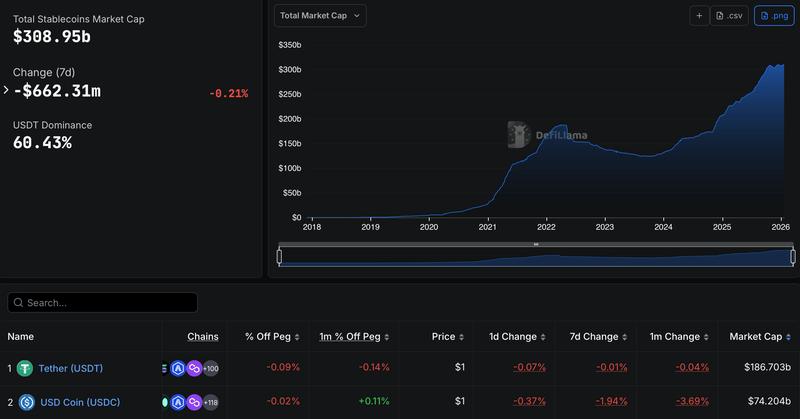
On Thursday, the combined market capitalization of stablecoins stood at $309 billion, per data from DefiLlama.
USDC from Circle represents approximately $74.2 billion of the total market, securing the second position after Tether's USDt, which continues as the leading issuer with roughly $186.7 billion currently in circulation.