
US Regulators Grant Sony Bank Preliminary Authorization for Stablecoin Operations
The Office of the Comptroller of the Currency has granted Sony Bank conditional authorization to launch a stablecoin issuance operation in the United States, supported by an initial investment of $40 million.

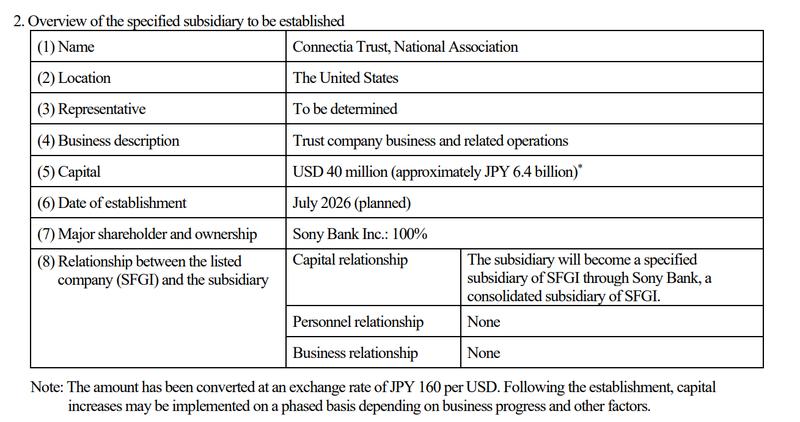
A subsidiary of Sony Financial Group, Sony Bank, has announced that it secured conditional authorization to create a fresh US national trust bank subsidiary dedicated to issuing stablecoins pegged to the US dollar.
The Office of the Comptroller of the Currency (OCC) granted conditional authorization to the new entity, Connectia Trust, National Association, on July 2.
Connectia Trust will operate under complete ownership by Sony Bank and will facilitate the creation and oversight of stablecoins denominated in US dollars, as stated in a Monday disclosure from Sony Financial Group.
This authorization marks Sony's entrance into the regulated sphere of US stablecoin creation, representing a component of an extended digital asset business infrastructure, which the company is supporting with an initial capital investment of $40 million.
According to Sony Bank, no operational activities or stablecoin creation will take place until complete approvals and permissions are obtained, including final authorization from the OCC. The corporation intends to activate the stablecoin subsidiary within the current month.
Cointelegraph reached out to Sony Bank seeking additional information regarding the business operations and whether plans include the introduction of a proprietary stablecoin, but had not received a response at the time of publication.
In March of this year, Sony Bank entered into a memorandum of understanding with stablecoin provider JPYC Inc. to explore whether the stablecoin pegged to the Japanese yen could be integrated more seamlessly with the bank's deposit infrastructure.
Financial Institutions Pursue Stablecoin Integration Amid Regulatory Challenges
An increasing number of the globe's largest financial institutions are pursuing the integration of stablecoin infrastructure within conventional systems, notwithstanding regulatory obstacles in the United States.
This past Thursday, British international banking institution Standard Chartered and Circle, the issuer of USDC, announced they created a mechanism enabling institutions to create and redeem the USDC stablecoin via a bank-facilitated onboarding procedure. Customers will have the capability to create and redeem the stablecoin backed by US dollars directly using StanChart's platform rather than establishing separate accounts with Circle.
At the same time, Congressional advancement on the United States' first regulatory framework for digital assets, known as the CLARITY Act, continues to be stalled, leading Galaxy Digital to reduce its probability estimate of the bill's passage into law in 2026 to 50%.
Although the legislation is scheduled for a House of Representatives hearing on July 17, Alex Thorn, Galaxy's head of research, cautioned that the bill might not receive sufficient floor time prior to the Senate departing for its customary four-week recess on Aug. 8
After clearing the Senate Banking Committee in May, the bill encountered opposition from the majority of Democrats and the banking sector due to worries it would permit crypto companies to provide yields on stablecoins without facing identical requirements as conventional financial institutions.
At the start of June, over 200 cryptocurrency companies and associated organizations called upon the Senate to approve the CLARITY Act, through a letter distributed by cryptocurrency advocacy group Stand With Crypto.
During May, Jamie Dimon, CEO of JPMorgan, stated to Fox Business that banking institutions will persistently "fight" against the present version of the CLARITY Act and indicated that cryptocurrency companies desiring to provide yield-bearing products "should apply for banking charters."