
Minnesota Deepfake Political Advertisement Sparks Debate Over AI Transparency Requirements
An AI-generated attack advertisement in Minnesota's political campaign has ignited debate about ethical boundaries for artificial intelligence in political messaging and existing regulatory frameworks governing AI deployment.
As the election cycle accelerates across the United States, campaign advertisements have begun saturating both traditional broadcast channels and digital social media platforms.
Political aspirants, alongside political action committees (PACs) that back or oppose various candidacies, are expected to allocate an unprecedented $10 billion toward advertising during this electoral period. A portion of these expenditures is being directed toward AI-generated deepfake content.
According to reporting from NBC News, no fewer than 15 campaign advertisements utilizing AI generation have aired since November. Several of these deepfakes have depicted political candidates engaging in activities or making statements that could damage their campaign's reputation.
Advocates for transparency in electoral processes warn that such advertisements, which face prohibition in certain states, may undermine the credibility of elections throughout America.
Ad runs afoul of local election laws
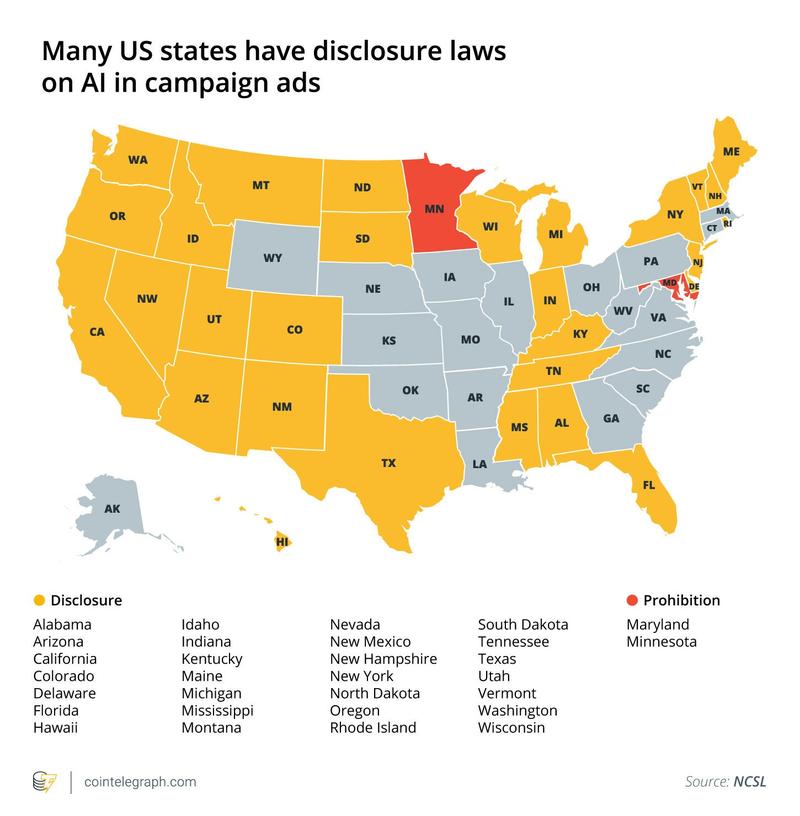
When it comes to campaign advertising, artificial intelligence faces regulation primarily through state-level legislation. Approximately 28 states have enacted disclosure requirements, while two states maintain prohibitions, albeit with limitations.
Within Minnesota, an advertising campaign has already encountered conflict with state regulations. On June 3, Minnesota Lt. Governor Penny Flanagan took to BlueSky to alert followers that "you might see a TV ad starring something that... kind of looks like me."
The post referenced an advertisement produced by a PAC backing her primary challenger in the Senate contest, fellow Democrat and US Representative Angie Craig. The commercial depicts Flanagan positioned on top of an enormous pile of currency, while attacking her purported connections to special interest organizations.
"My opponent's super PAC is using an AI deepfake of me to mislead voters. They can't win with the truth - so they're resorting to lies."
"It's disgusting. Minnesotans deserve better."
The commercial may potentially violate Minnesota's campaign regulations. During 2023, Democratic State Representative Maye Quade put forward legislation prohibiting AI deepfakes. The measure became law, stipulating that "anyone who widely shares a deep fake within 90 days of an election" commits a criminal offense. This applies when the individual also:
- Knows or should have known the ad was a deepfake and made without the consent of the depicted person
- Acted with the intent to harm a candidate's reputation to influence an election
Because the advertisements appeared following the DFL, Minnesota's Democratic party, officially nominating Flanagan, it technically might not have breached the statute. Nevertheless, Flanagan's campaign is reportedly seeking legal counsel.
Speaking with local news outlets, Quade stated the advertisement contravened the law's underlying purpose, adding that public sentiment generally opposes this application of AI. "People don't like this, broadly [...] What campaign on either side of the aisle is going to help voters feel good about their candidate using this?"
Among Democratic ranks, 40 DFL state legislators affixed their signatures to correspondence denouncing AI deepfake utilization in campaign content. The letter highlighted that during 2023, "lawmakers voted nearly unanimously to ban the use of deceptive AI-generated deepfakes in elections, recognizing the threat manipulated AI content poses to voters and public trust."
"Regardless of party, the use of AI-generated deepfakes in campaign advertising is unacceptable."
Mark Jablonowski, who serves as CEO of advertising company DSPolitical, shared with NBC his belief that most political figures will maintain ethical standards. "I think most campaigns on both sides of the aisle probably want to do the right thing [...] There, of course, are going to be examples that you can point to where people are going about it the wrong way."
North Star Dawn PAC, the organization responsible for publishing the advertisement, failed to provide a response to Cointelegraph's request for comment.
What do election laws say about AI deepfakes?
As previously mentioned, roughly 30 states maintain legislation addressing AI usage in electoral contexts. The overwhelming majority of these statutes pertain to basic disclosure requirements, with numerous states imposing only civil sanctions for violations.
The Federal Elections Commission (FEC), the regulatory agency tasked with establishing funding, disclosure and additional regulations concerning elections. On the subject of advertisements, the FEC informed Cointelegraph:
In 2023, Public Citizen, an organization advocating for consumer interests, filed a petition for rulemaking with the FEC, requesting the commission establish regulations for AI. However, the agency "decided not to initiate a rulemaking."
"The Commission determined that the statute's fraudulent misrepresentation ban is technology neutral, applying to all means of the specified fraud, including AI-assisted media."
Congressional action demonstrates a complete lack of willingness to enact meaningful AI regulation. Approximately one year prior, President Donald Trump enacted the One Big Beautiful Bill Act into law. The legislation's final draft narrowly escaped including a decade-long prohibition on any state and local AI regulation, which would have granted the industry unrestricted freedom regarding everything from data center construction to AI deployment in popular media.
Currently, two members of Congress are pursuing similar objectives. On June 4, Democrat Lori Trahan and Republican Jay Obernolte presented legislation that, should it pass, would prohibit states from enacting laws "targeting artificial intelligence model development."
The American Civil Liberties Union (ACLU) warns "This could include anything from privacy regulations to antidiscrimination requirements to AI safety laws."
The ACLU observed that the previously mentioned 10-year prohibition was removed from the Senate version through a nearly unanimous 99-1 vote.
Jina John, senior policy counsel for AI, privacy and technology at the ACLU, said, "This draft bill fails to learn from Congress's previous attempts to block state AI regulations. States must be able to protect their own residents from harm, hold tech companies accountable, and ensure that AI is safe and trustworthy."