
Layer-2 Networks Arbitrum, Optimism, and Base React to Vitalik's Critique of L2 Scaling Strategy
Jesse Pollak from Base argues that layer-2 solutions must move beyond being merely "cheaper Ethereum" in response to Vitalik Buterin's push for greater specialization among L2 networks.

A number of layer-2 developers have issued responses following statements from Ethereum co-founder Vitalik Buterin, who declared that the initial concept of L2s serving as the main scaling solution "no longer makes sense," advocating instead for a transition toward specialized functionality.
Buterin stated in a post published on Wednesday that numerous L2 networks have not successfully inherited Ethereum's full security model, primarily because they still depend on multisig bridges, while the underlying base layer continues to expand its capacity for handling greater throughput through gas-limit adjustments and the eventual implementation of native rollups.
These remarks triggered feedback from various Ethereum layer-2 projects, who generally concurred that rollup solutions need to progress beyond simply offering more affordable alternatives to Ethereum, though they expressed differing views regarding whether scaling should continue to be a fundamental aspect of their purpose.
The broader Ethereum community is currently navigating a transitioning roadmap designed to enhance the capabilities of the base layer, while L2 solutions are working to redefine themselves as specialized platforms catering to unique technical requirements.
Ethereum L2 builders accept shift, differ on scaling's role
In an X post, Karl Floersch, a co-founder of the Optimism Foundation, expressed his enthusiasm for the opportunity to construct a modular L2 infrastructure that accommodates "the full spectrum of decentralization."
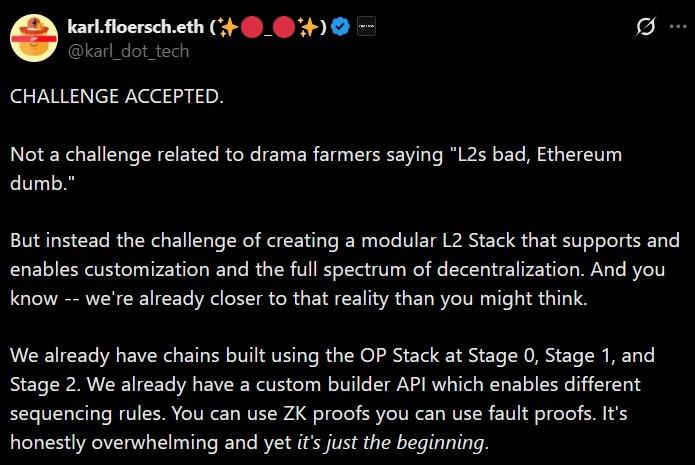
Floersch also recognized that significant obstacles remain to be overcome. Among these challenges are extended withdrawal timeframes, the absence of production-ready Stage 2 proofs, and inadequate tooling infrastructure for applications operating across multiple chains.
"Stage 2 isn't production-ready," Floersch wrote, adding that existing proofs are not yet secure enough to support major bridges. Floersch also voiced his support for native Ethereum precompile for rollups, an idea that Buterin has recently highlighted as a method to enhance the accessibility of trustless verification.
In a comprehensive X thread, Steven Goldfeder, the co-founder of Arbitrum developer Offchain Labs, presented a more assertive position. His argument centered on the idea that although the rollup framework has undergone changes, scaling continues to represent a fundamental purpose of L2 solutions.
According to Goldfeder, Arbitrum was not developed as a "service to Ethereum," but rather because Ethereum offers a settlement layer with high security and low costs that enables large-scale rollups to function effectively.
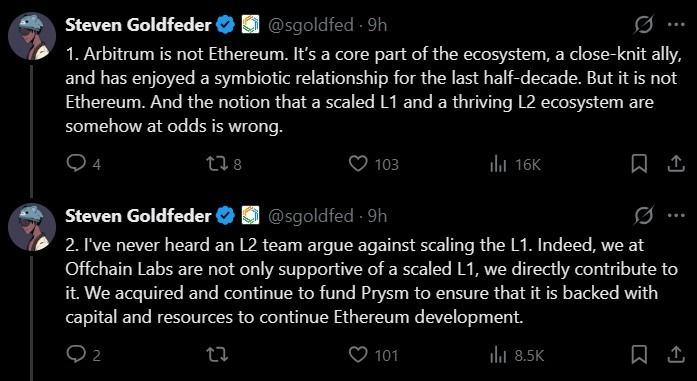
Goldfeder also challenged the notion that an enhanced Ethereum mainnet could substitute for the transaction volume currently managed by L2 platforms. He referenced instances of elevated network activity during which Arbitrum and Base processed over 1,000 transactions per second, while Ethereum handled fewer.
Goldfeder issued a warning that if Ethereum was viewed as antagonistic toward rollups, institutional players could opt to launch independent layer-1 blockchains instead of building on Ethereum.
Base frames differentiation, Starknet hints alignment
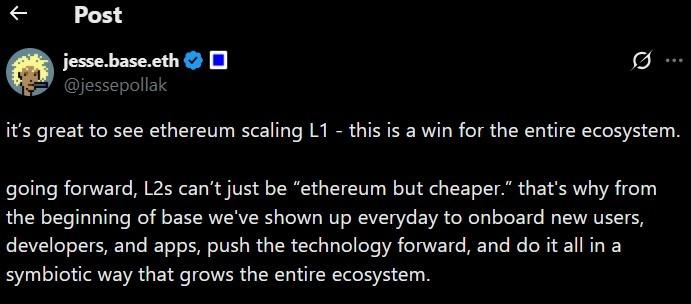
In an X post, Jesse Pollak, head of Base, characterized Ethereum's L1 scaling as "a win for the entire ecosystem." Pollak concurred that L2s cannot just be "Ethereum but cheaper."
According to Pollak, Base has concentrated its efforts on bringing users and developers onboard while simultaneously advancing toward Stage 2 decentralization, noting that creating distinction through applications, account abstraction, and privacy-oriented features corresponds with the vision that Buterin articulated.
Eli Ben-Sasson, CEO of StarkWare, the company behind the non-EVM Starknet rollup, provided a succinct yet significant response on X, writing: "Say Starknet without saying Starknet."
The comment from Ben-Sasson suggested that certain ZK-native L2 platforms view themselves as already embodying the specialized function that Buterin outlined in his remarks.