
Euro stablecoins not the path forward for currency's global influence, ECB chief Lagarde warns
Christine Lagarde, President of the European Central Bank, advocates for Europe to develop tokenized settlement systems based on central bank money instead of depending on privately-issued stablecoins.

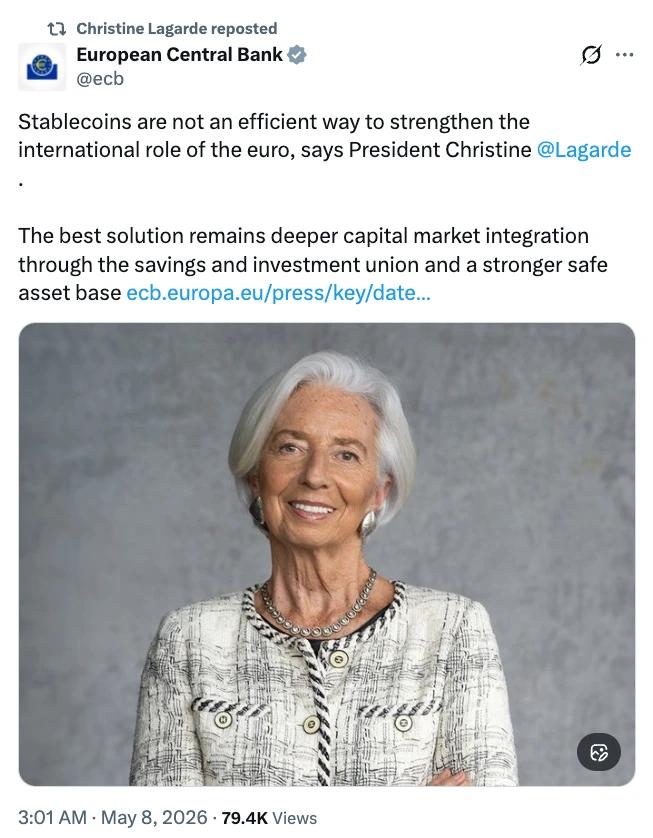
Christine Lagarde, President of the European Central Bank (ECB), has stated that stablecoins do not represent Europe's optimal pathway for enhancing the euro's global standing, countering proposals to match US dollar-backed stablecoins with euro-denominated alternatives.
During her address on Friday at the Banco de España LatAm Economic Forum held in Roda de Bará, Spain, Lagarde delivered multiple remarks concerning stablecoins' position within the European economy. "It is no longer about whether stablecoins should exist, but whether jurisdictions can afford to be without them," she stated, maintaining that the justification for advancing euro stablecoins loses clarity when their two primary functions are examined separately.
The benefits attributed to them [stablecoins] rest on two distinct functions — a monetary function and a technological function — that are systematically conflated in the current debate.
The address presents one of Lagarde's most explicit arguments to date against positioning euro stablecoins as Europe's counterweight to US dollar-backed stablecoins, which presently command the market with approximately 98% market share. The United States has been championing dollar stablecoins as a mechanism to reinforce the US dollar's status as a global reserve currency. As an alternative, she proposed that Europe should construct tokenized financial infrastructure founded on central bank money, encompassing the Eurosystem's Pontes project for wholesale settlement and the Appia roadmap for establishing an interoperable European tokenized finance ecosystem.
Monetary function: Potential benefits, but significant trade-offs
Nevertheless, Lagarde acknowledged that euro-denominated stablecoins functioning under the European Union's Markets in Crypto-Assets Regulation (MiCA) "could generate additional global demand for euro-area safe assets."
She emphasized that this potential benefit carries substantial trade-offs, encompassing financial stability risks like fund runs and reserve fragility, alongside diminished monetary policy transmission should deposits migrate away from banks.
Lagarde referenced the 2023 collapse of Silicon Valley Bank, during which Circle's USDC stablecoin temporarily lost its peg following disclosures of exposure to the failed bank, as a demonstration of how rapidly confidence can deteriorate.
She indicated that such incidents illustrate how redemption pressures can cascade into underlying asset markets and, with expanding stablecoin adoption, establish feedback loops between redemptions and prices, especially in situations where issuers lack banking licenses.
Technology function: Stablecoins represent one option among many
Regarding the technological aspect, Lagarde recognized the contribution of stablecoins to cross-jurisdictional financial market infrastructure that remains accessible "without relying on a maze of legacy intermediaries."
Nevertheless, she contended that this technological capability is not exclusive to stablecoins. Alternative forms of tokenized money, such as commercial bank deposits or central bank money, could fulfill the identical function within distributed ledger systems, Lagarde explained.
The answer [...] does not lie in rejecting technology or discouraging stablecoins altogether. Instead, we must build the public infrastructure that will enable alternative instruments, such as stablecoins and other forms of tokenised money, to operate within a framework anchored by central bank money.
Lagarde explained that the EU response involves facilitating wholesale settlement in central bank money via its Pontes project, which establishes connections between distributed ledger platforms and the Eurosystem's current settlement infrastructure, enabling DLT-based transactions to settle directly in central bank money.
She further noted that the Appia roadmap, released in March, extends beyond this and presents a comprehensive plan for achieving a fully interoperable European tokenized financial ecosystem by 2028.
Europe knows which port it is sailing to. Our task is not to replicate instruments developed elsewhere, but to build the foundations and the infrastructure that serve our own objectives, so that we can harness the benefits of innovation without importing the fragilities.