
Democratic Lawmaker Questions Kansas City Fed on Kraken's Federal Reserve Account Access
In March, Kraken's banking entity chartered in Wyoming made history as the inaugural cryptocurrency-focused firm to obtain a Federal Reserve Master Account.

Maxine Waters, a US Representative serving as the top-ranking Democrat on the House Financial Services Committee, is seeking detailed explanations from the Federal Reserve Bank of Kansas City regarding its decision to approve a limited-purpose master account for Kraken Financial.
Waters sent a formal letter on Thursday requesting Kansas City Fed President Jeff Schmid provide a response no later than April 10, detailing the practical implications of Kraken's account approval; which specific Federal Reserve services the company will have access to; any applicable conditions or limitations and what considerations were made regarding consumer protection and anti-money laundering safeguards.
The banking division of Kraken received approval for a limited-purpose master account from the Federal Reserve Bank of Kansas City during the early part of this month. This development was recognized as a significant achievement for the cryptocurrency sector, given that multiple crypto-related American companies have been attempting to obtain a master account with the Fed over the course of several years.
The master account grants direct connectivity to Fedwire, which serves as the Fed's primary payments infrastructure, creating the possibility for Kraken to transfer funds using the identical payment rails that traditional banks and credit unions utilize.
"The Kansas City Fed's announcement does not disclose specific information about Kraken's access to the range of Federal Reserve financial services due to the confidentiality of business information provided by applicants," Waters wrote in the letter.
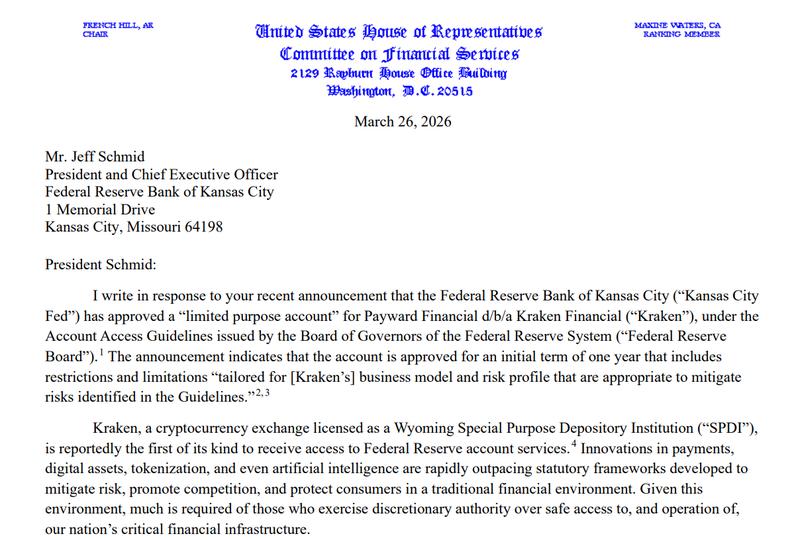
"Answers to these questions are critical to ensuring that the process of approving Federal Reserve Bank account access is conducted consistently with the law, with impartiality, and in a manner that continues to foster a safe and efficient payment system," she added.
Full transparency required to mitigate risks, Waters argues
Waters further contended that providing Kraken with access to the Federal Reserve's payment infrastructure creates concerns related to policy matters, regulatory oversight and consumer protection. Consequently, she emphasized that complete transparency and sound legal foundation are essential to guarantee that any potential risks are adequately addressed and managed.
"Innovations in payments, digital assets, tokenization, and even artificial intelligence are rapidly outpacing statutory frameworks developed to mitigate risk, promote competition, and protect consumers in a traditional financial environment," Waters wrote.
"Given this environment, much is required of those who exercise discretionary authority over safe access to, and operation of, our nation's critical financial infrastructure," she added.
Among the American cryptocurrency firms that have been actively seeking Fed master accounts is Custodia Bank, led by Caitlin Long, which submitted a court petition toward the end of 2025 seeking to revive its application.
Anchorage Digital Bank, another cryptocurrency platform, submitted its application for an account during last year, while Ripple has pursued the same through its Standard Custody & Trust Company subsidiary.
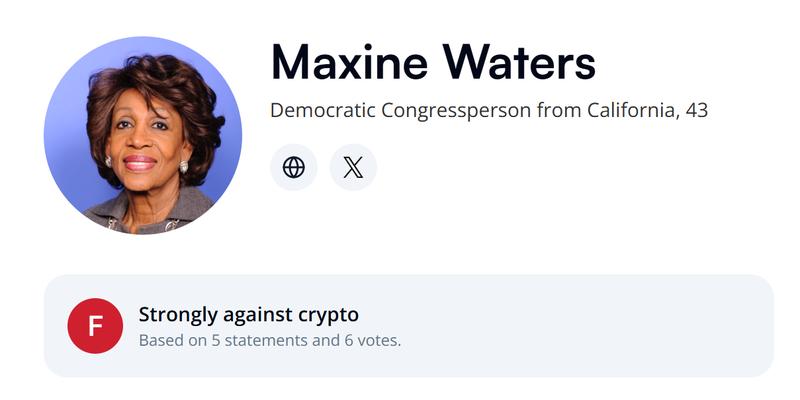
Waters is classed as "strongly against crypto" by advocacy group
Stand With Crypto, an advocacy organization for the cryptocurrency industry, maintains a scorecard tracking US politicians that evaluates their level of support for crypto assets based on their public statements and legislative voting records.
The group has categorized Waters as "strongly against crypto," a classification based on five public statements and six legislative votes opposing cryptocurrency-related legislation, including votes against the Digital Asset Market Clarity Act and the GENIUS Act.
Waters additionally requested a hearing last year with Paul Atkins, Chair of the Securities and Exchange Commission, expressing concerns regarding the regulatory agency's decision to dismiss various cryptocurrency enforcement cases.