
Coinbase Faces Backlash Over Aggressive Prediction Market Push Notifications
As prediction market services face ongoing legal challenges across the United States, numerous Coinbase users are voicing concerns that the platform is encouraging gambling behavior.

The cryptocurrency exchange Coinbase is facing mounting criticism from users who describe its notification strategy for promoting event contract wagers during the March Madness basketball tournament as everything from "annoying" to "absurd."
Back in January, the exchange introduced prediction market wagering capabilities for users located in the United States through a collaborative arrangement with Kalshi. Yet for certain users, the past two months have appeared to serve as a window for Coinbase to encourage people to become "hooked on sports gambling" through an application that many had originally designated for cryptocurrency trading purposes.
"I have received three separate notifications about College Basketball from Coinbase in the past *hour* alone," stated X user AvgJoesCrypto on Thursday. "It is absurd that, amidst arguably the worst collapse in trust in this industry's history, the largest American CEX has completely pivoted to trying to get their customer base hooked on sports gambling, so that they can extract even more exorbitant fees."
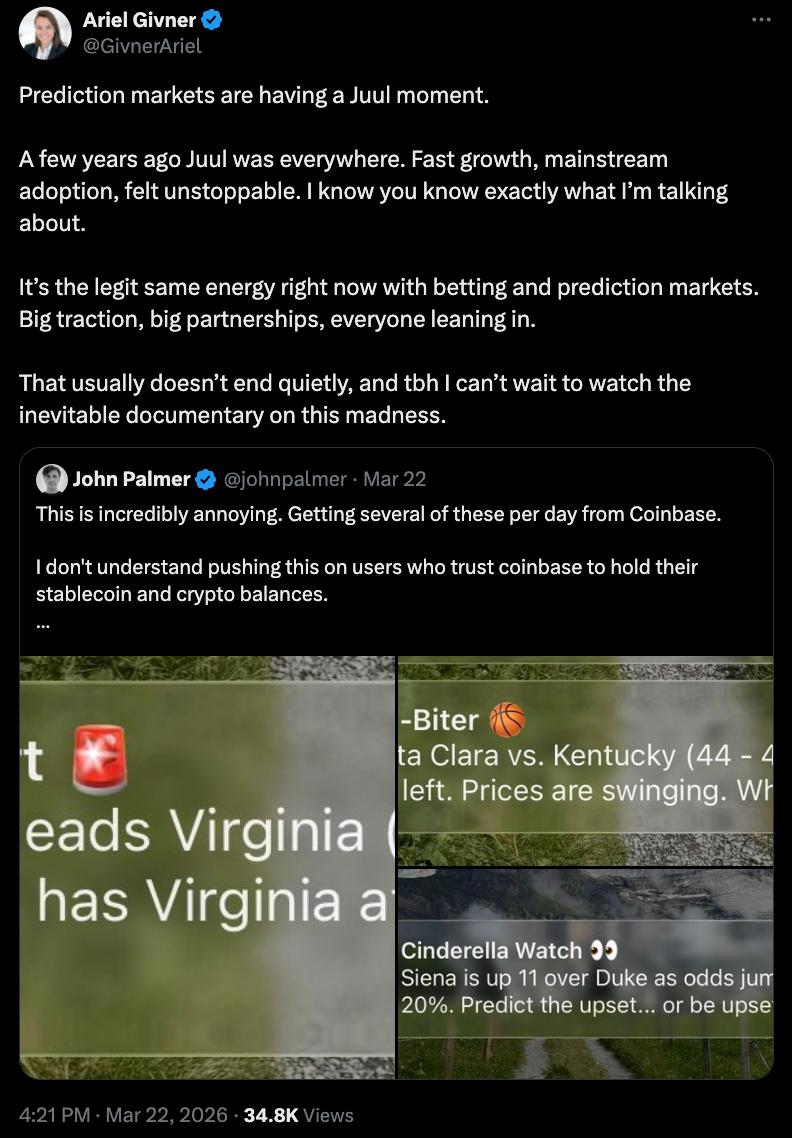
Similar to sports event contract wagering available on services such as Kalshi and Polymarket, the Coinbase Prediction Markets feature provides users based in the United States with opportunities to place wagers on the results of various events.
Services offering prediction market functionality are currently dealing with multiple legal actions brought forward by authorities at the state level, even while the federal regulatory body, the US Commodity Futures Trading Commission (CFTC), advocates for "exclusive jurisdiction" over this market segment.
John Palmer, who serves as co-founder of PartyDAO, voiced a comparable concern regarding the Coinbase notification messages promoting wagers on March Madness tournament games:
"This is essentially encouraging me to gamble. What does that say about the internal philosophy around money management? Can I trust the yield sources on USDC interest, can I trust internal risk management, etc."
Back in December, prior to the official rollout of its prediction market offering, Coinbase initiated legal proceedings against regulatory bodies in Connecticut, Illinois and Michigan. The cryptocurrency exchange contended, presumably in preparation for its prediction market service debut, that oversight should fall under the CFTC rather than state-level gambling regulatory authorities.
Cointelegraph reached out to Coinbase seeking commentary on the user grievances, but had not received a response at the time of publication.
Congress seeks to ban politicians from using prediction markets amid insider information allegations
Alongside user criticism and state-level legal challenges, numerous lawmakers in the United States have also been advocating for legislative action to tackle concerns surrounding prediction markets. Claims that someone within government circles utilized Polymarket to gain financial benefits from a wager on the ousting of Venezuelan President Nicolás Maduro have resulted in proposed legislation aiming to prohibit any US President or member of Congress from accessing these platforms.
Both Kalshi and Polymarket have rolled out distinct policies designed to prevent insider trading. Kalshi announced it would prohibit political candidates from engaging in trades on event contracts associated with their own campaigns, and Polymarket implemented measures aimed at restricting markets that are easily manipulated or raise ethical concerns.