Bank for International Settlements Report Reveals Significant Discrepancies in Bitcoin Transaction Measurement
Research from the Bank for International Settlements reveals that commonly relied upon cryptocurrency metrics may hide true economic activity, with data measurement issues affecting Bitcoin, Ethereum and stablecoin ecosystems.

A team of researchers from the Bank for International Settlements has discovered that valuations of Bitcoin onchain transfers can differ by up to six times, depending on the specific methodology employed to measure transactions.
The research focuses specifically on onchain Bitcoin transfer valuations, distinct from exchange-based trading volumes. This sixfold variation emerges from differences in measurement approaches, particularly in how change outputs and funds returned to original senders are accounted for.
The root cause of this discrepancy lies primarily in the architecture of Bitcoin transactions. During Bitcoin spending, any remaining unspent funds typically get sent back to the original sender as change, potentially being registered as an additional output despite not representing an actual transfer to a different party.
Metrics such as transaction volumes, market capitalisation and total value locked often suggest a degree of accuracy that is not supported by the nature of the underlying data
BIS researchers
This measurement issue also affects Bitcoin's market capitalization calculations. According to the researchers, traditional market cap measures have occasionally registered as much as four times greater than realized capitalization, a metric that assigns each coin the value it held during its most recent transaction.
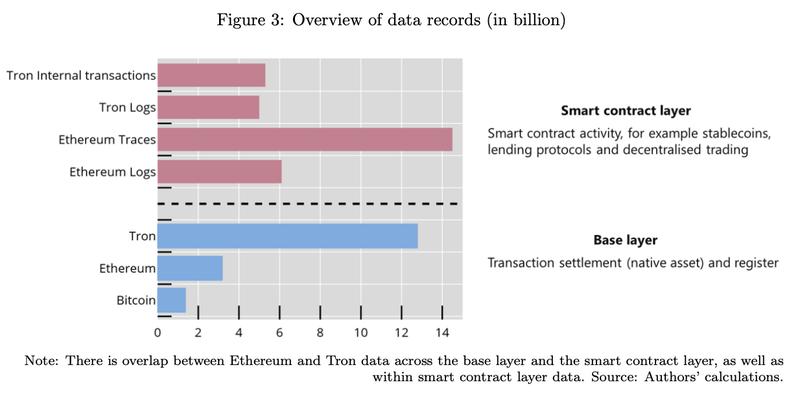
The research, drawing from 100 billion blockchain records spanning Bitcoin, Ethereum and Tron networks, discovered that comparable measurement difficulties exist throughout the wider cryptocurrency landscape.
Ethereum and stablecoins present additional challenges
The Ethereum network introduced a distinct measurement obstacle due to the widespread deployment of smart contracts. Among approximately 67.5 million active contracts analyzed, roughly 54 million remained impossible to categorize within the classification framework utilized in the research.
Analyzing stablecoin activity introduces yet another complication, given that identical assets can fulfill varying functions across different blockchains. USDT deployed on Ethereum demonstrated stronger connections to DeFi activity, whereas USDT on Tron showed greater association with payment-oriented and value-storage functions.
These distinctions proved especially pronounced in smart contract holdings. The proportion of USDT maintained by smart contracts on Ethereum surpassed 20% during 2022, in contrast to approximately 1% on Tron. Given these divergent use cases, the researchers noted that combining USDT activity across multiple blockchains can merge distinct types of economic activity and mask the actual utilization patterns of stablecoins.
The BIS research team reached the conclusion that onchain indicators ought to be regarded as "noisy approximations rather than direct measures of economic activity."
Visa filters stablecoin data to reflect economic activity
Certain analytics service providers have already begun differentiating between unfiltered blockchain activity and modified measurements designed to more accurately represent genuine economic activity.
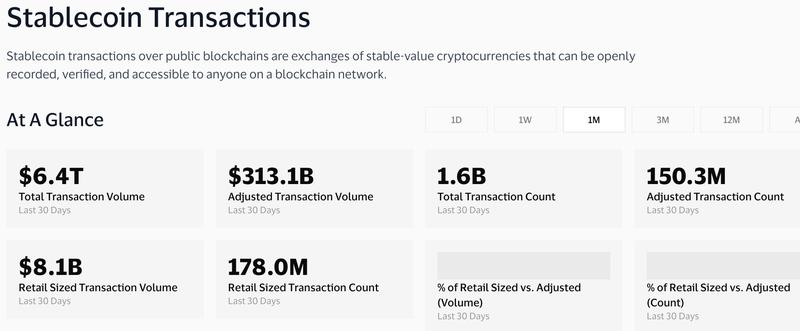
The Visa Onchain Analytics dashboard, utilizing data provided by Allium Labs, presents both comprehensive and adjusted stablecoin transaction volumes. According to Visa, its adjusted approach seeks to eliminate potential distortions arising from activities such as high-frequency trading, automated bot operations, bridge routing processes and internal exchange operations.
The dashboard presently displays $6.4 trillion in total stablecoin transaction volume across monitored networks during the preceding 30 days, contrasted with $313.1 billion in adjusted volume.