
TradFi Comeback Establishes Bitcoin Support 'Around $70K': Can Institutional Faith Survive Geopolitical and Inflation Threats?
Institutional investment in Bitcoin has made a strong comeback, yet geopolitical tensions and potential US inflation increases continue to cap BTC price rallies beyond the $70,000 threshold.
The consolidation phase for Bitcoin (BTC) extended into Thursday trading as market participants fought to maintain price levels at $70,000, while conflicting perspectives on BTC's technical formation competed against its growing institutional acceptance amid the broader bearish pressures weighing down US stock indices.
Referencing Bernstein's projection of $150,000 by the close of 2026, analysts from Bloomberg noted that incoming data demonstrates institutional capital flowing back into Bitcoin markets en masse, supporting the thesis that BTC has "established a price floor."
During the initial week of March, consecutive daily inflows into spot Bitcoin ETFs approached the $1 billion threshold, while Strategy acquired 22,237 BTC valued at $1.6 billion utilizing its newly launched perpetual preferred equity instrument, Stretch (STRC). Beyond STRC's successful deployment, Strategy simultaneously announced intentions to secure funding for an additional $44.1 billion worth of Bitcoin acquisitions.
Additional evidence of institutional re-entry into cryptocurrency markets emerged when Morgan Stanley, managing $10 trillion in assets, submitted regulatory filings to introduce its proprietary spot Bitcoin ETF. The firm advises clients to establish cryptocurrency allocations ranging from 2% to 4%, and on March 26, a Labor Department regulatory proposal enabling brokerages operating within the $10 trillion 401(k) retirement ecosystem to incorporate Bitcoin investments advanced through the White House's regulatory oversight procedures.
Thursday also witnessed Coinbase introducing cryptocurrency-collateralized down payments for Fannie Mae mortgage products, effectively enabling Bitcoin owners to leverage BTC and USDC holdings for residential mortgage financing. This innovation provides investors the ability to access Bitcoin's otherwise locked value without liquidating positions or triggering capital gains tax obligations.
What's the significance of Bitcoin maintaining $70,000 as support?
Despite the evident resurgence of institutional appetite for Bitcoin acquisitions, BTC's price fluctuations and continued failure to escape a nearly 6-month descending price channel present ongoing obstacles. The escalating US-Israel and Iran military conflict, combined with President Trump's statements regarding potential ground force deployment to Iran, continues exerting downward pressure on equity markets and digital assets.
In a Thursday message posted to Truth Social, President Trump warned that Iranian representatives "better get serious soon, before it is too late, because once that happens there is NO TURNING BACK, and it won't be pretty!" The visible accumulation of American military capabilities being positioned throughout the Middle East has created market anxiety that ground combat operations may commence as soon as this weekend.

In the aftermath of multiple presidential statements, American equity markets experienced significant selloffs, with the DOW declining 400 points, while the S&P 500 and Nasdaq recorded respective decreases of 1.49% and 2.07%. Conversely, WTI crude oil alongside Brent Crude experienced upward momentum, with both petroleum benchmarks posting gains exceeding 4%.
Given the mounting ambiguity surrounding the trajectory of the US-Israel and Iran confrontation and the potential long-term consequences of historically elevated oil valuations on American inflation dynamics and broader economic conditions, market participants are choosing to reduce their risk exposure to volatile assets.
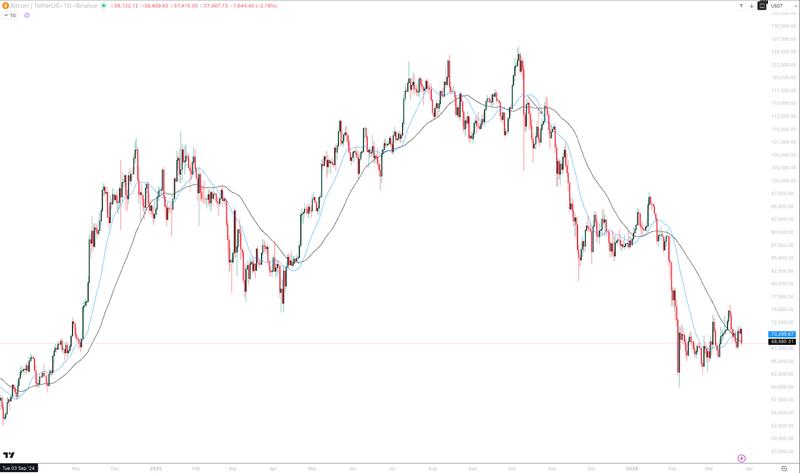
This market dynamic accounts for Bitcoin's recurring pullbacks beneath $70,000 alongside the limited sustainability of price advances within the $71,000 to $76,000 corridor. Nevertheless, one encouraging indicator suggests that both institutional entities and individual investors perceive the $70,000 level and below as an attractive entry point, thereby strengthening this price zone as a foundation for future support.