
Sepolia testnet welcomes Ethereum's Glamsterdam upgrade deployment
The deployment on Sepolia represents a crucial final testing phase before Glamsterdam's mainnet launch, designed to enhance Ethereum's efficiency and scalability capabilities.

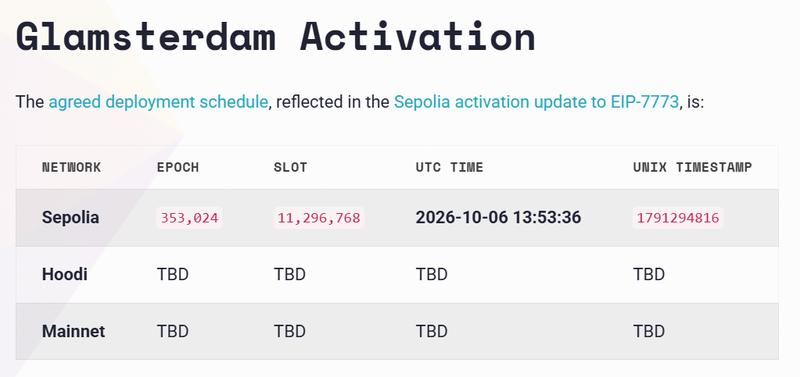
The Sepolia testnet has successfully activated Ethereum's Glamsterdam upgrade, representing a critical final testing phase ahead of the network's mainnet deployment.
The activation occurred on Tuesday at precisely 1:53 pm UTC, reaching epoch 353,024, as confirmed by blockchain information retrieved from the Sepolia explorer.
This upgrade is designed to push forward Ethereum's layer-1 scaling initiatives through the implementation of enshrined proposer-builder separation, the introduction of block-level access lists, and modifications to gas pricing mechanisms that more accurately represent execution costs, as detailed in a Sept. 28 blog post from the Ethereum Foundation.
This milestone represents one of the concluding testnet deployments for Glamsterdam, widely considered among the most significant upgrades scheduled for 2026, with the goal of enhancing both scalability and efficiency across the Ethereum network.
After this testnet deployment, developers will proceed to establish Glamsterdam's activation timeline on the Hoodi testnet, subsequently setting the official date for its deployment on the mainnet.
Targeting enhanced Ethereum efficiency and scalability
Positioned as the subsequent major upgrade following Fusaka, Glamsterdam has been engineered to enhance scalability, strengthen the layer-1 infrastructure and improve network usability.
The most prominent features of this upgrade include enshrined proposer-builder separation (ePBS) and block-level access lists (BALs), which fundamentally alter the mechanisms for block production and validation to accommodate increased throughput on Ethereum's mainnet.
The Enshrined Proposer-Builder Separation, designated as EIP-7732, establishes a division between block proposers and builders within Ethereum's consensus protocol, while simultaneously separating consensus validation from execution validation, thereby allowing validators additional time to validate execution payloads.
At present, Ethereum operates in single-lane mode, handling transactions in a sequential order. The implementation of parallel processing aims to facilitate higher transactions per second on Ethereum and accommodate larger block sizes, all without increasing the gas limit.
The additional major feature, EIP-7928, implements mandatory block-level access lists that document accounts and storage locations accessed throughout a block, alongside post-transaction state modifications. These lists allow clients to retrieve state from disk in parallel, validate transactions concurrently and calculate state roots with greater efficiency.
According to a May blog post from the Ethereum Foundation, a 200 million gas limit floor has been established for Glamsterdam, delivering a substantial post-upgrade performance enhancement from the current gas limit of approximately 60 million.
Once Glamsterdam's mainnet activation is complete, Ethereum developers will shift their focus to implementing Hegotá as the subsequent major upgrade. During August, Ethereum developers initiated the review process for 66 proposals to consolidate them as part of defining Hegotá's scope, with multiple proposals focused on integrating additional privacy features into the protocol.