
PwC Report Highlights Uneven Global Cryptocurrency Adoption Patterns
According to PricewaterhouseCoopers, cryptocurrency operates within a "fragmented global ecosystem," addressing distinct challenges across various international markets.

The rate of cryptocurrency adoption varies significantly across global markets, with certain regions experiencing far more rapid progress than others, according to a report from accounting giant PricewaterhouseCoopers (PwC).
"While crypto networks are borderless, adoption is not," PwC said in its Global Crypto Regulation Report 2026. "Payments, remittances, savings, capital markets, and tokenization use cases are emerging unevenly across regions."
According to PwC's analysis, cryptocurrency adoption continues to be influenced by prevailing economic conditions, levels of financial inclusion, and the maturity of existing financial infrastructure. This creates a "fragmented global ecosystem" in which the technology addresses "very different problems" depending on the market in question.
The findings arrive at a time when blockchain technology and cryptocurrency adoption have gained momentum within the United States, where a crypto-supportive Trump administration has provided institutions with the confidence needed to develop and launch products connected to cryptocurrencies and stablecoins.
Crypto institutional interest past the point of no return
In the meantime, PwC's report indicates that institutional participation in the crypto sector has "crossed the point of reversibility."
"Banks, asset managers, payment providers, and large corporates are embedding digital assets into core infrastructure, balance sheets, and operating models," PwC said. "This is no longer optional or peripheral."
Despite the Trump administration's efforts to enact cryptocurrency regulations through legislative channels, certain market analysts express concerns that a future administration less favorable toward crypto could potentially influence institutional sentiment negatively.
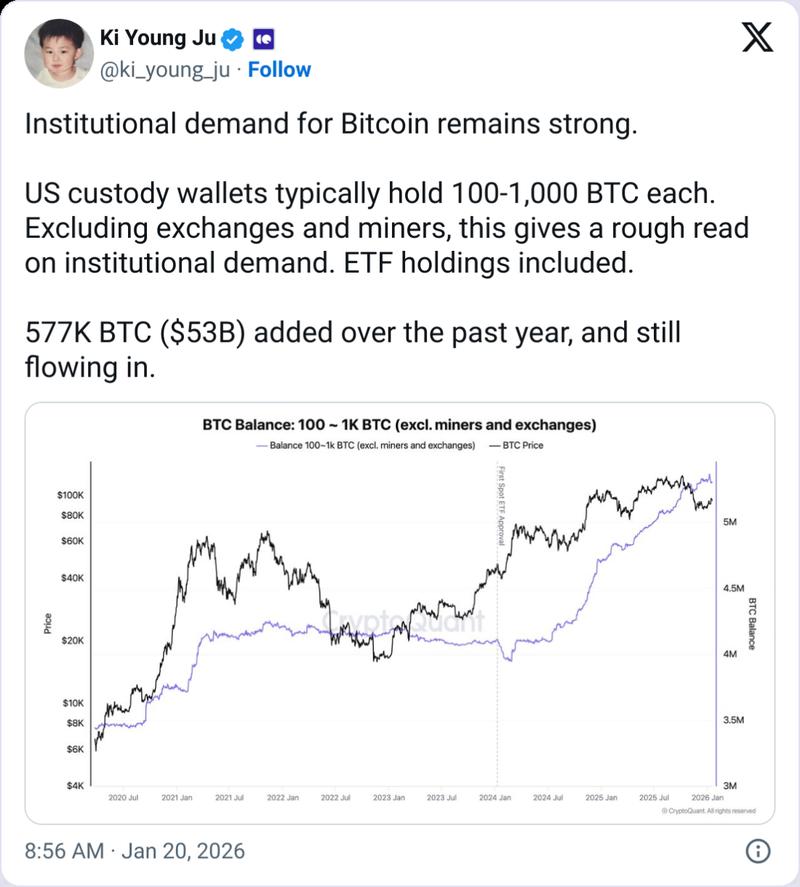
During statements made on Wednesday, CryptoQuant Ki Young Ju highlighted the 577,000 Bitcoin (BTC) that institutional investment funds have acquired throughout the past year, representing approximately $53 billion in value.
"Institutional demand for Bitcoin remains strong," he said.
PwC noted that as financial institutions increase their commitment to cryptocurrency, "they reshape market norms around scale, governance, resilience, and accountability, displacing crypto-native practices with institutional ones."
Institutions unlikely to push prices as high as hoped
Despite the upward trend in institutional interest surrounding cryptocurrency, some market analysts remain skeptical that it will drive prices upward to the extent the market anticipates.
Luke Gromen, a macro researcher and founder of FFTT, expressed his view that institutional investors are unlikely to be the primary force driving Bitcoin to reach new record highs this year in the absence of a significant market-moving event.
"If you're counting on institutional investors to run it from you know 90 to you know 150, if that's your plan, that's probably not going to happen without some major catalyst," Gromen said on Wednesday.