
Prediction markets emerge as crucial macro indicators amid Iran tensions: Sygnum analyst
Sygnum's Fabian Dori highlights how prediction platforms like Polymarket and Kalshi are evolving into essential macroeconomic monitoring tools for cryptocurrency trading desks as Iran conflict probabilities fluctuate.
The likelihood of United States involvement in the Iran situation experienced rapid recalibration across prediction markets, delivering immediate geopolitical risk indicators that traders could act upon in real time.
Probability assessments on services including Polymarket and Kalshi fluctuated dynamically as President Donald Trump combined aggressive rhetoric with indications of potential diplomatic engagement on Sunday, coinciding with Bitcoin (BTC) climbing over 3.5% the following Monday.
During episodes of geopolitical uncertainty, cryptocurrency-based prediction platforms have evolved beyond novelty status, with institutional trading operations progressively relying on them for macroeconomic risk assessment, says Fabian Dori, chief investment officer at Sygnum Bank.
"Prediction markets price discrete, named outcomes with real capital behind them," Dori told Cointelegraph. "For crypto in particular, where so much price action is driven by specific binary events, regulatory decisions, geopolitical developments [and] protocol upgrades, that is a categorically different signal."
During the Iran conflict's intensification, probability assessments regarding de-escalation moved in prediction markets ahead of traditional financial news outlets' reporting and showed "had direct correlation" with Bitcoin price, Dori added.
Prediction markets enter macro playbooks
Among certain institutional trading operations, prediction markets have become integrated as live event-tracking mechanisms during rapidly evolving geopolitical scenarios, positioned alongside funding rates, options surfaces and flows, Dori said.
The fact that ARK Invest integrated Kalshi's prediction market data into its investment process shows how event odds are migrating into mainstream institutional workflows.
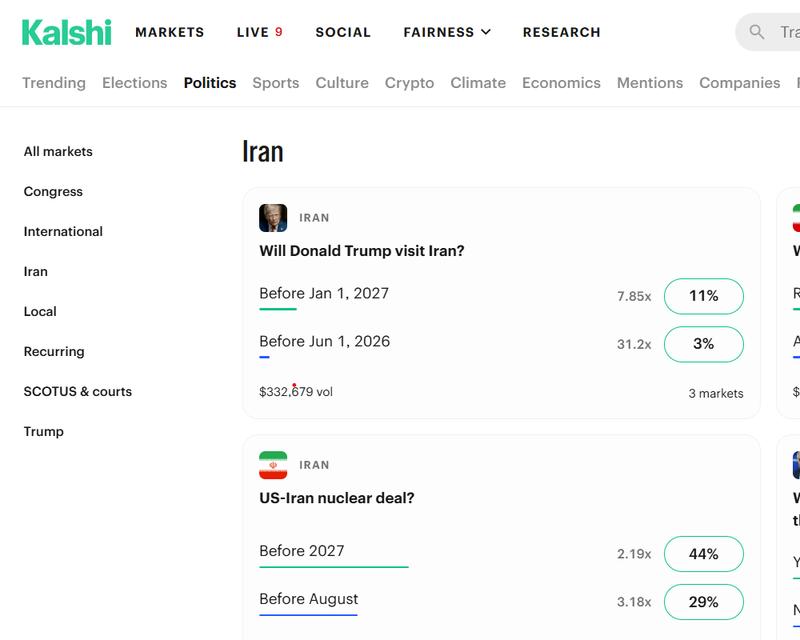
Within a regulatory framework, prediction markets operate as a contextual intelligence layer, shaping how investment teams conceptualize risk scenarios instead of functioning as explicit trading triggers.
"The goal is to decide what to do before the event happens," he said, arguing that markets that continuously update a capital-weighted probability of war, sanctions or ceasefire are a natural fit for that discipline.
Institutional money and growing scrutiny
Transaction volumes have reached sufficient scale that institutional capital allocators can no longer disregard the signal as merely retail speculation. During March, prediction market transactions totaled approximately 191 million, representing a 2,838% increase year-on-year, while monthly notional volume expanded to around $23.9 billion.
Simultaneously, established exchange operators are entering the space. Intercontinental Exchange, the parent of the New York Stock Exchange, completed a new $600 million investment in Polymarket on March 27, deepening its conviction in prediction markets.
"This is no longer a niche product," Dori said, adding that the real question for professional investors is no longer whether to watch Iran-linked markets at all, but "how to integrate them in a way that adds genuine analytical value rather than simply adding a new source of noise."
The rapid expansion has also attracted more stringent questions regarding fairness and integrity. Six Polymarket traders netted around $1 million betting on the timing of US strikes on Iran in late February, sparking insider trading concerns.
The platform also pulled a market on a missing US pilot on Saturday after backlash over over related wagers.